
How Ideate Software Improves Revit Data Management and QA/QC
For many construction and design teams, the daily frustration of working inside Revit runs deeper than modeling complexity. Duplicate styles creep into documentation packages, critical element data stays buried where nobody can find it, and exporting thousands of parameters means hours of tedious, error-prone manual work. Most teams have quietly accepted these inefficiencies as simply part of the job.
But they don't have to be.
In this interview, we sit down with the team behind Ideate Software to explore how tools like Ideate StyleManager, Ideate Explorer, and Ideate BIMLink are tackling the BIM problems that often go unspoken. From automating overnight model health checks to turning Revit into a genuine data exploration environment, the conversation reveals a bigger ambition: transforming messy, overcomplicated models into reliable, data-enriched assets that teams can actually trust.
1) Many construction teams think that inefficiencies in Building Information Modeling (BIM) are just part of the job. When looking at tools like Ideate StyleManager, Ideate Explorer, and Ideate BIMLink what problems are you trying to solve?
Tools like Ideate StyleManager, Ideate Explorer, and Ideate BIMLink help construction professionals solve some of the biggest problems in BIM that are often overlooked. Quite often, inefficiencies stem from poor data visibility, inconsistent standards, and manual, error-prone data extraction, modification, and propagation workflows. This is detached from issues with the modeling itself.
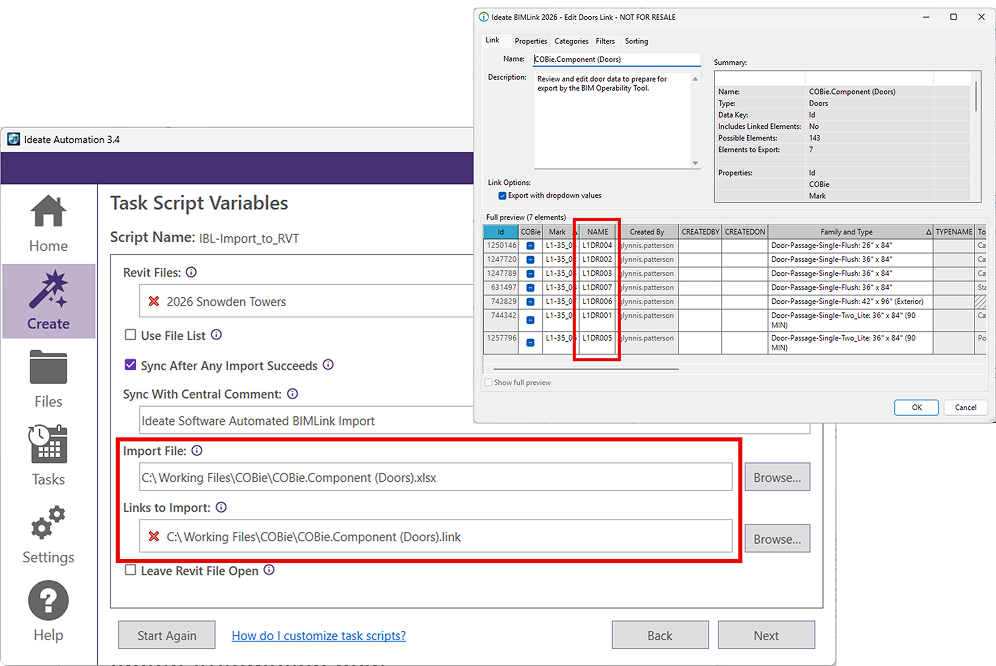
A few examples would be making it easier to find and validate model elements during QA/QC before coordination meetings with Ideate Explorer, enforcing and maintaining consistent standards across models from multiple consultants or teams with Ideate StyleManager, and automating large volumes of data modification using Excel for tasks like equipment changes, quantity validation, and COBie reporting and documentation with Ideate BIMLink and Ideate Automation.
Construction teams can reduce rework, improve data accuracy, and increase confidence in their models or those from their subcontractors, ultimately turning Revit models from overcomplicated, messy environments into reliable, streamlined and data-enriched environments that support faster decisions and more efficient project delivery.
2) Can you describe a real project where unmanaged styles, like duplicate line styles or unused materials caused problems? How does StyleManager change that outcome?
Unmanaged styles, like duplicate line styles or rogue font overrides, are a constant threat to BIM standards and QA/QC standards for deliverables. Global design firm Stantec frequently faced this challenge when migrating complex project data into standardized office templates. During project deadlines, non-compliant styles slipped through to final documentation packages, compromising design standards.
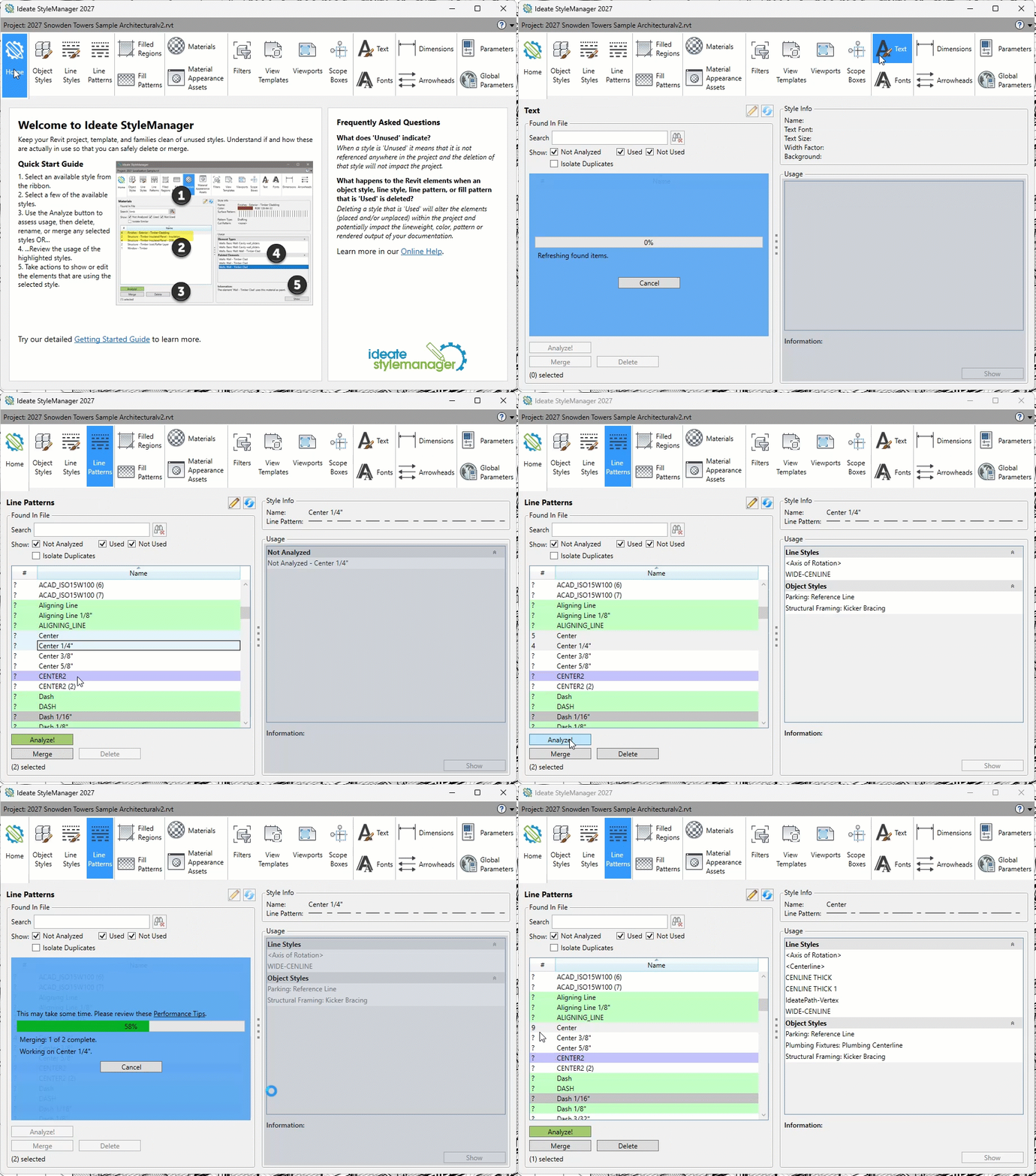
Ideate StyleManager fundamentally changed this outcome by introducing precision and visibility to the cleanup process. Stantec relied on Ideate StyleManager to seamlessly update drawing elements so that line weights, hatching, text, and nested families instantly aligned with new template protocols. The tool analyzed exactly how non-standard styles were being used before any action was taken. This allowed BIM managers to safely merge duplicate styles with total confidence, eliminating visual chaos and ensuring 100% brand consistency across all construction deliverables.
You can read the full success story on the Ideate Software Stantec Case Study page.
3) StyleManager lets teams merge, delete and standardize styles. How do you balance giving users cleanup tools without risking accidental loss of critical project standards?
Balancing deep model cleanup with the preservation of critical project standards defines how we view user access. We believe the key to safeguarding a model isn't hiding its data away, but rather democratizing access to it. Ideate StyleManager is designed to upskill and educate team members, turning institutional BIM knowledge into an open, best-practice workflow for everyone. The risk to project standards is much higher without StyleManager, where anyone with model access can delete styles and lose critical data without understanding the consequences.
Ideate StyleManager eliminates this risk by enforcing an analysis-before-action workflow. Before a user can modify, merge, or delete a style, the tool deep-dives into the Revit model to map out exactly where that style is being used. This allows team members to navigate the model in an active view and fully understand the impact of their changes before committing them. By transforming cleanup from a guessing game into a fully informed, deterministic process, StyleManager ensures teams can confidently clear out model clutter while keeping vital project standards completely secure.
"We believe the key to safeguarding a model isn't hiding its data away, but rather democratizing access to it."
4) Ideate Explorer helps users find hidden or hard-to-access elements. What’s a moment where this visibility fundamentally changed how a team understood their model? For example, locating elements or resolving warnings.
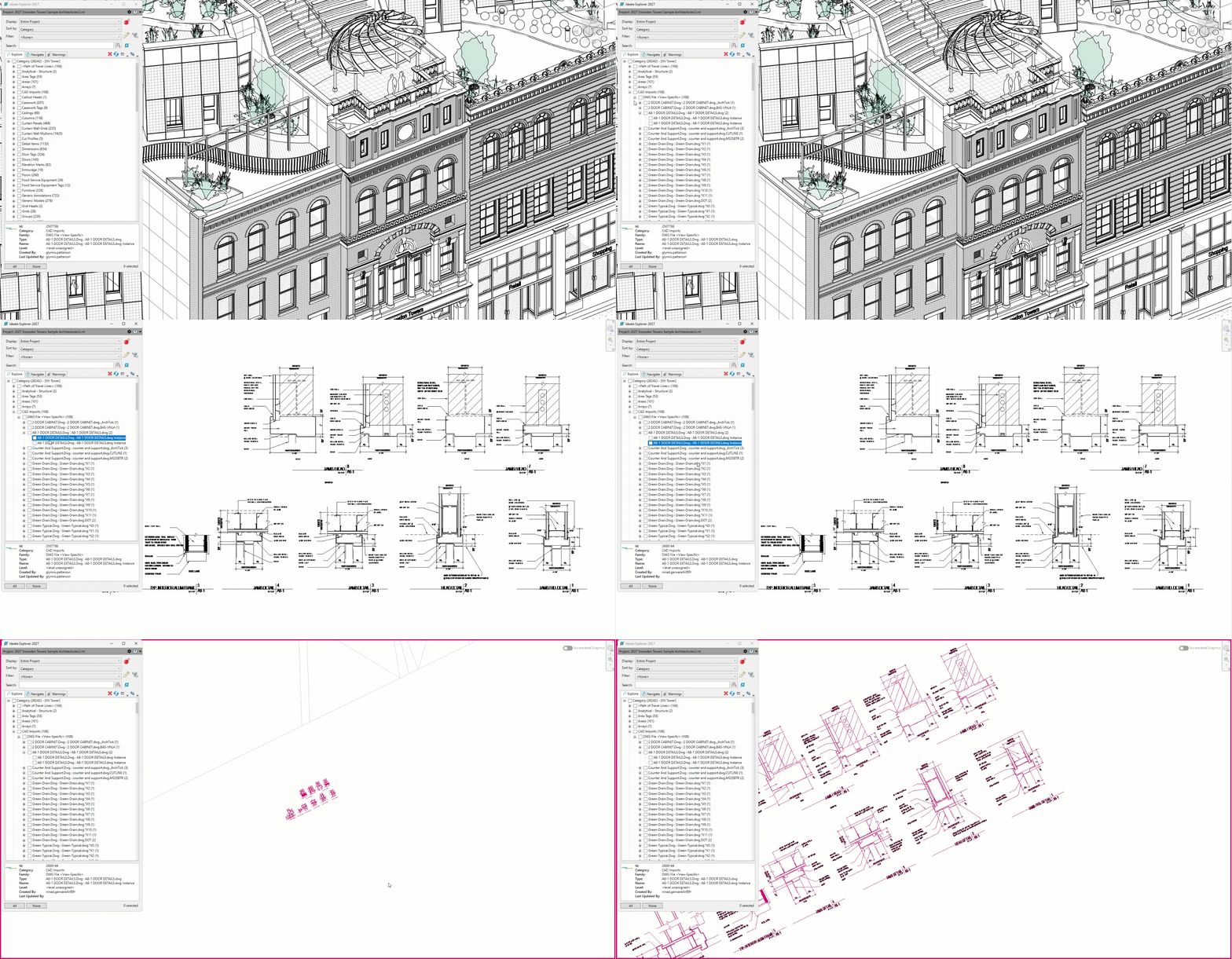
Ideate Explorer fundamentally changes how teams interact with their projects by demystifying the hidden complexities in Revit models - surfacing rogue CAD imports, buried elements, and obscure warning conditions that are shielded from view. For example - instead of treating model auditing as a punitive exercise, it transforms warnings into actionable, localized teaching moments that prevent hidden model bloat from degrading model performance. Explorer enables comprehensive discovery and navigation, allowing users to pinpoint the exact context of a warning for an informed resolution process. By transforming warning resolution into a transparent workflow, it elevates modelling standards from a guessing game into a precise, empowering process that protects both model integrity and team productivity.
with an easy-to-use interface and powerful filters
5) Explorer isn’t about finding elements - it’s about querying and analyzing them. How do you see this changing BIM from a modeling tool into more of a data exploration environment?
Shifting the perception of a Revit model from a documentation tool to a rich data warehouse is essential for the future of design technology. Ideate Explorer drives this transformation by enabling teams to treat Revit as a data exploration environment, using smarter rules, advanced filtering, and precise queries to analyze the organization and logic of the model rather than just its 3D geometry. This level of granular interrogation does more than just surface hidden elements; it establishes the clean, highly structured data-readiness. By replacing chaotic modeling habits with a highly deterministic foundation, Explorer ensures that when AI tools are layered onto the model, they are working off a pristine and reliable dataset, ultimately turning raw model information into a sophisticated, future-proof asset.
"Shifting the perception of a Revit model from a documentation tool to a rich data warehouse is essential for the future of design technology."
6) With Ideate BIMLink teams move data between Revit and Excel to edit thousands of parameters at once. What’s a story where this dramatically reduced time or errors compared to workflows?
Managing parameter data within the native Revit UI can be time-consuming and error-prone. Ideate BIMLink solves this by allowing users to export instances or type data to Microsoft Excel, allowing teams to pull deep backend metadata, edit or create thousands of parameters simultaneously, and push them back into families or models instantly.
This capability is vital for complex MEP workflows. For instance, engineering firm Engineering PLUS faced a major transport project requiring instance parameter changes across massive family datasets. Performed manually, the task would have taken days and risked critical input errors. By deploying Ideate BIMLink, the team compressed hours of tedious typing into less than ten minutes with absolute data accuracy.
When firms pair these customizable workflows with Ideate Automation, they can scale parameter updates across large batches of files overnight. This integration ensures absolute data consistency, turning a frustrating administrative pain point into a highly dependable business asset.
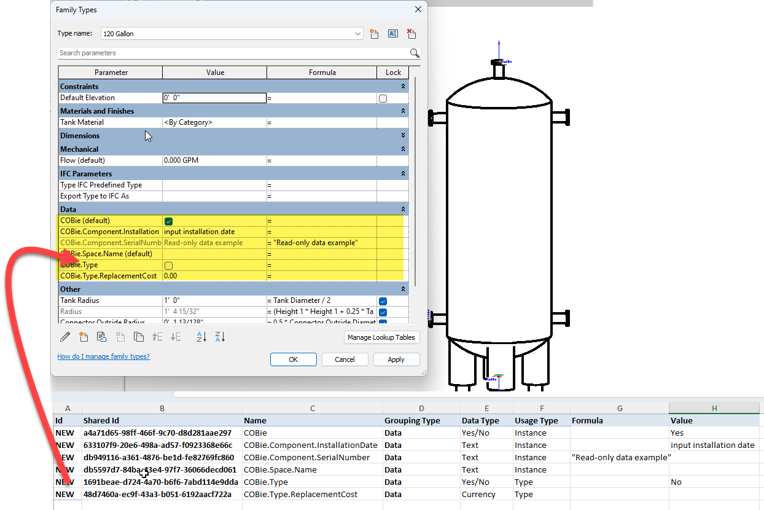
allowing for hundreds of families to be edited as part of a single task
7) Explorer helps with small-scale selection and inspection while BIMLink enables large-scale data manipulation. How do these tools complement each other in practice on projects?
Ideate Explorer redefines model navigation in Revit by replacing the standard view-based project browser with an all-encompassing and highly customizable dynamic model browser. It gives BIM managers and design teams granular visibility into not just every element in the model but also helps streamline model auditing and QA through tools like Ideate Query, and zoom to, isolate and fix Revit warnings. It accelerates the process of element manipulation by creating deterministically driven selection sets and then actions on them – such as bulk swapping Revit types, reassigning Worksets, and shifting elements across levels.
Ideate BIMLink, on the other hand, serves as a powerful data conduit between Revit’s database and Microsoft Excel, unlocking large-scale data management capabilities outside of the Revit context. By decoupling data from native Revit schedules, BIMLink allows project teams to seamlessly export massive Revit datasets to Excel to leverage advanced formulas, quick fill-downs, and mass parametric editing.
When used together with Ideate Automation, Ideate Explorer and Ideate BIMLink evolve from individual utilities into a model maintenance ecosystem where visual discovery leads to high-speed data manipulation, all in the name of better model health and performance. This integrated approach establishes a comprehensive, multi-tiered QA/QC strategy where BIM managers use Explorer to visually audit structural alignment, hidden clutter, and geometry-based errors, while simultaneously deploying BIMLink to sweep and correct the element metadata.
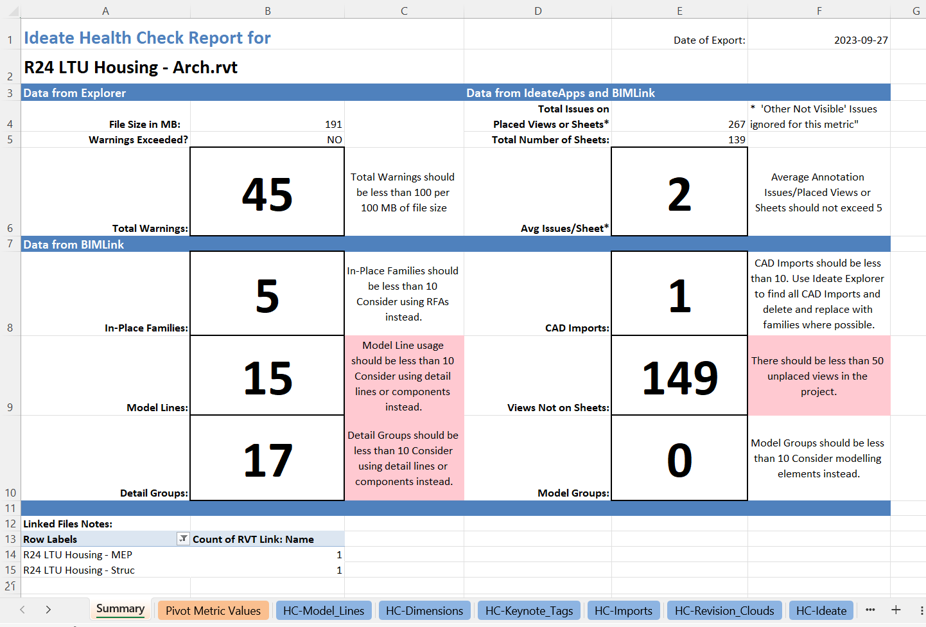
to Excel, summarizing iton a dashboard to create an actionable guide in model maintenance for project team members
8) Across all three tools there’s a strong theme of quality assurance and quality control (QA/QC) - whether it’s cleaning styles, resolving warnings or validating data. How do you see QA/QC evolving from a checkpoint activity into something continuous and automated?
While a continuous and automated QA/QC model sounds ideal on paper, it conflicts with the daily reality of how design and construction teams interact with BIM software. Revit models are inherently complex, fast-moving environments, at least in phases when changes are actively being made in models. Forcing automated, real-time compliance checks onto users during active design cycles creates immediate software performance bottlenecks and introduces immense user frustration through constant, disruptive alerts.
True project delivery is cyclical, not linear. Designers need the freedom to work through messy, iterative phases where data is intentionally incomplete or temporarily uncoordinated without a system halting their progress. If QA/QC becomes entirely automated and forced into the background, it risks identifying and over-correcting minor, transient issues, muddying the larger contextual errors which should be addressed.
This is exactly where scheduled health check workflows and solutions like Ideate Automation provide a practical answer. Instead of forcing intrusive, real-time background automation onto users during their active workday, Ideate Automation allows teams to script and schedule comprehensive model audits during off-peak hours or overnight.
"True project delivery is cyclical, not linear. Designers need the freedom to work through messy, iterative phases where data is intentionally incomplete or temporarily uncoordinated without a system halting their progress."
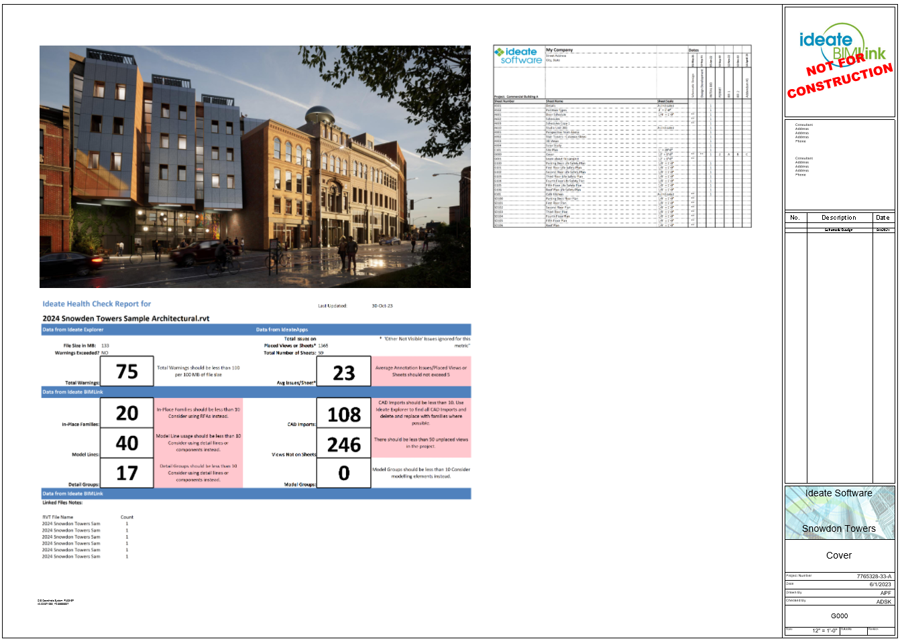
By automating these heavy data-extraction tasks to run in the background while nobody is working, firms can generate consistent, repeatable health check reports without draining local hardware performance or disrupting design flow. When teams log in the next morning, they are equipped with fresh, actionable data insights. They can then utilize Ideate Explorer and Ideate BIMLink at intervals to address the surfaced warnings, clean up model clutter, and validate data integrity.
9) Tools like BIMLink leverage familiar environments like Excel to reduce training time. How intentional was that decision? How does it affect adoption across large firms?
The decision to leverage Microsoft Excel, or specifically XLSX, as the primary file format exported from Ideate BIMLink was entirely intentional, directly addressing the steep learning curves and training bottlenecks that often hinder new software adoption in large firms. Microsoft Office is the universal global standard for business operations, and Excel is a tool that virtually every professional - from architects and engineers to project managers and coordinators – is familiar with and already understands. By keeping the data modification environment familiar, firms can bypass weeks of specialized training, drastically lowering the barrier to entry and accelerating user adoption across the entire enterprise.
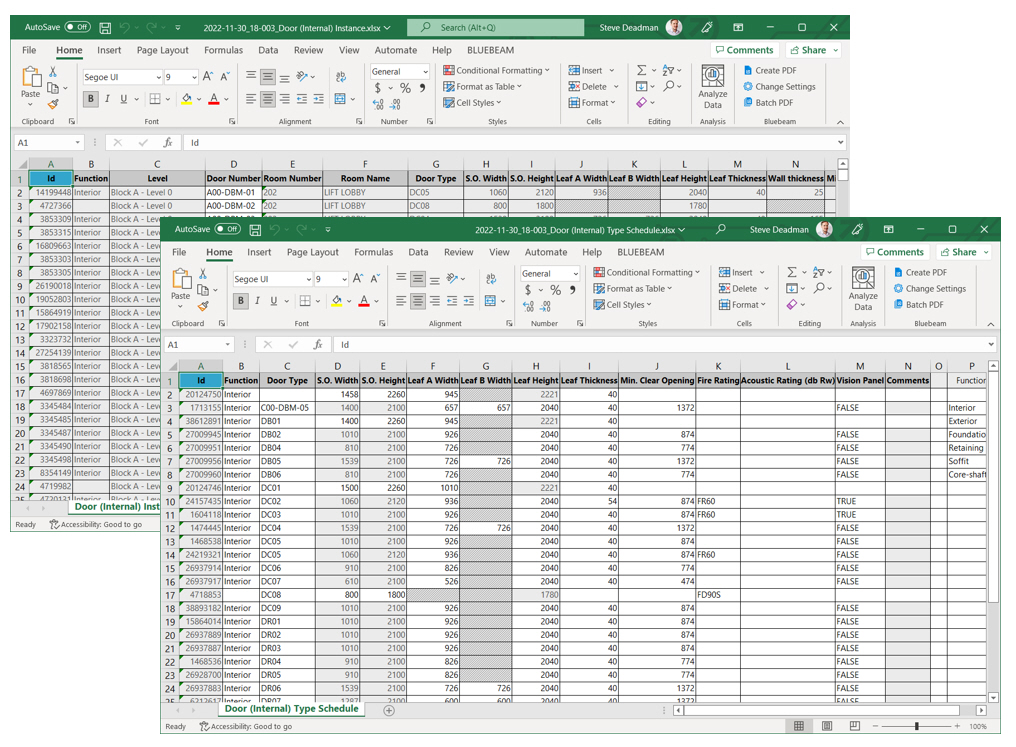
like adding door hardware sets to door schedules
Importantly, firms adopt Ideate BIMLink not just because it utilizes a familiar spreadsheet format, but because it acts as a data conduit. It allows users to extract and organize complex parameter data that is otherwise completely inaccessible or buried deeply within the native Revit user interface. Ideate BIMLink pulls this information out while maintaining its strict, underlying database structure.
Once exported, this highly organized data can be easily distributed to project team members who can confidently audit, manipulate, and execute bulk edits using Excel features like formulas, VLOOKUPs, and rapid fill-downs, and just as easily push the data back into Revit seamlessly. This process successfully democratizes data management, allowing firms to maximize the value of their entire staff's expertise without forcing everyone to master complex BIM authoring software.
10) What are some new areas that Ideate Software is exploring that address the need for more robust tools for data management, standardization and deliverables?
Export workflows in Revit may not meet the realities of production-level project delivery. Teams are forced to manually select sheets or views one export format at a time with no unified interface, inconsistent naming convention enforcement, and no true scheduling capability. Every milestone submission becomes a time-consuming, error-prone ritual: re-navigating export dialogs, rebuilding sheet sets from scratch, and reconciling file names across disciplines. On large projects with hundreds of sheets, this isn't just an inconvenience - it's a measurable drain on project hours and a significant source of deliverable inconsistency that puts client relationships and project timelines at risk.
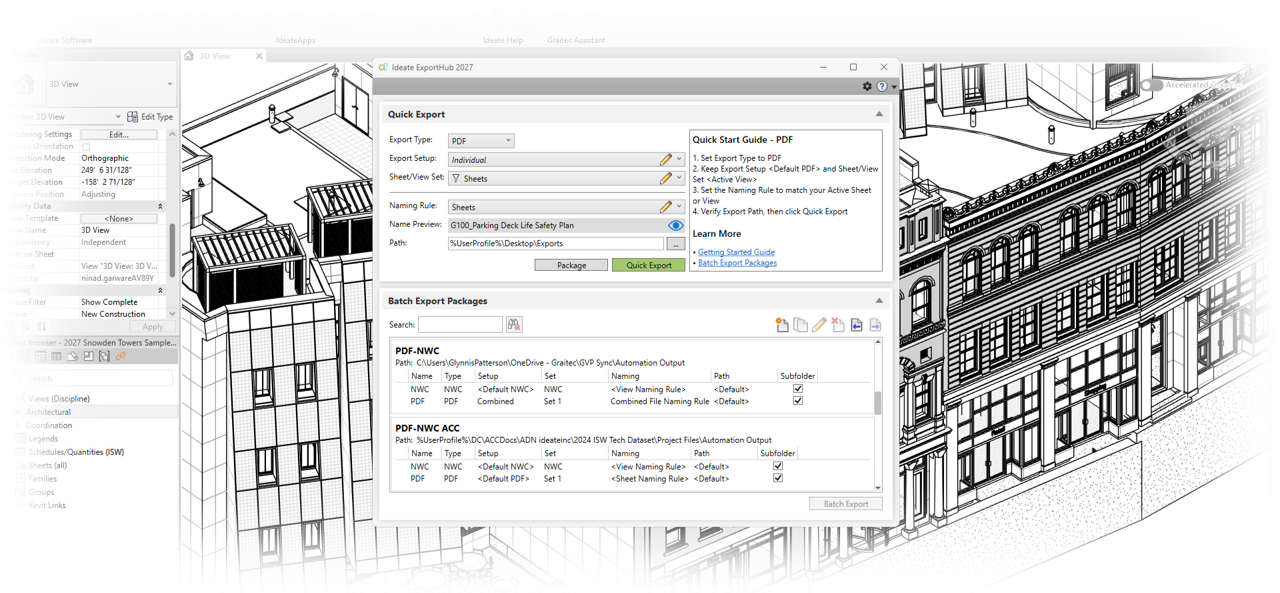
Ideate ExportHub directly eliminates these bottlenecks by centralizing all export types into a single, intelligent hub within Revit. Dynamic, parameter-based sheet and view filters replace manual selection, ensuring the right content is captured every time without re-doing the work for each submission cycle. Naming conventions and export configurations are defined once and shared across the project team, so deliverables are consistent regardless of who runs the export. And for teams leveraging Ideate Automation, scheduled off-hours exports mean packages are ready when the day starts. For firms serious about protecting margins and elevating the quality of their project deliverables, ExportHub is the operational upgrade they’ve been looking for.
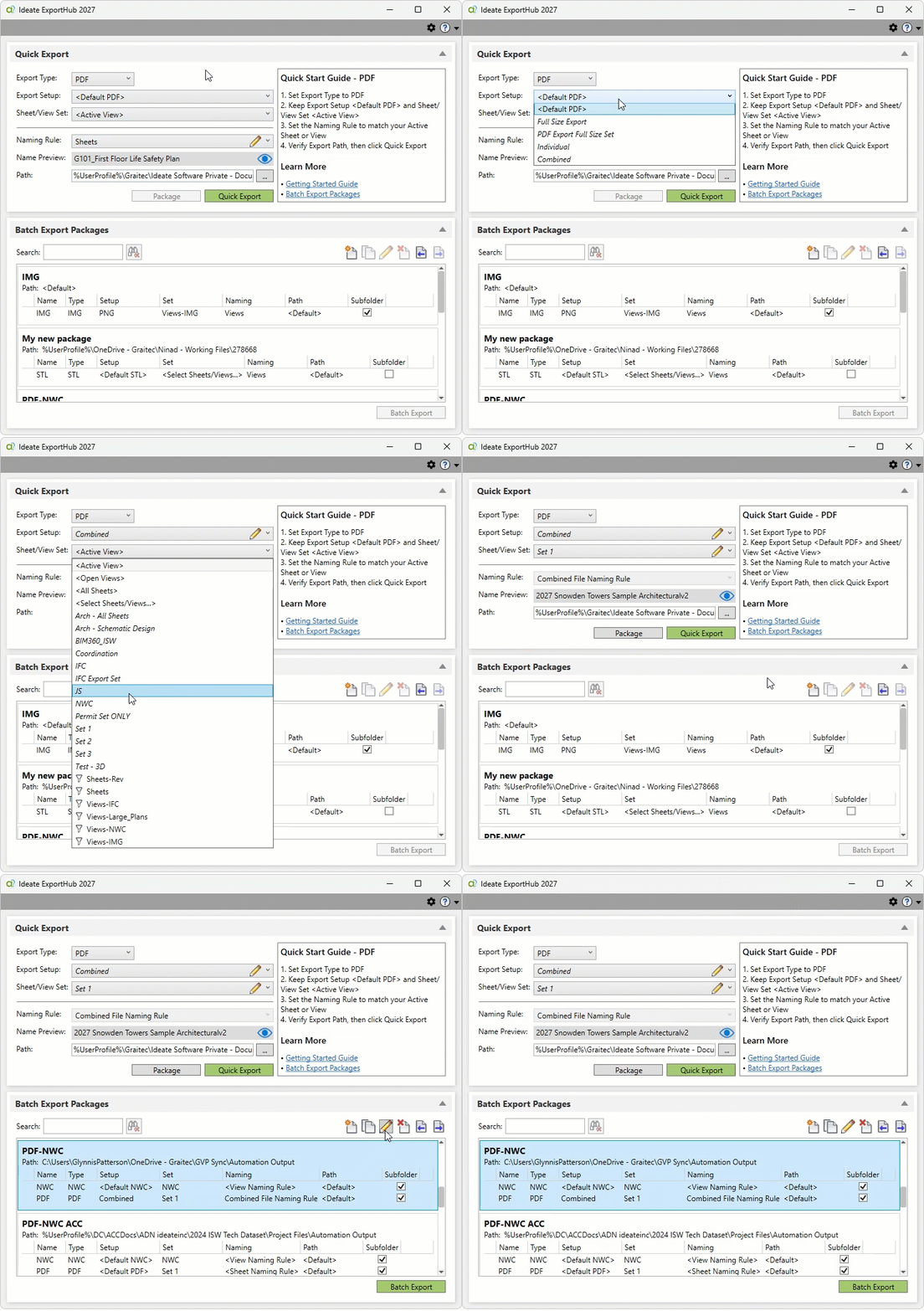
or robust batch multi-format exports, with shareable settings and customizable filters and rules.
11) It seems each tool exists because of something Revit doesn’t do well - whether it’s style management, filtering or bulk data editing. Do you see your products as extensions of Revit or as a layer redefining how BIM should work?
At GRAITEC, our mission isn't simply to patch temporary gaps in Revit functionality; rather, we design our solutions to solve fundamental workflow challenges that design and construction teams face every day. We look holistically at the entire project lifecycle to identify where production, documentation and deliverable bottlenecks occur, where model health risks emerge, and where communication breaks down. By focusing on the workflow itself, we create tools that address the root causes of inefficiency, helping teams establish smoother, more reliable processes from initial design all the way through construction and final handover.
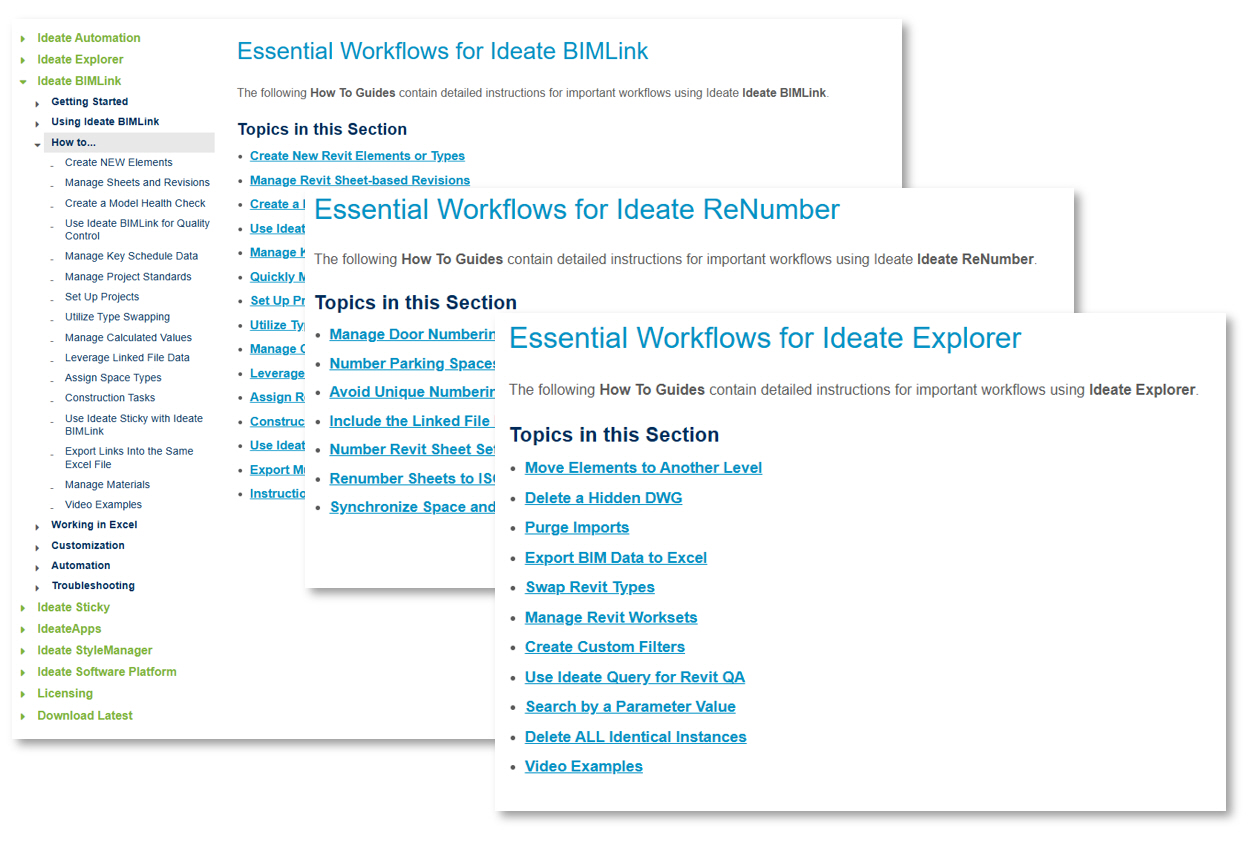
using tools that are a part of the Ideate Software toolkit
Rather than redefining how BIM operates, we see our products as powerful extensions of Revit that amplify its native capabilities. We are passionate about democratizing access to model data and workflows, and ultimately, our goal is to empower our customers to save time, automate manual work, and improve BIM efficiency, making the design and construction process more open, collaborative, and rewarding.
12) If we fast-forward five years, do you think tools like Ideate StyleManager, Ideate Explorer and Ideate BIMLink will remain utilities or evolve into a more unified intelligent BIM workflow—possibly even moving toward automation or AI-driven model management, with BIM and Revit?
Five years from now, we see our core philosophy remaining unchanged: we pride ourselves on building highly deterministic tools that keep the professional in control.
Our evolution is already driving toward a more unified, intelligent workflow because all our tools are built on the same shared foundation, allowing them to communicate seamlessly. For instance, firms increasingly use Ideate Automation to orchestrate the entire bundle - scheduling overnight routines to open heavy Revit models, deploying Ideate BIMLink, Ideate Explorer, Ideate StyleManager, and IdeateApps to export critical element data, to keep model health in check, creating an interconnected, automated pipeline that works while you sleep.
Looking ahead, we are optimistic about the growing use of AI in the AEC industry and are currently developing AI solutions at GRAITEC. True AI-driven model management requires exceptionally clean, structured, and predictable data to be successful, anchored by a foundation of deterministic AEC software tools that validate and guide its outputs. By continually unifying our product bundle and expanding automated workflows, we continue to create solutions that bring value and real productivity gains for our customers.
"Five years from now, we see our core philosophy remaining unchanged: we pride ourselves on building highly deterministic tools that keep the professional in control."
To learn more about Ideate Software, explore Ideate BIMLink, Ideate StyleManager, and Ideate Explorer on aec+tech, or visit each tool's website directly: Ideate BIMLink, Ideate StyleManager, and Ideate Explorer.

This interview was conducted with Ninad Garware, RA, a licensed architect and AEC technology leader who serves as Technical Evangelist at Ideate Software, where he drives innovation in BIM workflows and helps design teams work more efficiently while fully leveraging their data and tools. Drawing on deep experience in architecture and customer success at firms like HOK, Handel Architects, and UpCodes, Garware is a trusted voice at the intersection of design and technology, guiding the AEC industry toward scalable, future-ready digital transformation.
Recent Articles
Learn about the latest architecture software, engineering automation tools, & construction technologies