
Inside ArchiMind: Bringing Automated California Code Compliance Into Revit
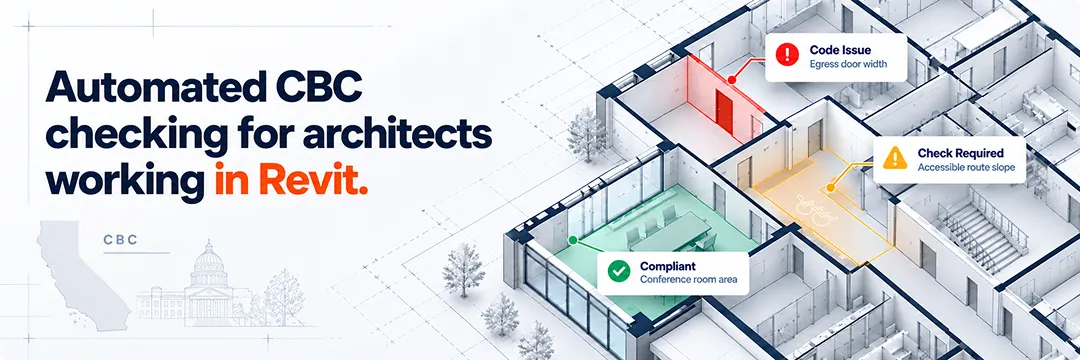
Why California Needed a Better Way
Q1: California architects have lived with the plan check correction cycle for decades. What made it clear to you that this was a technology problem worth solving, not just an accepted cost of doing business?
I saw that this issue kept coming up again and again. Code reviews required the use of paper code books, spreadsheets, handwritten notes from drawings, and a great deal of manual referencing.
And even after that, there was a possibility that teams would get comments during plan check because of some requirement being missed, misunderstood, or influenced by design changes that came at a later stage.
The issue was not that architects were negligent or inexperienced. The issue was the process itself, which made it challenging for architects to synchronize the model, the drawings, and the code requirements while the design was changing.
This caused me to think about moving compliance closer to the design process. If a possible issue could be spotted by the architect at the time when he/she is working on Revit, it would give a chance for more investigation and making the appropriate change. This is what ARCHIMIND aims to solve.
“The issue was not that architects were negligent or inexperienced. The issue was the process itself.”
Q2: ArchiMind was built by a practicing California architect who works on DSA projects. How has that firsthand experience shaped the product and the problems you chose to solve?
My background informed the product decisions for each feature that was created. I have over 21 years of experience working in architecture and construction, including some time in California for K-12, Higher Education, civic, industrial, and other large-scale projects. I also had some experience working with Revit coordination and California codes, including projects that had to go through DSA approval.
This made me realize that a useful application would not just be able to present text from code books. This tool needed to understand the design model, recognize the specific element, explain why the issue was flagged, and integrate seamlessly within the workflow that the project team uses.
The focus on California was also influenced by my background. California has its own unique code framework, amendments, accessibility laws, and DSA-specific workflow. Building from a known regulatory framework allows us to create a more advanced coverage than promising universal coverage before the workflow is solid.
How the Technology Works
Q3: Automated code review concepts have existed for decades. Why is comprehensive, live automation only becoming possible now through Revit APIs, model-aware software, and modern AI?
AI is certainly not the only key factor here. This is rather a collection of different innovations.
Revit APIs allow interacting with model elements directly rather than requiring the team to manually export drawings or send separate files. Data from structured BIM allows software to have access to information about rooms, doors, walls, areas, occupancies, dimensions. Rules-based logic helps in evaluating predefined criteria. AI and retrieval algorithms can assist in organizing coding knowledge and explaining the findings.
All these technologies, together, allow integrating at least some part of the review process into the model. The architect can spot an issue in the context and navigate straight to the element.
Limitations are still there. The results of the automated process must be verified by a professional, and the software must not be presented as something that substitutes the architect of record, AHJ or the professional judgment of the architect.
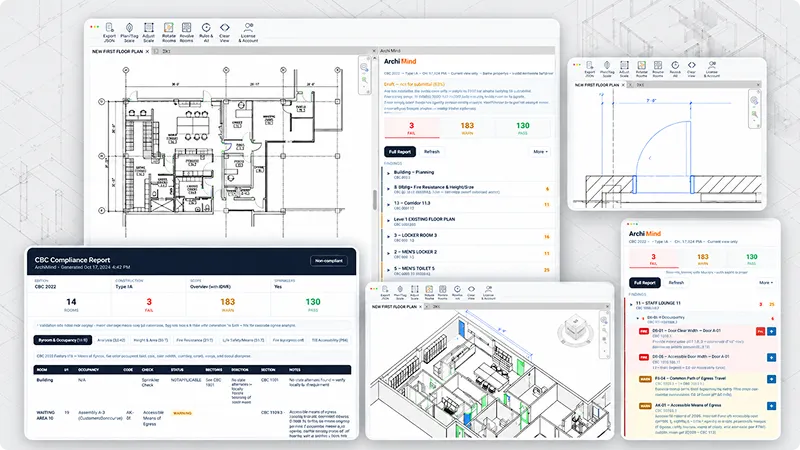
Q4: ArchiMind runs 200+ compliance checks across 12 CBC domains in a single run and can Auto-fix certain issues. Walk us through what happens when an architect hits “run,” and how you determine which violations can be safely corrected while keeping the architect in control.
When the architect runs ARCHIMIND, the add-in reads relevant information from the active Revit model and evaluates it against the California Building Code and related requirements represented in the product. The result is a structured list of potential findings and recommended or available adjustments.
The workflow is designed to take the architect from the report to the model element. ARCHIMIND can locate elements with potential violations, and some findings include a fix button or an adjustment that the software can apply. The product also includes workflows such as gross-area adjustment and plumbing-fixture calculations.
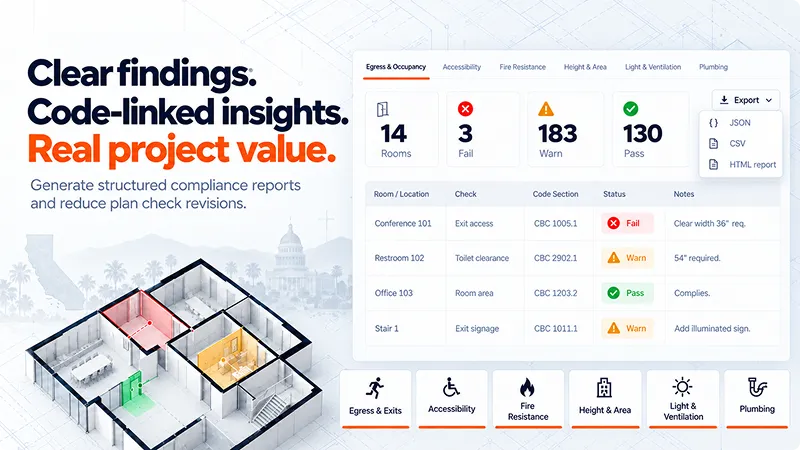
The safety boundary is important. An automated change should be limited to a defined, model-level correction where the expected result can be checked. If a finding depends on design intent, professional interpretation, incomplete project information, or a judgment about how a code provision applies, ARCHIMIND should present the issue and supporting information rather than silently changing the model.
The architect remains in control. A result from ARCHIMIND is a design aid and a potential issue to review, not a guarantee of compliance. The architect must verify the finding, decide whether a change is appropriate, and approve the final model and submission.
Important verification before publication: replace “more than 200 compliance checks across 12 CBC domains” with the exact current product claim if that number has changed. Also add one specific auto-fix example that ARCHIMIND currently performs reliably.
“A result from ARCHIMIND is a design aid and a potential issue to review, not a guarantee of compliance.”
Value for Architecture Firms
Q5: What measurable improvements in time, rework, or project margins should an architecture firm expect when deploying ArchiMind?
The first benefit that we achieve is saving on the need for cross-checks done manually and making any possible problems more visible in the model. It usually takes under three minutes to get a list of potential problems and the corresponding changes needed for both mandatory and optional fixes. ARCHIMIND works with Revit 2023-2026.
The benefit that we want to quantify here is the early detection of the problem, reduction of the review time internally, fewer repeated manual checks, and fewer changes before submitting the document. They can influence the project timeline and the workload of the employees, but I would like to publish the exact number only after we measured the savings for several customer projects.
Our initial measurements are meant to provide that evidence. We will compare the regular process of reviewing with ARCHIMIND, measure the time it took, see which problems were identified and if the team continues using this workflow after the presentation.
Q6: Who is the “wrong” customer for ArchiMind at this stage, and what type of firm or project is the strongest fit today?
Today’s wrong customer is a company which doesn’t use Revit, doesn’t have projects in California or looks for a solution which will guarantee its approval without any review by professionals. ARCHIMIND is not a substitute for the architect of record, code consultant or AHJ.
Our best-fit customer is a California architecture or design firm working with Revit on permit-sensitive projects. Our relevant stakeholders include Project Architects, BIM/Design Technology Directors, QA/QC Directors and Technical Principals. K-12, higher education, civic, multifamily and commercial projects are especially relevant in cases of egress, accessibility, occupancy, fire and/or DSA review requirements.
Right now, I’m looking for companies ready to try the product out on a real project and give detailed feedback.
Q7: What operational evidence or performance data do you need from your first five evaluations to validate a repeatable product value proposition?
I need evidence from both the product and the customer workflow.
For the product, I want to measure run time, the number and type of findings, confirmed findings, false positives, missed issues identified by the team, and the percentage of suggested or available fixes that architects accept after review.
For the workflow, I want to measure how long the normal review takes, how long the ARCHIMIND-assisted review takes, whether the tool helps teams find model elements faster, whether it is used more than once during a project, and whether it fits naturally into the firm's existing QA/QC process.
For the business case, I need to understand which problems matter most to the buyer, whether ARCHIMIND reduces rework or late review effort, who owns the budget, what seat or team structure makes sense, and whether the firm is willing to pay after the evaluation.
The first five evaluations are not only about collecting compliments. They should tell us where the product is reliable, where it needs improvement, and whether the value is strong enough to support a repeatable paid pilot.
What Comes Next
Q8: With California as your launch market, what adjacent codes, states, or design workflows is ArchiMind positioned to support next?
We will start in California because that is where our experience and our current understanding of the product are strongest. We would look at neighboring jurisdictions and other workflows if there is customer demand, if the code is structurally similar, if there is good source material, and if we can validate the process with practitioners.
Potential future areas may be additional state or regional codes, more depth in the DSA project workflow, or more support for the administration side of projects in terms of readiness, submission packages, reviews, and closeout. Those are the things that we are evaluating right now rather than offering as proven processes.
The rule here is to build out from a validated process. I would rather focus on one jurisdiction than list several jurisdictions without validation of the process.
Q9: As more companies enter automated code compliance, how do you see ArchiMind differentiating itself, and where do you draw the line between what technology should automate and what should remain in the architect’s hands?
The differentiation of ARCHIMIND is based on the depth of analysis of the specific workflow – California Building Code and DSA review inside of Revit. The product itself is developed around the model collaboration process in the architectural practice and not around trying to get a general AI to summarize text of the code.
The product is capable of identifying problems, connecting the findings to the elements in the model, offering a structured explanation and assisting in adjustment procedures if the adjustment can be performed safely. The long-term differentiation will have to come out of reliable results, validation of customers, explainable findings and the workflow expertise that we will accumulate by using the product in real projects. At the moment I do not consider the differentiation achieved.
It is very clear where technology should stop. Technology should take care of repetitive analyses, calculations, navigation and model manipulation processes.
The architect should stay responsible for design intention, professional interpretation of the results, decisions in case of incomplete information and approval of the model and documentation.
ARCHIMIND should assist in making better decisions sooner. It should never hide uncertainty and offer any automated result as a professional approval.
“Technology should take care of repetitive analyses, calculations, navigation and model manipulation processes. The architect should stay responsible for design intention, professional interpretation of the results, decisions in case of incomplete information and approval of the model and documentation.”
From Code Checking to Continuous Compliance
The automation of code compliance is probably one of the most interesting things being developed now at the crossroads between BIM, computational design, and AI.
But the real benefit here might not be so much in automating the process but rather in being able to bring the process of compliance earlier in the design process so that architects would be able to spot problems when making decisions, and not only after completing their designs.
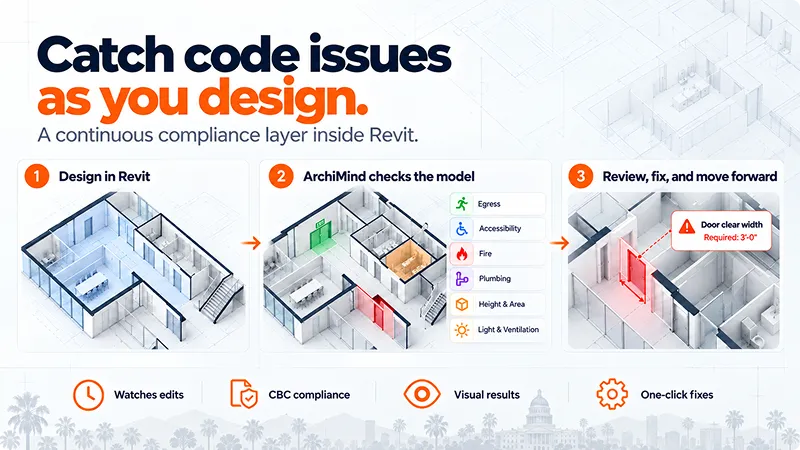
And in this sense, the approach of ArchiMind to go California-first appears to be very interesting: instead of trying to automate the compliance process instantly for all jurisdictions, they have chosen to start with a very particular regulatory environment.
This test will help to find out the efficiency of the process: how much time is saved, how many mistakes are prevented, what kind of control processes can be automated, and how well the tools integrate into the Revit process.
If platforms like ArchiMind prove to be efficient enough, automated compliance can become an integral part of the architectural process instead of just another BIM add-on.
To learn more about ArchiMind, visit their page on aec+tech or explore more on the official ArchiMind website.

Founder of ArchiMind, Ali Jooyandeh brings over 21 years of experience in architecture and construction, specializing in California building codes, DSA requirements, and Revit workflows. He developed ArchiMind to automate code compliance checking and improve architectural workflows. In this interview, he shares his vision for the future of automated compliance.
Recent Articles
Learn about the latest architecture software, engineering automation tools, & construction technologies