
Inside MeltPlan: AI Built for Preconstruction
The Problem and the Approach
Q1: Preconstruction is where most projects fail. What specific problem was MeltPlan built to fix?
Design has robust software for its processes (Autodesk, Revit). Similarly, construction has robust software for managing construction execution process (Procore, Sage). The gap, therefore, has been in having a smart solution for the decision making process in pre-construction process which is scope, budget, schedule and trade-off between them.
Currently, the pre-construction process is disjointed and inefficient as the team of the GC spends majority of the time in performing repetitive tasks such as taking quantities, performing bid tally spreadsheet and going through spec books for spotting risks. However, all these tasks are not related to judgement calls but are simply time-consuming routine tasks that prevent estimators from focusing on strategy to win projects.
The major issue, thus, is that there have been important decisions made by GC teams without having knowledge about the constraints related to these decisions. Scope decisions are being made without resolving the code issues. Budget decisions are being made without going through spec books.
MeltPlan is the solution to fill this gap as it provides robust, construction native AI based solution for pre-construction process for teams of GC.
"Scope decisions are being made without resolving the code issues. Budget decisions are being made without going through spec books."
Q2: What makes MeltPlan's AI different from just using ChatGPT or Copilot for precon work?
General AI from OpenAI, Google, and Anthropic is designed to answer everything, meaning that it isn't designed to answer construction questions accurately. The frontier models function at 75-80% accuracy when it comes to preconstruction-specific tasks. And that sounds like a reasonable metric except for the fact that below 85%, the time spent correcting AI's output surpasses the time of doing the whole thing yourself. At this accuracy level, the AI is no longer a productivity tool; it is a risk.
Here's how the MeltPlan's AI works:
-
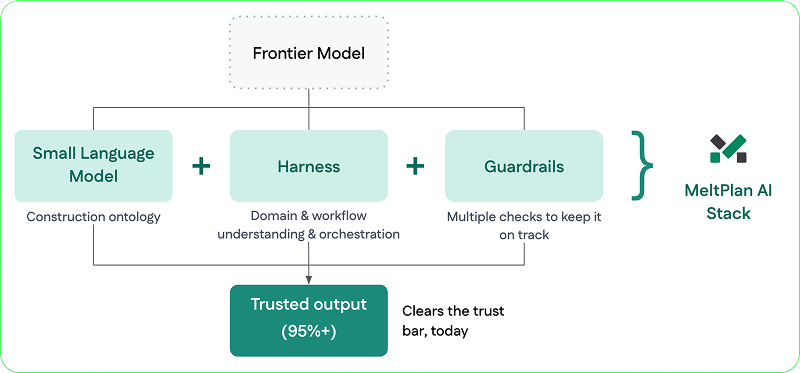
Small Language Models (SLMs): In contrast to the general model, we create specialized models for various construction-specific tasks such as understanding drawings, classifying trade scopes, and analyzing bid proposals.
-
Harnesses: This is the workflow orchestration that stops the AI from going off track during long and multistep preconstruction process.
-
Guardrails: A system of checks that catch mistakes before they get to your team. The low confidence outputs get flagged rather than filtered out.
This results in 95+% accuracy on preconstruction-specific tasks compared to 75-80% of the frontier models. That margin makes the difference between productive AI and one that will just give you extra work.
Accuracy and the Human Role
Q3: How does MeltPlan validate and maintain that accuracy?
This thorough eval methodology is at play for every single product and every single model version upgrade. Four pillars define it:
-
Golden sets compiled by top 1% practitioners: The truth is first determined by top 1% practitioners within that field. No crowdsourcing. No ChatGPT answers.
-
Diversity of data: Eval sets include projects of different sizes, different buildings, firms of various sizes, and sub quote format. A model that works on just one kind of projects doesn't get deployed.
-
Continuous evaluations: Each new model version triggers a run of evaluation. If accuracy decreases due to anything, it is caught at the development stage.
-
The 95% bar as a hard minimum: We don't release our products until they pass 95%+. Below that level - workflow is not real.
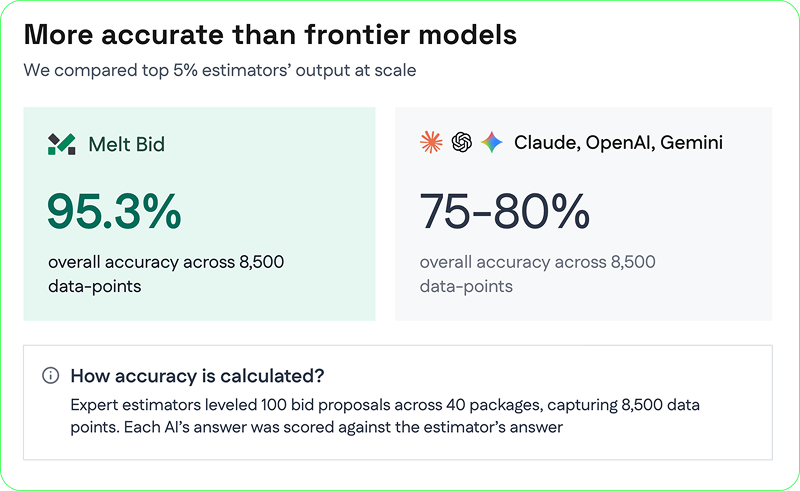
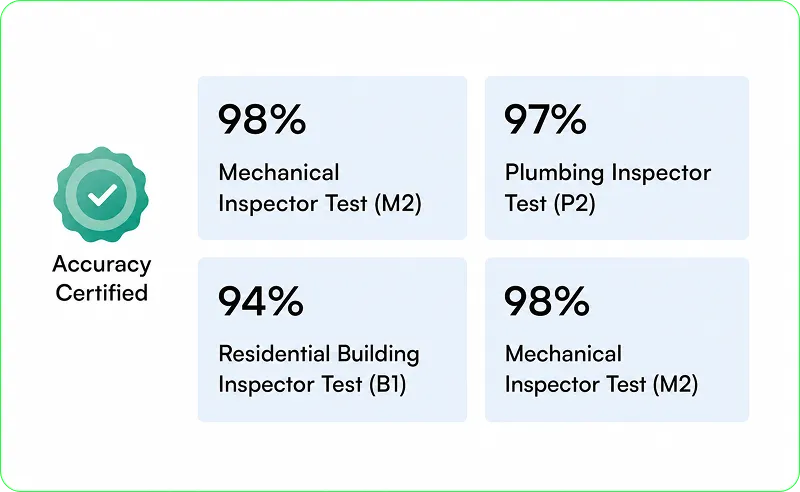
For Melt Bid, estimators estimated 100 bids for 40 packages, generating 8,500 data points, all evaluated against an estimator's answer. Melt Bid passed 95.3% compared to frontier LLM models passing 75-80%. For Melt Code, we tested on 2,000+ questions from official building inspector certification exams for four discipline paths: 98% for Mechanical, 97% for Plumbing, 94% for Residential, 93% for Commercial.
Melt Bid - AI bid leveling software
Melt Code - AI building code software for compliance decisions
Q4: Is MeltPlan's AI replacing human estimators or augmenting them? Where is the line?
Non-replacement, and the product is intentionally designed to be. MeltPlan does the first pass. Your estimators do the finish.
This means in concrete terms that when a takeoff arrives at your estimator, it's essentially finished, with all quantities tied to the plan sheet it originated from. When a leveled bid comparison arrives at them, every single figure is tied to the sub proposal it originated from. When a document review is complete, all problems noted are tied back to the original spec section. Your estimator is not proofreading. They are making judgments about an essentially finished product.
What shifts here is the amount of project your team is able to handle. With the same headcount on the estimating side, they can handle more projects that matter when they aren't drowning in the first passes of work. This is the framework: AI takes care of the drudgery, and humans make the decisions.
There are four things that are always the case when MeltPlan hands off work to your team:
-
Accurate enough to be improved in review, but not perfect enough to have to correct: at 95%+ accuracy, your estimator uses construction judgment, not proofreading.
-
Everything has a tie-back to its source: drawing sheet, spec section, sub quote, verifiable in seconds.
-
Low confidence areas identified, not hidden: gaps in coverage are explicitly identified so you know precisely where to apply your expertise.
-
Delivered at the right point in the process: an essentially finished product where experience makes the final difference.
"MeltPlan does the first pass. Your estimators do the finish."
What MeltPlan Delivers
Q5: What are the core benefits MeltPlan delivers for GC preconstruction teams?
There are three factors, one making the next worse:
More activities. MeltPlan AI saves estimators time with the same tasks in takeoff, bidding leveling, and review. That leaves them with more time to engage in other activities, the right ones. One ENR Top 10 GC saves about 150 hours per project just by automating the bid tally spreadsheet. Five hours per package, 30 packages.
Narrower margins. With more time to use comes more time to make strategic choices, and with more strategy, estimators will know what work to pursue and how to protect the margins in the process. Melt Bid finds scope gaps, exclusions, and qualifications in subcontractors' proposals, that might go unnoticed otherwise. Melt Review detects design inconsistencies and sole-source specifications that may lead to future change orders. Problems detected at the pre-construction stage cost less than problems detected at the construction stage.
Smart from the very first project. Intelligence gained from every project is integrated back into the platform. Estimations in the following projects will be based on the real history of your projects, not cost publications. You will know which subs failed to identify scope gaps in the previous project. The platform will learn with every project.
"Problems detected at the pre-construction stage cost less than problems detected at the construction stage."
Q6: Walk us through what Melt Bid actually does: from a stack of sub proposals to a leveled comparison.
Every GC preconstruction team gets sub proposals in all possible formats, from PDF, Word documents, Excel spreadsheets to emails. In order to make a comparison, one should first get everything into a standardized format. Historically, this process took hours of manual labor per each trade package. This step is completely eliminated in Melt Bid.
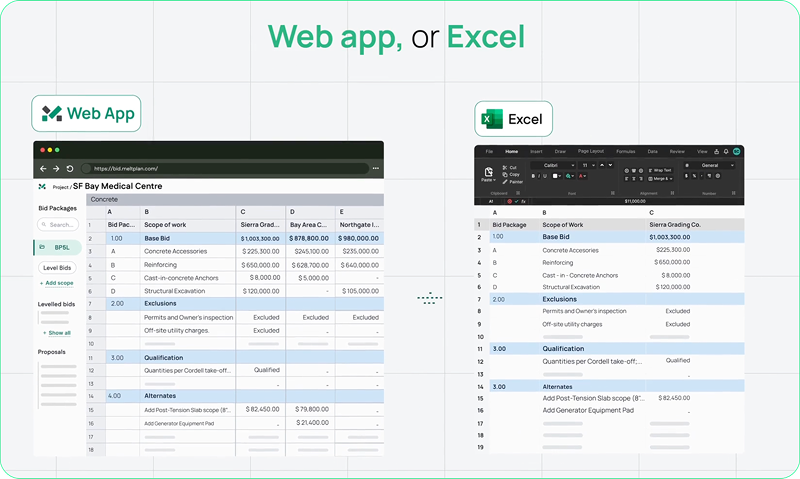
Upload the proposals. Melt Bid will process everything independent of their format, will extract all necessary data like scope of work, pricing, exclusions, qualifications, and alternates and will provide an unbiased comparison among all subs within two minutes. All data points will be linked to their source proposal for verification purposes.
The most important part is that the whole process will happen in your current Excel template and not in some other system which needs to be sold to your team members. MeltPlan and Excel will be in sync at all times. Why is it important? Because the bid leveling methodology of your GC team is tribal knowledge. MeltBid does not replace it but simply helps to fill it up.
Q7: Bid leveling is notorious for missed exclusions and buried fine print. How does Melt Bid catch what human reviewers miss?
The problem isn't that your estimators aren't looking for anything in particular. It's the sheer volume of reading material your estimators have to get through in the time allotted for preconstruction.
The fine print in 30 sub proposals per trade package is overlooked. The qualification on page 8 out of a 22-page document is never read.
Melt Bid reads every word of the proposal. Melt Bid surfaces any scope gaps (what's missing from the scope of work of the project), highlights exclusions (the items the sub does not cover explicitly), and finds qualifications (the criteria on which the sub's price is based). Melt Bid surfaces all this information normalized between different subs so your estimator can compare apples to apples instead of spending countless hours sorting through different formats.
One VP of Preconstruction at Midwest regional Top 10 GC said it best: "We mostly get lump sum bids, but Melt Bid helps us find inclusions and exclusions from each sub really well since they are never stated in the same verbiage."
Q8: Melt Takeoff pairs AI with experienced U.S.-based estimators. Why is human review still part of the model?
Because takeoff AI isn't at the accuracy level where it can be fully unsupervised - not yet, and not for the stakes involved in a GMP estimate. The AI reads the plan set and produces a quantity takeoff. Experienced estimators then review and adjust it. The result is a verified takeoff ready to use.
This isn't a workaround. It's the right model for where the technology is today. Melt Takeoff customers report 40% faster turnaround and a cost significantly lower than what they pay their current takeoff vendors. You get speed and price improvement without trading accuracy for it.
One Platform, Compounding Value
Q9: What is "Connected Preconstruction" and how is MeltPlan pioneering it?
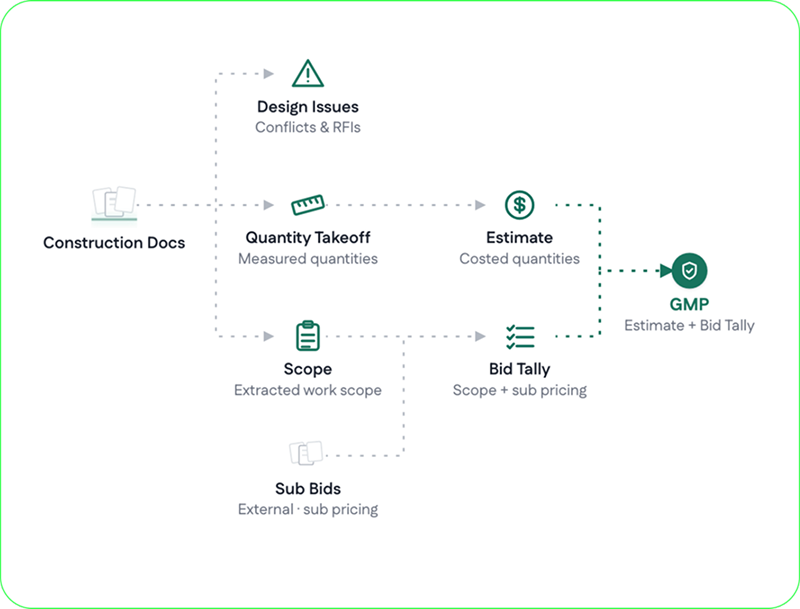
Connected Preconstruction: Every preconstruction workflow uses the same platform and relies on the same base of data – without any re-entry, silos, and stack of disconnected tools not talking to each other.
In the vast majority of GC organizations, drawings are uploaded to a certain software for the takeoff process, then re-uploaded somewhere else for the review process, then re-uploaded somewhere else for code questions. Sub proposals are stored in an Excel spreadsheet, takeoffs are kept in another spreadsheet and bid tally is managed in yet another spreadsheet. This approach is not only inefficient but also risky, as decisions made at one workflow are not necessarily communicated with the other processes.
With MeltPlan, the very same plans and specifications used for document review get automatically uploaded to the processes of quantity takeoff and scope generation. The very same sub proposals used for bid leveling become updated automatically in your cost database. No matter what work you've already done – it is accessible anywhere you need. The connection is not only about the convenience but also about the quality of decision-making, based on the information provided within one platform across all precon workflows.
At the moment MeltPlan provides connection between four major workflows: Document review(Melt Review), Quantity takeoff (Melt Takeoff), Scope generation (Melt Bid), Bid leveling (Melt Bid), and Code compliance (Melt Code).
Q10: What is "Connected Preconstruction" and how is MeltPlan pioneering it?
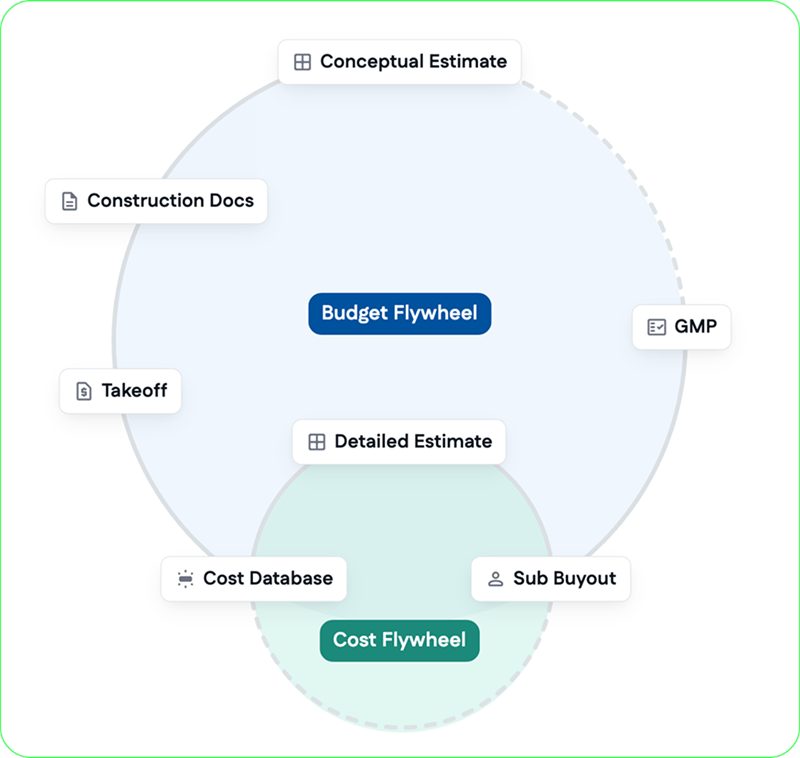
Precon Flywheel is the result of continuous automatic refinement of each subsequent project based on its predecessor.
Most preconstruction information collected by the GC in spreadsheets dies along with the project. With closure of each GMP, the actuals get filed somewhere, and next estimate is generated from published cost guides rather than your historical data of previous projects. The information about sub performance such as submissiveness to scope or consistently delivering clean scope is also not transferred systematically from one project to another. Each new project begins almost from scratch.
This situation is completely changed with MeltPlan because it organizes and stores the intelligence of each project while running through the platform. There are two flywheel effects at work here:
-
The Budget Flywheel: each closed GMP feeds back into the platform and allows to build early budget of each future project basing on your historical projects' data: your actual costs on similar projects, not industry benchmarks.
-
The Cost Flywheel: each leveled bid feeds back into cost database the prices of participating subcontractors. Over time, the MeltPlan learns which subcontractors in your market charge certain scopes and which subcontractors miss inclusions or deliver scopes with qualifications affecting their competitive pricing.
The Flywheel begins from your first project and accumulates with volume. More projects you run through MeltPlan – sharper estimates and leveling runs of all future projects become.
The Team and Early Traction
Q11: What makes the MeltPlan team specifically suited to build preconstruction AI - and not just another software team pointing a model at construction?
These three different backgrounds were embedded in the founding team: software expertise at scale, construction delivery, and frontier AI. Such a combination is very rare.
The CEO and co-founder Kanav Hasija has the background of establishing a $3B software company. Another co-founder Tanmaya Kala has the experience of delivering multi-billion dollar construction projects on time. And, the wider team also comprises individuals with the experience of developing globally top-ranked AI models.
It is important since the hardest part of creating preconstruction AI is not the development of technology itself. A team of software experts will be able to create a model capable of reading drawings, however, they will not be able to understand what a leveled bid comparison should look like and what kind of things a general contractor is looking for when he reviews a takeoff. Due to the construction experience of the team members, the evaluation, golden sets, and threshold accuracies will be defined based on the output of real experts – estimators or building inspectors.
The advisory bench of the company consists of Amar Hanspal, who was the Co-CEO and CPO of Autodesk, Eric Lamb, the co-founder and Board Member at DPR Construction and Yindy Felkins, the Board Member at Western Allied Mechanical. The company raised $14 million till now, which included the $10M seed round led by Bessemer Venture Partners.
"The hardest part of creating preconstruction AI is not the development of technology itself."
Q12: What has been the early response from GC customers?
Teams most extensively utilizing MeltPlan are very large, sophisticated general contractors: Top 10 ENR GCs and Regional Top 5 GCs.
Several points have emerged in the initial feedback:
The time savings are tangible. A Precon Manager for one of ENR Top 10 GCs reports saving around 150 hours per project for bid tally spreadsheet calculations only: 5 hours per package multiplied by 30 packages. Not a marginal productivity improvement; it's weeks of estimator's availability per project.
The accuracy builds trust. As Henry Tooryani, Principal of MicroEstimating Inc. stated: "MeltPlan became part of our estimating team. They provide us with accurate takeoffs really fast, quantification of the drawings and identifying scope gaps. It's AI-assisted, but validated by estimators with decades of experience in constructing actual buildings who vouch for it."
Construction document review is changing owner-GC relationship. One VP of Preconstruction at a Southeast Regional Top 5 GC stated: "Speed of execution is critical for us and our owners want us to act fast. After we have started using Melt Review, even our owners and architects are impressed with the speed of construction document reviews we perform."
The software picks up on stuff missed during manual review. A Preconstruction Manager for one of Midwest Regional Top 10 GCs reports: "We discovered a lot of issues even in permit-ready packages and protected our margins due to this. Melt Review picks up on things that are impossible to catch manually."
The aec+tech Takeaway
The MeltPlan solution simply involves a delegation of responsibilities. While the AI is responsible for handling the tedious aspects of the task that consume the estimators’ time, the estimators make the decisions that help in winning projects and preserving margins. With every figure being attributed to its source, GC teams have the luxury of checking figures within seconds and strategizing.
To learn more about meltplan, visit their page on aec+tech or explore more on the official meltplan website.

Co-Founder and CEO of MeltPlan, Kanav Hasija, leads an AI-first preconstruction platform for general contractors, and in this conversation, he makes the case for why general-purpose AI falls short in preconstruction and what purpose-built AI does differently.
Recent Articles
Learn about the latest architecture software, engineering automation tools, & construction technologies