
Forma Futures: Design the Housing of 2035 in One Hour
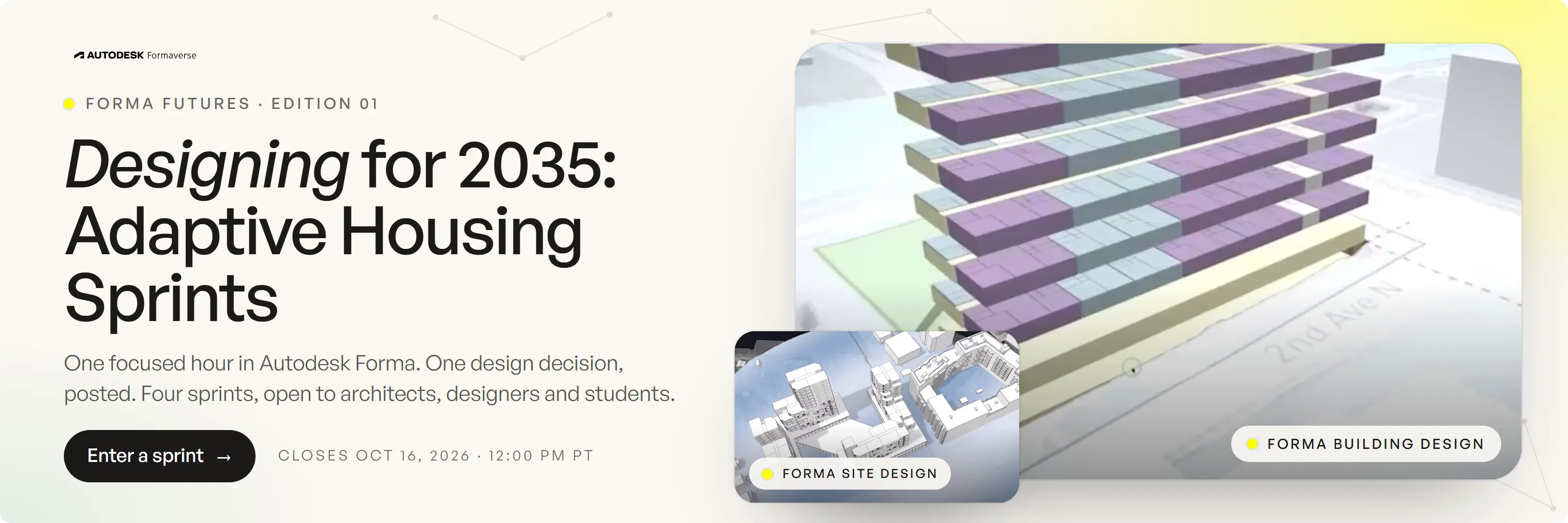
Just last week, Autodesk opened Forma Futures, a design challenge built around a question most of practices are already living with: what does housing need to be by 2035?
Niknaz Aftahi, founder and CEO of aec+tech, has joined the jury. Here is what the challenge asks, how it works, and how to enter before submissions close on October 16.
The short version: pick one of four adaptive housing briefs, spend as little as one focused hour in Autodesk Forma Site Design or Forma Building Design, and post the thinking behind one design decision on LinkedIn. That post is the entry.
What Forma Futures is
Forma Futures is a new challenge series from the Autodesk Forma team. Edition 01, "Designing for 2035: Adaptive Housing Sprints", runs as four short design sprints, each a self-contained brief on one facet of adaptive housing.
It went live at Autodesk University 2026, and all four sprints are open. Participants can take on one or all four; each is judged on its own, and every sprint closes on October 16, 2026 at 12:00 PM Pacific.
Entry is open to architects, designers and students aged 18 and over in 29 eligible countries, listed in the official rules.
Why adaptive housing, and why 2035
The framing draws on RIBA's Horizons 2034 research and sits at the overlap of two shifts: who housing is for, as households get smaller and older and affordability reshapes tenure, and what conditions it has to perform in, as overheating, flooding and carbon cost stop being edge cases.
Every brief is hypothetical, with no client, live project or NDA site involved, so participants can name their studio in the post without clearing anything first.
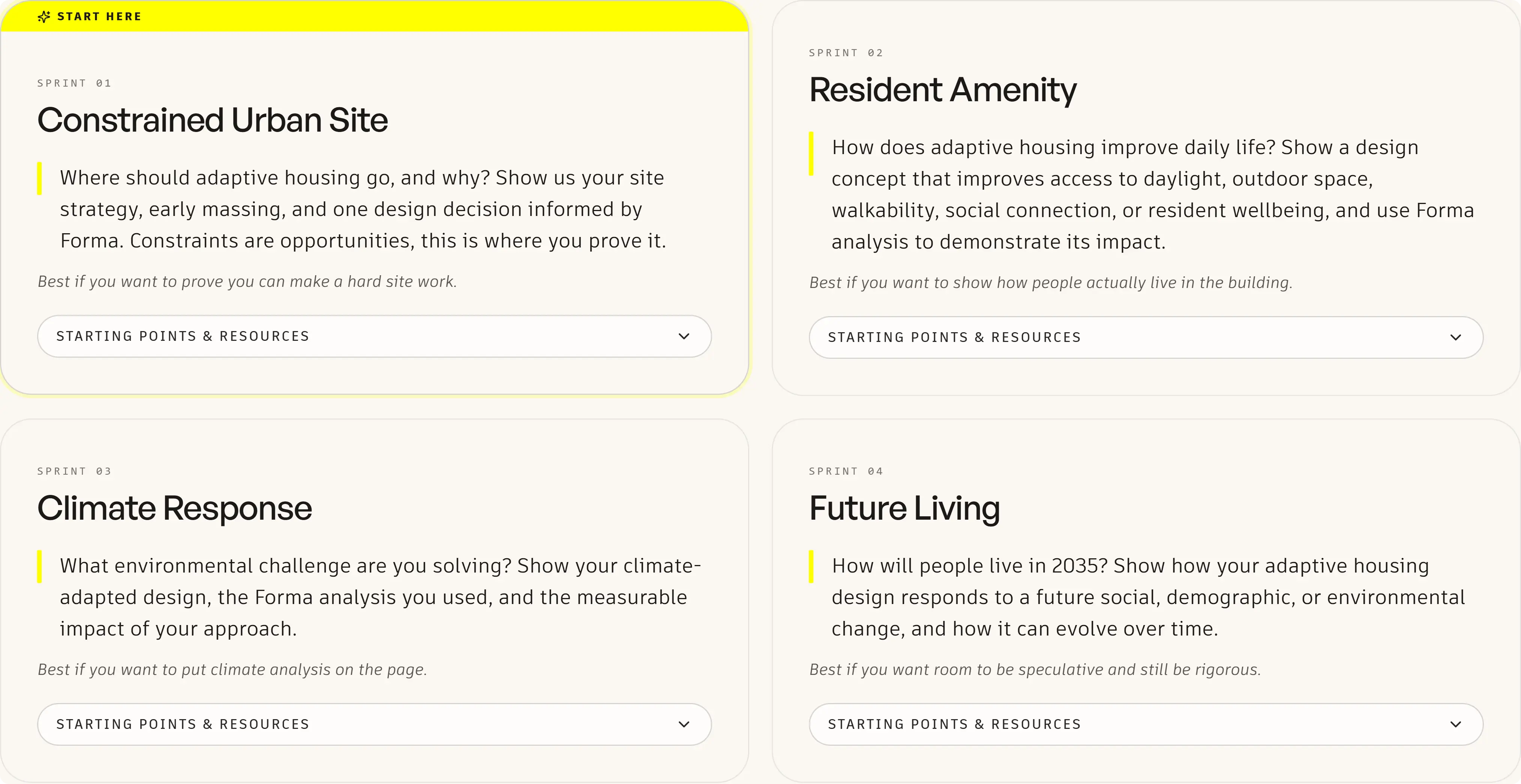
The four Forma Futures sprints, each a complete brief judged on its own.
The four sprints
Sprint 01, Constrained Urban Site, is the suggested starting point. Where should adaptive housing go, and why? It asks for a site strategy, early massing, and one design decision informed by Forma.
Sprint 02, Resident Amenity, asks how adaptive housing improves daily life, through daylight, outdoor space, walkability, social connection or wellbeing, with Forma analysis to demonstrate the impact.
Sprint 03, Climate Response, asks which environmental challenge the design solves, and wants the climate-adapted scheme, the Forma analysis behind it, and the measurable impact of the approach.
Sprint 04, Future Living, asks how people will live in 2035, and how the housing responds to a future social, demographic or environmental change and evolves over time.
How to enter in about an hour
Pick a sprint and spend as little as one focused hour in Forma Site Design or Forma Building Design; a real or invented site both work. Publish a public LinkedIn post with at least one image of the work, , the sprint name, the hashtag #FormaFuturesChallenge and a tag for @Autodesk Forma.Once it is live, the entry is in. The Forma team finds entries through the hashtag, and there is nothing to send back.
One image qualifies, but posts stand out with two or three: a Forma UI screenshot or analysis result, or an interoperability story such as Rhino or Revit massing brought into Forma for analysis. The challenge page also offers a post-drafting tool, a Figma carousel template and a one-hour webinar recording.
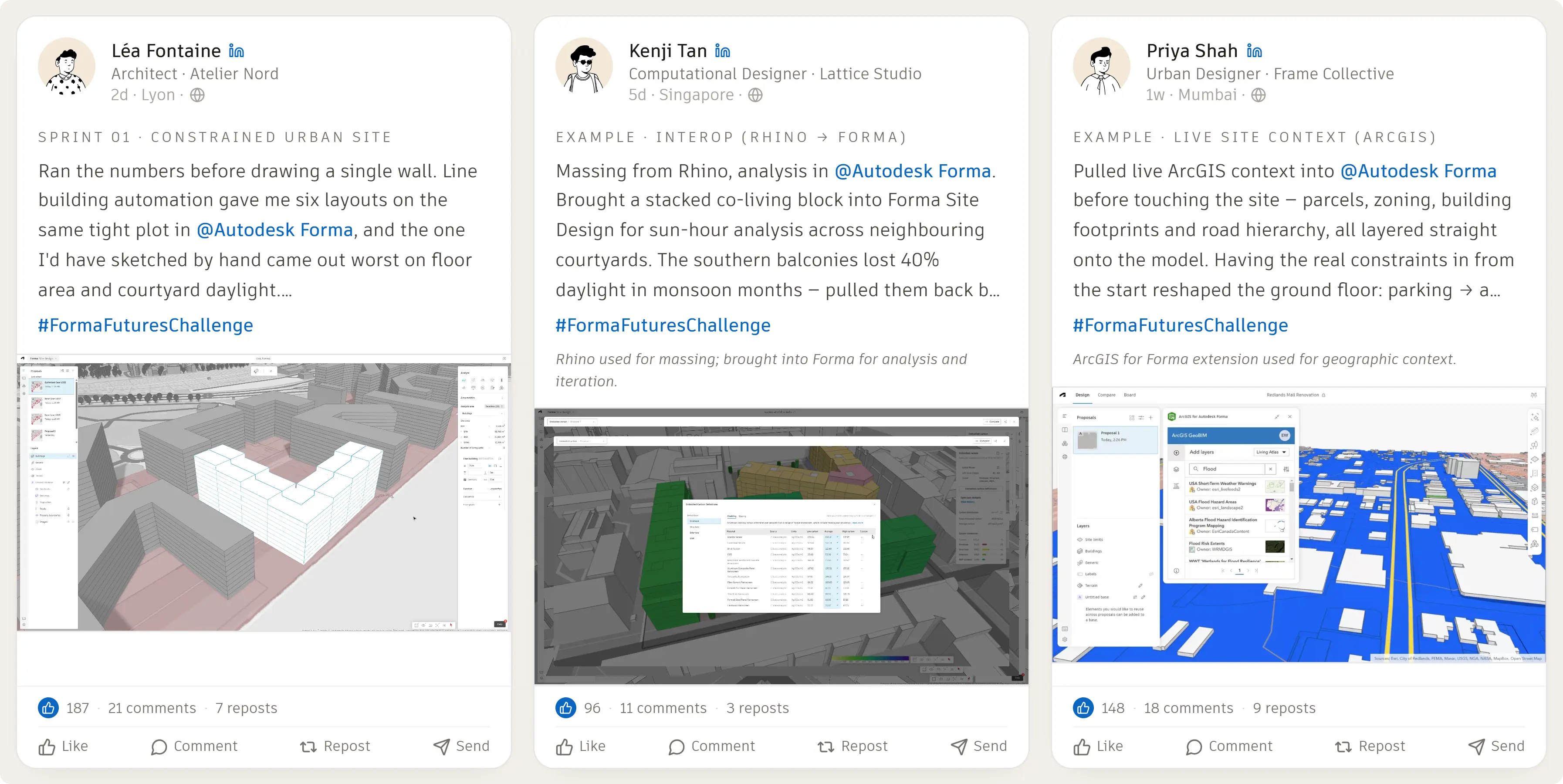
Strong entries show the study, the number it produced, and the decision that changed.
What the jury is looking for
Autodesk has published four criteria for a strong entry: a clear response to the sprint prompt, one concrete Forma analysis that changed a design decision, honest design reasoning including what did not work, and something another architect can learn from.
Read together, they describe a studio crit note. The example posts on the challenge page each name a study, give the number it produced, and explain the decision that changed, such as a balcony line pulled back 1.8 metres to recover sun hours.
Show the study you ran, the number it gave you, and the decision you changed.
The distinction matters. A finished render shows what was made. A post that shows the analysis, what it revealed, and what changed as a result shows how the designer thinks.
What winners receive
One winner per sprint receives a USD $1,000 digital gift card, up to $4,000 across the season. The four winning projects are featured together in a dedicated round-up on ArchDaily, and each winner gets a project deep dive on the Autodesk Forma blog and an official Forma badge for their website and portfolio.
Getting access to Forma
Participants need Forma Site Design or Forma Building Design . Autodesk offers a free 30-day trial that includes both. Anyone already on Revit or the AEC Collection has both included at no additional cost. Students and educators can verify with a school email for a free one-year educational licence.
The challenge page also hosts sixteen short Forma tutorials, most under four minutes.
The jury
Niknaz Aftahi is joined on the jury by Adrianne Steichen, FAIA, principal at PYATOK architecture + urban design in Oakland, with more than 24 years in affordable housing.
Mariana Cabugueira, founder of [MC] Studios in London and formerly a senior architect at Zaha Hadid Architects.
Oliver Thomas, founder and CEO of Archi-Tech Network.
Stjepan Mikulić, founder of AI in AEC and a former Project BIM Lead at BIG in Copenhagen.
The jury will read the architecture and the workflow, and an entry strong on only one of them will show it.

Why aec+tech is involved
aec+tech exists to connect AEC professionals with the technology changing how they work, and Forma Futures does that in a very direct way: it asks entrants to run one real analysis, let it change one real decision, and write down what happened.
All four sprints are open until October 16, 2026 at 12:00 PM Pacific. Anyone with Forma through a trial, a Revit or AEC Collection subscription, or an education licence already has what they need. Pick the brief that fits the work you want to be known for, spend the hour, and post it.
Recent Articles
Learn about the latest architecture software, engineering automation tools, & construction technologies