
From Prompts to Agents: Agentic AI for Running an AEC Firm

- Why AI adoption is high while confidence in business data is low
- The practical difference between a prompt and an agent
- Workflows already running in timesheets, cash flow, reporting and lead intake
- How to tell whether a process is ready for an agent
- What agentic tools change for risk monitoring and resource planning
Adoption is high, readiness is not
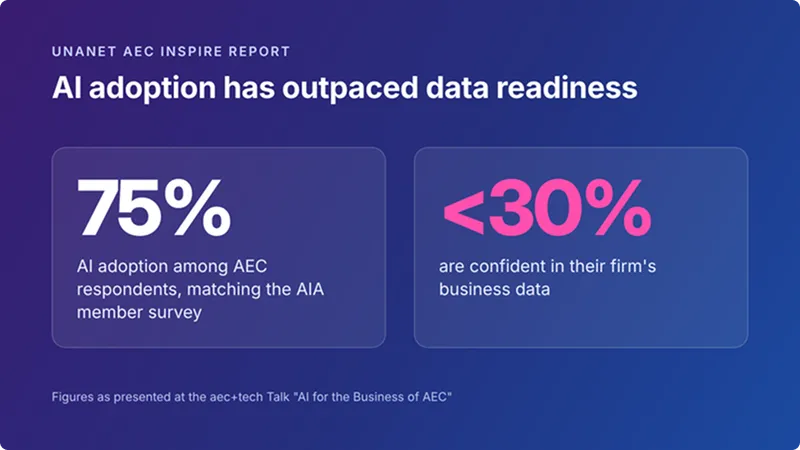
Hayden opened with Unanet's annual AEC Inspire report, which put AI adoption in the industry at 75%. Aftahi, who co-chairs the AIA's AI task force, noted that the AIA's own member survey returned exactly the same figure.
The numbers underneath are less encouraging. Adoption spiked between 2025 and mid-2026, Hayden said, but the use of AI to run full workflows has not kept pace, and just under 30% of AEC respondents are confident in their business data. That matters because, in his words, AI "is highly reliant on the context that it has in order to provide value."
Over the past six months, Hayden has also watched attitudes shift from generative or assistive AI toward agentic AI: from prompting for answers toward handing over parts of a workflow. Most of the talk explored what that looks like inside a firm.
What separates a prompt from an agent
Pantana was careful not to dismiss prompting. He still asks AI questions every day. The difference with an agent, he explained, is agency: "having the ability to take input or context and then do something with it." A prompt is a single turn. You ask, it answers, and you carry on. An agent works towards a goal with a set of tools and somewhere to store data along the way.
In practice, Pantana said, the line between the two is blurry. Some of Wyatt's own workflows run end to end and are only checked occasionally. Others produce an output that becomes the input for the next piece of work. "Every day I'm waking up and thinking, oh yeah, I could also stitch those two workflows together to make a super workflow," he said.
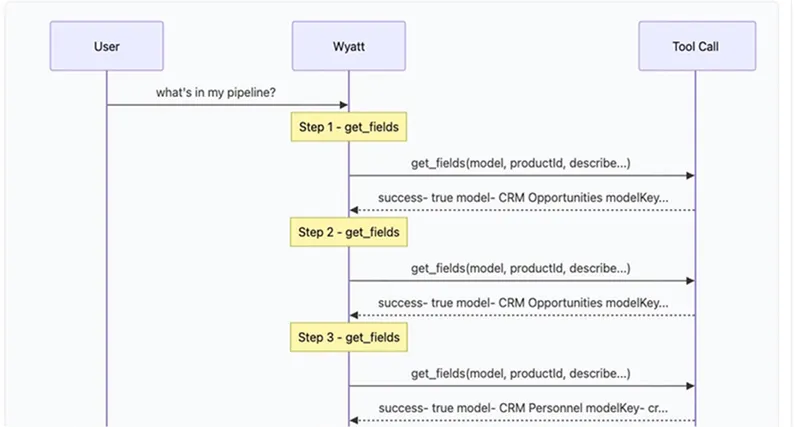
That idea shaped how Wyatt was built. Rather than hardcoding each step, the team gives the model tools, context and a desired outcome, and lets it choose how to get there within its data access and permissions.
“Agency means you're handing off a multi-step process.” – Matt Pantana
Bertsch described the same progression from a finance seat in three words: ask, analyze, act. First you check whether the answers are correct. Then you ask the tool to analyze them, for example by comparing your firm with others of the same size. Then you let it act.
Hayden compared the effect to compounding interest. The more you work with AI and the more it understands your goals, the more it becomes a participant in getting work done, rather than a passive bystander you phone for help.
The workflows already running
Most of the session focused on examples Bertsch has built, many during his time as a CFO.
Lead intake. An agent scans a marketing inbox full of spam and genuine quote requests, logs the real ones in a workbook, compares them against historic projects, ranks them and hands them to a person. Bertsch's next step is having it create the opportunity in the CRM once that person approves. Hayden summed up the benefit: the agent "can start to do that busy work" and "that reserves the judgment for the person."
Timesheet compliance. Late timesheets slow the monthly close, and discovering weeks later that extra people charged to a project erodes its profit. Bertsch's agent checks that timesheets are submitted and approved, then reads the comments and writes a progress summary for each project manager. PMs told him it would have taken them hours to piece that together themselves.
Cash forecasting. The same approach works for accounts receivable. Beyond alerting PMs and principals to overdue invoices, the agent uses each client's payment history to forecast how cash will arrive across the month. "It's done a really good job at that," Bertsch said.
Month-end reporting. Bertsch used to spend about a week building a PowerPoint for senior management and private equity after each close. Now, he said, "I push a button, and two minutes later, this beautiful PowerPoint is produced." He then asks the agent to rank his results against industry benchmarks from sources such as PSMJ.
Contract review. For new opportunities, he drops in a contract and asks the agent to flag any risks.
Hayden noted how quickly this kind of analysis now arrives. Overlaying current activity on a historical snapshot to see where a firm stands, and where it might go next, "would have taken weeks and weeks" to baseline. Now it takes minutes.
Hayden added one more candidate: the handoff from a won opportunity to an active project. Teams can't bill until accounting issues a project code, and firms have long relied on forms and spreadsheets to gather what's needed. Automating it, he said, could "save a ton of time and also get to billables as quickly as possible."
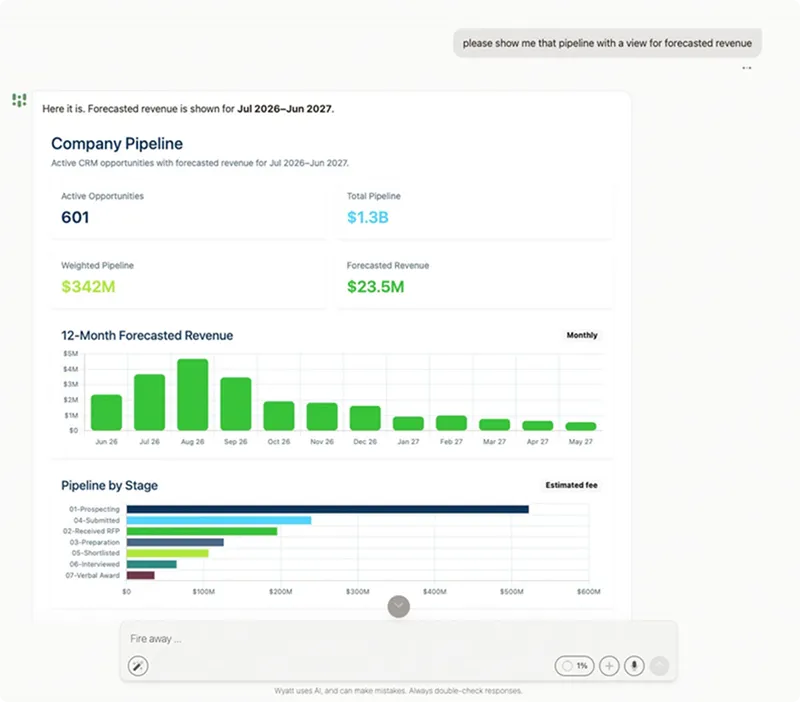
Pantana pointed out why these results come quickly. Off-the-shelf AI tools are capable, but without access to your data and systems, and without the right permissions, connecting them across a firm gets complex. A vertical tool built into the ERP or CRM cuts that learning curve. As Hayden put it, you no longer need "to know SQL or the right filters or the right magic words." You simply ask for the revenue forecast, or whatever else you need.
How to tell if a process is agent-ready
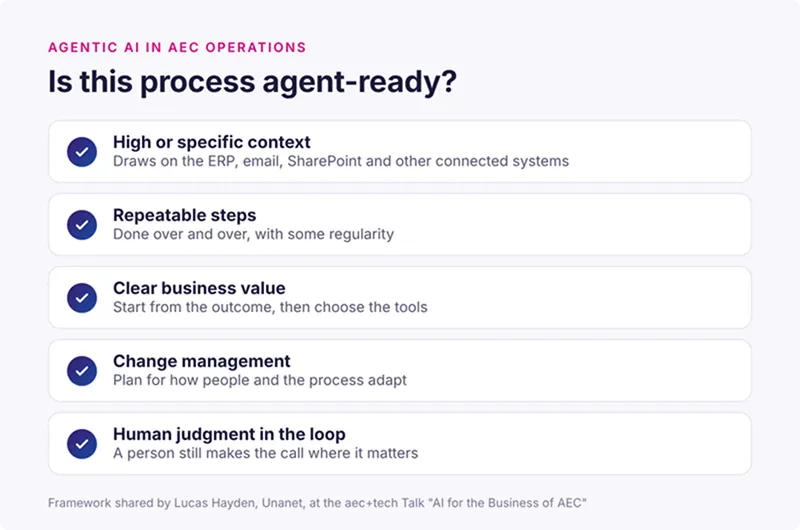
Hayden outlined five traits of a good candidate: high or specific context (a vertical ERP or CRM, or broad access across email, SharePoint and other systems), repeatable steps, clear business value, attention to change management, and human judgment kept in the loop where it's needed.
Pantana illustrated business value with a story from a recent visit to the Culinary Institute in New York. Standing in a kitchen full of professional equipment, it is easy to feel you could make anything. The better question, he said, is "I want to make a cake. So, which tools do I need?" Start with the outcome and the tools fall into place. Look at the tools first, and you get "lost in the weeds of potential."
Aftahi said aec+tech sees the same pattern across the market. New AI products appear every day, and users are becoming more overwhelmed, not less. Firms that don't know which problems they are solving simply get lost faster.
On context, he was blunt: each token a model produces is predicted from the ones before it, so "if you don't have good tokens before it, you're not going to get good tokens after it." Access to the ERP/CRM is good. Access to the ERP/CRM plus other systems, through direct connections, MCPs or APIs, is better.
He also reassured firms that they don't need to jump straight from prompting to agents. Each time you realize you don't need to be in the middle of a step, you move yourself further along, until the process quietly becomes agentic.
“You're just moving yourself further down the stack of where you insert your judgment.” – Matt Pantana
Bertsch offered a practical starting point. He has set up his own "organization" inside Champ Agents, powered by Wyatt that defines who handles what and how they analyze it. He then describes a current process and asks how to improve it, what data is missing, how to clean it up and what it would look like with agents involved.
Risk monitoring that runs on its own
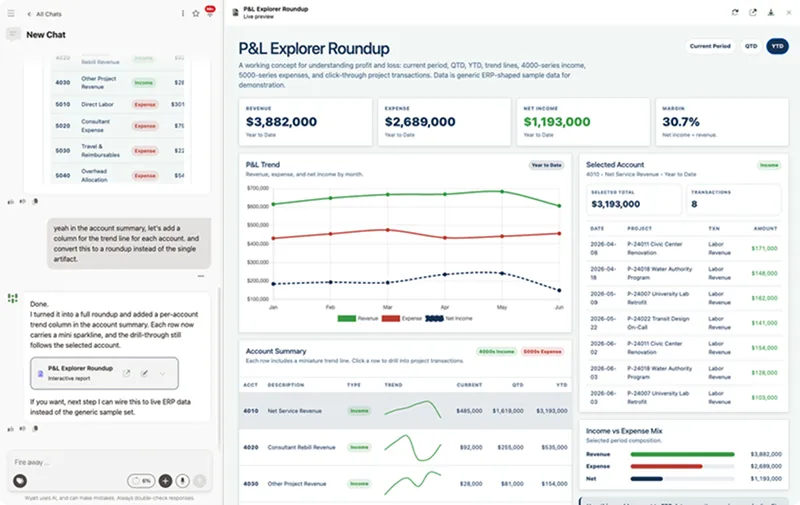
Pantana walked through how Wyatt handles project risk using what he calls three pillars: chats, chores (automations) and roundups (a visualization layer). A user might say they want to see every project ranked by backlog, with anything at risk flagged. Wyatt's agent builder then creates a chore to fetch the data on a schedule, a table to store it, a second chore to score it before Monday morning, and a roundup to display it. A threshold rule can email the PM and their manager when something slips.
Pantana borrowed a line from a client to describe it: Wyatt "can be the tool or it can make the tool." It can analyze on request, or build repeatable dashboards and even custom scheduling screens.
Resource planning without the data entry
For Hayden, the biggest shift is in staffing. Firms have long tried to balance backlog, incoming pipeline and available staff, but resource planning tools needed so much data entry that many never got value from them. With past project actuals and proposed schedules already in the system, AI can now seed a schedule for similar work. "The whole equation has just flipped," he said.
Hayden described the goal as a 360-degree view: where the firm stands, how it has staffed work over the past 12 months, what it needs for the next 12, and a tool that rebalances schedules as plans change.
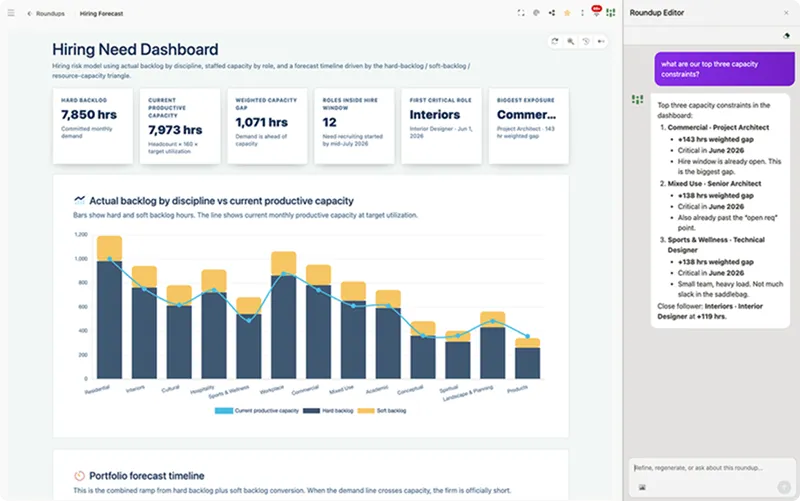
Pantana argued that the capability was always there. Unanet AE already has powerful features, but getting value from them depended on who was using the system and how well, or as he put it, "who's the jockey on that particular horse." Ask an employee to seed schedules from actuals and they would need months. Ask the agent and it simply asks which data and date range to use. That is also why he favors connected, purpose-built tools over a general chatbot: generic AI is good at organizing, but multi-step business work needs rails so people don't burn out figuring out how to use it.
“It's never been about not having the right questions.” – Matt Pantana
Bertsch looked a step further. Decisions to pause, extend or accelerate a project usually surface in Teams or Slack, not in the ERP. He wants agents to pick up those signals so schedules no longer depend on someone remembering to update a date after a meeting.
The aec+tech takeaway
This conversation showed agentic AI arriving in AEC firms as a gradual handoff rather than a single leap. Timesheet summaries, cash forecasts, month-end reports and Monday-morning risk checks share the same pattern: repetitive work, deep business context, a clear outcome and a person who still makes the final call.
Readiness is the gap to close. As Aftahi noted, the AIA survey that recorded 75% adoption also found that only around 20% of firms have any AI policy, and about 10% have a written one. Firms that start with the outcome, trust their data and connect AI to the systems they already run on will be best placed to benefit. For firms on Unanet, Champ Agents, powered by Wyatt, is one way to put that into practice.
To learn more about Unanet, visit their page on aec+tech or explore more on the official Unanet website, and watch the full aec+tech Talk on our YouTube channel.
Recent Articles
Learn about the latest architecture software, engineering automation tools, & construction technologies