
Frank: SWAPP's AI Architect, Live Inside Revit
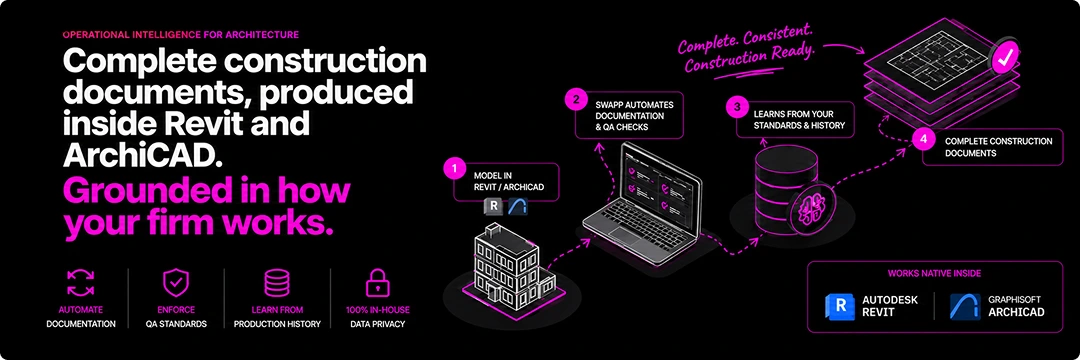
We had a chat with Eitan Tsarfati, CEO and co-founder of SWAPP, about Frank, the company's AI Architect. SWAPP builds construction documents inside Revit and ArchiCAD, grounded in how a firm works. This month Frank starts working directly inside Revit: modeling walls, doors, and fixtures, placing dimensions and tags, and checking sets against a firm's own standards before they leave the office.
Tsarfati explains how Frank learns from a firm's finished projects instead of its standards manual, and where he thinks AI in architecture is headed next.
In this conversation:
- What results like Place Studio's 68 percent reduction actually reflect
- Why Frank learns from a firm's built work, not its standards manual
- Where templates and BIM libraries fall short as a learning system
- Why the AI question in five years shifts from output to memory
What's New at SWAPP
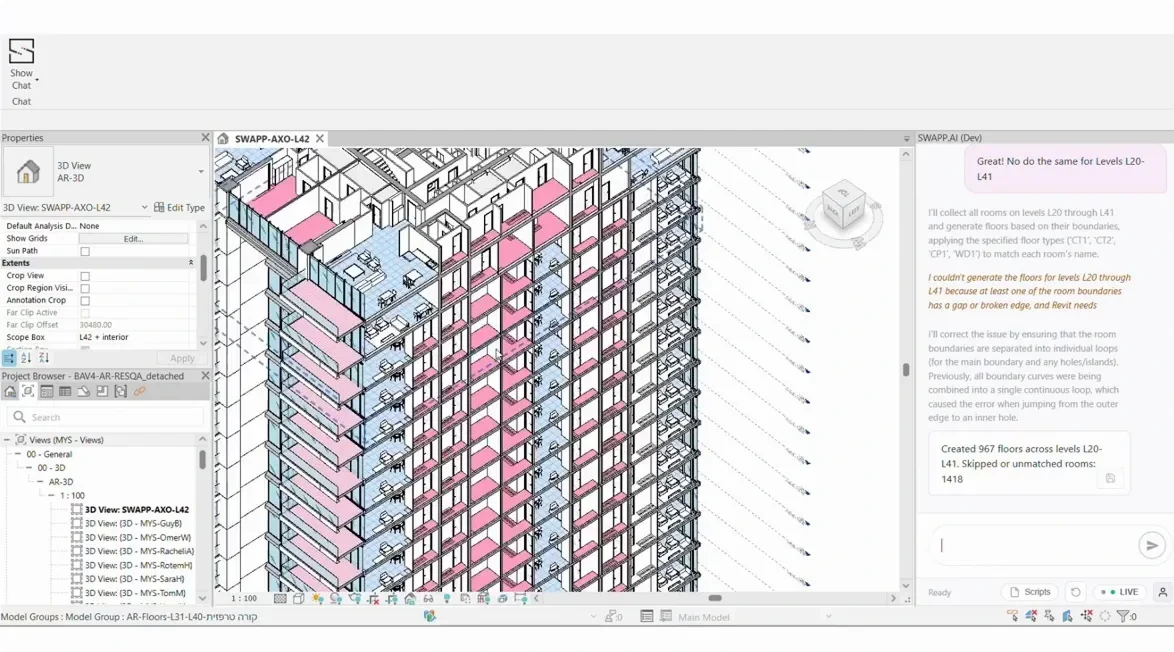
Frank, SWAPP’s AI Architect, now works directly in Revit:
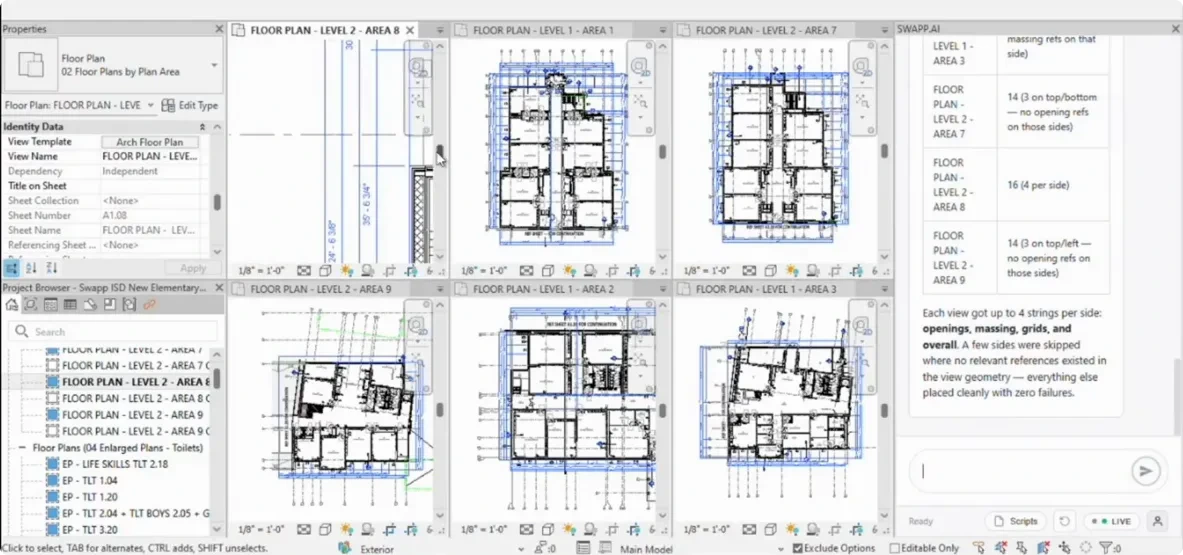
- Places dimensions and tags
- Models walls, doors, and fixtures
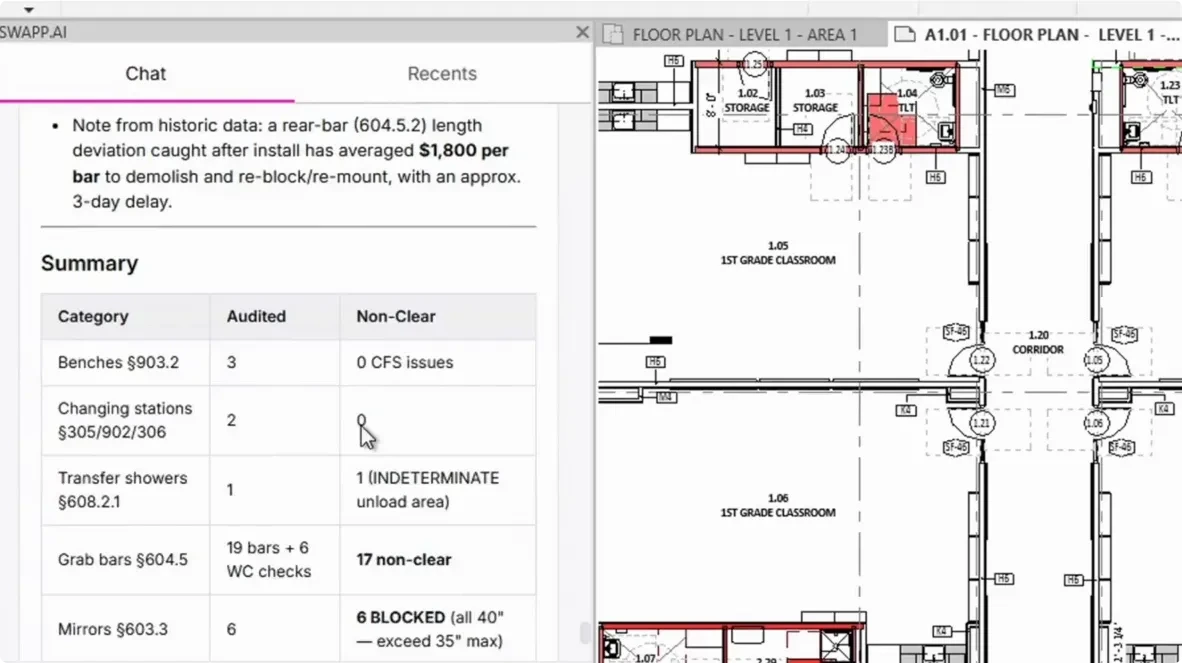
- Checks a set against a firm’s standards
- Flags collisions and ADA issues before your drawings leave the office.
Frank proposes the changes and your team approves them, and it keeps a full audit trail of everything it worked on. Every correction a team makes also becomes part of what Frank knows about that firm, so the tools gets better with each project instead of starting over every single time.
Today, firms including Stantec, Woolpert, MOREgroup, AHA, and MYS Architects are using SWAPP to accelerate production, improve consistency, and reduce repetitive documentation work. On live production projects, customers have reported dramatic reductions in documentation effort, allowing teams to spend more time on design, coordination, and client collaboration.
But perhaps the most significant shift isn't simply that SWAPP helps firms work faster. It's that the system becomes more valuable with every project completed.
Frank will be on live demonstration at Autodesk University 2026, where attendees can visit Booth 4311 to see it working inside Revit firsthand.
Every Project Should Make the Next One Better
Every architecture firm has something no generic AI model can download: years of accumulated knowledge.
Design standards. QA processes. Office templates. Project lessons. Coordination strategies. Thousands of small decisions that define how a firm works.
Traditionally, much of that knowledge has lived in BIM standards, office manuals, templates, and, perhaps most importantly, the experience of senior staff. While these resources help maintain consistency, they rarely improve themselves over time.
Most AI tools aren't much different. They can automate repetitive tasks or generate content, but each project largely begins from the same starting point.
SWAPP is taking a different approach.
Rather than treating every project as an isolated task, the platform continuously learns from a firm's own production history, standards, and documentation practices. Each completed project becomes another opportunity for the system to improve future work.
Instead of simply automating documentation, SWAPP aims to help firms build an AI-powered knowledge system that compounds over time.
We spoke with the SWAPP team about how that vision has evolved, what customers are seeing in practice, and why the future of AI in architecture may depend less on individual prompts, and more on organizational learning.
Eitan Tsarfati, SWAPP’s CEO and co-founder, started with the most basic and important question: how Frank gets to know a firm in the first place.
Learning From Finished Projects, Not Written Standards
Q1: Every firm has its own standards, workflows, and documentation practices. How does SWAPP actually learn from those firm-specific patterns, and how does that make each new project smarter than the last?
We start with the material a firm already has, which is almost never a written standard. It is finished projects. We take a firm's completed Revit models and its documentation history, and we learn how that firm actually draws: how it tags, how it dimensions, what goes on a wall type, where the details sit, which conventions are held absolutely and which ones are house preference.
That distinction matters more than people expect. Most firms have a standards manual that describes an ideal, and a body of built work that describes the practice. The gap between the two is where drawing review time goes.
Frank, our AI Architect, works inside Revit against the second one. And because every project a firm runs through Frank is another piece of evidence about how the firm works, the model of the firm sharpens rather than resets. The first project teaches it the office. The tenth teaches it the exceptions.
Q2: Many firms already have BIM standards, templates, and internal libraries. Where do those traditional approaches begin to fall short, and how does an AI system that continuously learns from completed projects change the equation?
Templates and libraries are static assets that solve the setup problem. They tell a team where to start. They cannot tell a team whether what it produced at 60 percent CD is consistent with what the firm produced on the last four projects of the same type, and they cannot carry a judgement.
So the standard degrades in a specific way. It holds at project kickoff, then drifts through DD and CD as deadlines compress and staff rotate. Firms compensate with senior review, which means the most expensive people in the building spend their evenings checking whether a junior tagged a door the house way.
A system that learns from completed projects changes the direction of the effort. The standard stops being a document someone has to remember and becomes something applied and checked continuously, at production speed. The library still matters. It just stops being the only place the firm's knowledge is written down.
What the Data Shows, and What the Best Firms Do
Q3: Some of your customer stories report remarkable improvements, from completing data center documentation in under 48 hours to reducing manual modeling effort by several multiples. Which results have surprised your customers the most?
The numbers people quote back to us are the throughput ones. Place Studio measured a 68 percent reduction on production documentation for a multi tower mixed use project. MYS reported around eight times more documentation output for the same team. Woolpert saw roughly seven times on the work they put through. HTA cut roughly half the effort on their scope.
But the result that actually surprises people is quieter, and it usually lands about six weeks in. It is consistency. When a firm looks at a set that came out of Frank, the sheets look like they were drawn by one person with a very long memory rather than by five people on a deadline. Principals notice that before they notice the hours, because it is the thing they have been trying to buy with review time for twenty years and could never quite hold.
Q4: Looking across firms such as Stantec, Woolpert, MOREgroup, and MYS Architects, what do the most successful customers have in common? Are there particular workflows or habits that allow them to get significantly more value from the platform?
Three habits, and none of them are technical.
The first is that someone senior owns it. Not a champion in the technology group with no authority over production, but a person who can decide that this is how the firm documents a project now.
The second is that they start with real projects immediately. The firms that try to prove the tool on a retired project learn very little, because a finished project has no deadline pressure and no live decisions in it. The firms that put a live job through in the first month know within weeks whether it works for them.
The third is that they treat the first pass as a conversation rather than a verdict. When a team tells us that a particular detail convention is wrong for them, that is the system working. Firms that correct it early get a version of Frank that fits them. Firms that stay quiet and grade it get a version that is merely generic.
Capacity, Quality, and the Metrics That Matter
Q5: Many people think about AI primarily in terms of saving time. Beyond productivity, how has SWAPP helped firms scale their business, improve quality, or take on more complex work?
Time saved is the easiest thing to measure and the least interesting thing to buy. What our customers are actually buying is capacity that does not require hiring.
Concretely, it shows up in what a firm is willing to pursue. A studio that knows it can carry documentation at several times its usual rate can chase a project type it would previously have declined, or take a second phase without adding staff for it. One of our customers used it to hold a schedule that would otherwise have cost them the client.
The quality side is less visible and probably more durable. Documentation errors are expensive twice: once in the drawing and once in the field. Catching a coordination problem or a standards break during CD instead of during construction is worth more than the hours it took to find it, and no one puts that number in a case study because it never happened.
Q6: As firms invest in AI, what metrics should they actually be measuring? Beyond hours saved, what indicators show that an AI-enabled workflow is becoming smarter over time?
Four, in rough order of how much I trust them.
Correction rate over time. How much of what the system produces does the team have to fix on project one, project five, project ten. If that line is flat, the system is automating but not learning, and you should ask why.
Review burden. How many hours of principal or senior time a set consumes before it goes out. That is the number that tells you whether the firm's knowledge is in the system or still in a person.
Consistency across teams. Take the same drawing type from three different studios in your office and compare them. Most firms have never run that test and are unsettled by the result.
And schedule adherence, not hours. Hours saved can be absorbed invisibly. A deadline that stops slipping is something the whole firm can see.
Where the Conversation Moves Next
Q7: If you asked one of your earliest customers to compare their first SWAPP project with one they're completing today, what has changed the most, not only in speed, but in workflow, consistency, and the way teams collaborate?
The honest answer is that the change is in where the argument happens.
On a first project, the conversation is about the output. Is this right, is that tag correct, why did it do that. The team is grading the machine, and reasonably so.
By the fourth or fifth project, that conversation has largely stopped and a different one has taken its place, about the firm itself. Which of these two detail conventions do we actually want to be ours. Why do two studios in the same office document a stair differently. Those questions were always there. They were just never forced, because nothing in the process made the firm write the answer down.
The workflow change follows from that. Documentation stops being the phase where senior people go quiet and start reviewing, and becomes a phase where they make a small number of decisions that then apply everywhere. That is a better use of their time.
Q8: Looking ahead, how do you see AI changing architectural practice over the next five years? What do you think firms will expect from AI that they don't expect today?
I think the expectation moves from output to memory.
Today firms evaluate AI the way they evaluate a plugin. What does it produce, how fast, does it fit the workflow. That is the right question for a tool and the wrong question for what this becomes.
In five years I think the question a principal asks a vendor will be different: what does this know about my firm, and what happens to that knowledge if I stop paying you. Firms will expect their AI to hold institutional knowledge the way a twenty year employee does, and they will expect to own it. The firms that start accumulating that now will have five years of compounding that a competitor cannot buy, because it is not a model, it is their body of work.
The part of this the industry has not priced yet is what happens when the senior people who hold that knowledge retire. That wave is not five years out. It has started.
Key Takeaways
The biggest lesson from SWAPP's evolution is that AI in architecture is moving beyond simple automation.
Instead of asking "How can AI complete this task?", firms are beginning to ask:
-
How can AI preserve what our firm already knows?
-
How can every completed project improve the next one?
-
How can years of production experience become a competitive advantage?
As more firms adopt AI, the winners may not simply be those with the best models, but those that build the strongest learning systems.
SWAPP's vision reflects this shift: from AI as a productivity tool to AI as an operational intelligence platform that grows alongside the firm itself.
Upcoming Virtual Talk
Join us for our upcoming live webinar with the SWAPP team, where we'll explore these ideas in more detail, see the platform in action, and hear directly from the team about how firms are putting AI into production today.
Tuesday, September 8 at 11:00 a.m. PT: join the live event on LinkedIn here.
Meet SWAPP at Autodesk University
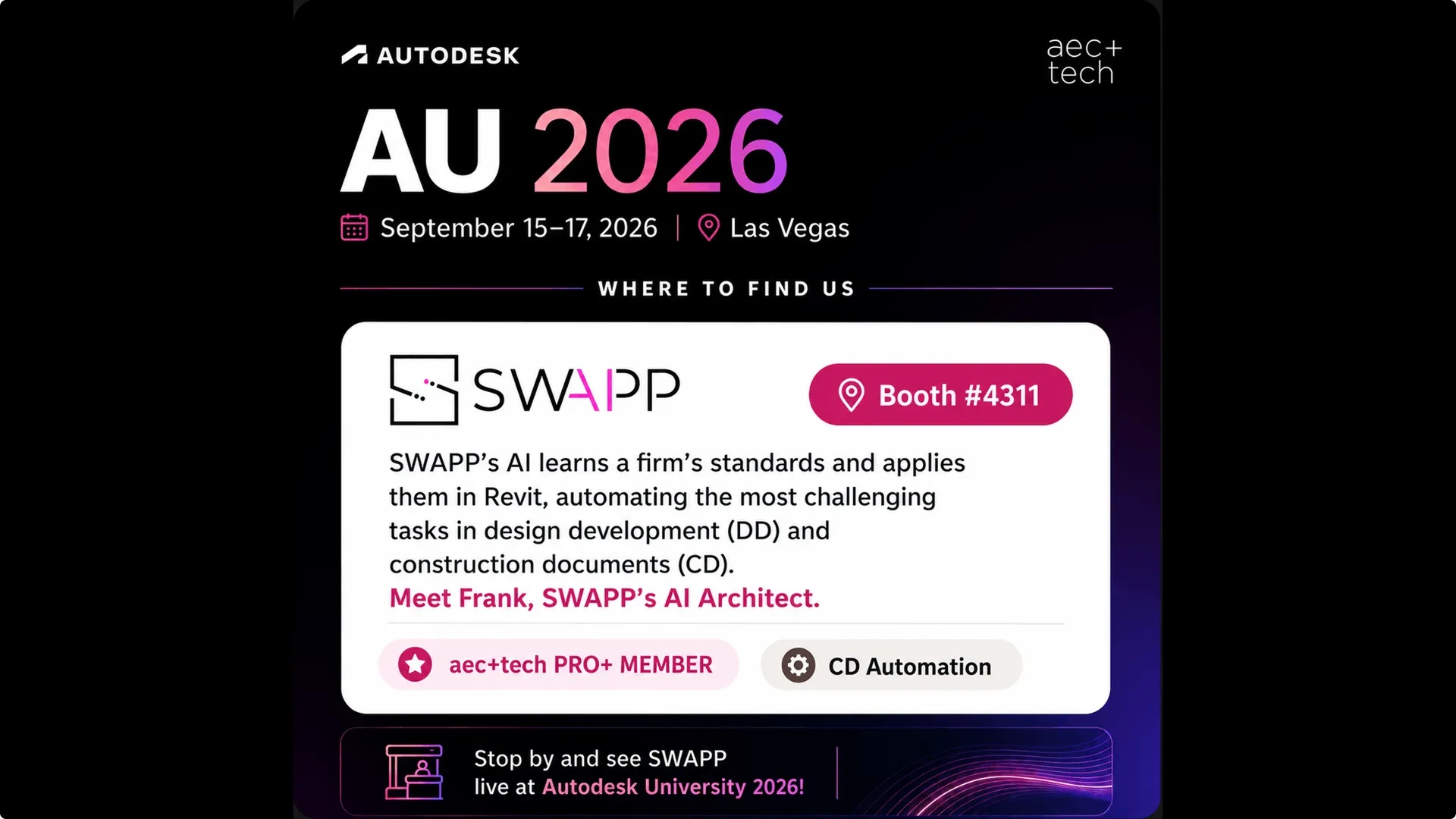
SWAPP will also be exhibiting at Autodesk University 2026. Attendees can meet the team, see the platform in action, and learn more about how firms are using SWAPP to improve documentation workflows and build stronger project-to-project learning systems.
If you haven’t yet, you can click this link to register for AU 2026

CEO and co-founder of SWAPP, Eitan Tsarfati built Frank, an AI Architect that works inside Revit and learns how a firm actually draws from its finished projects. In this conversation, he makes the case that the real value of AI in architecture is memory, and that the firms accumulating it now will have a lead a competitor cannot buy.
Recent Articles
Learn about the latest architecture software, engineering automation tools, & construction technologies