Archiboost AI Is Rethinking How AEC Teams Handle Code, Knowledge, and QA/QC
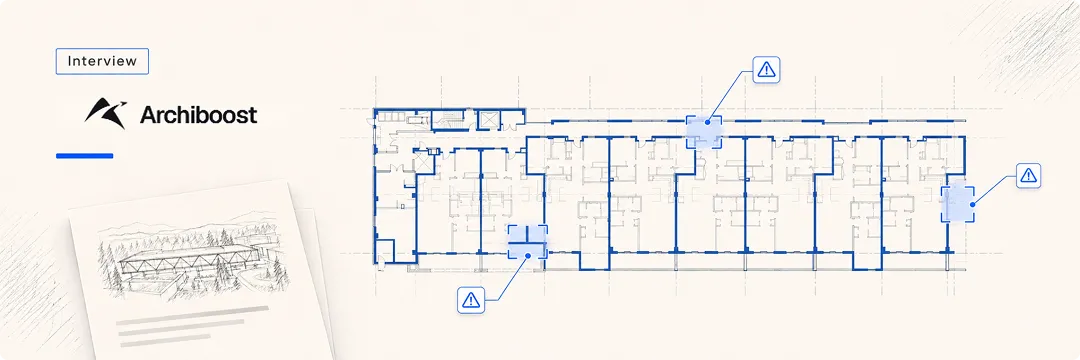
Architecture, engineering, and construction (AEC) teams do some of their hardest work after the design is developed: checking that drawings are coordinated, requirements are met, and documents are complete enough to build. Large drawing sets are still reviewed sheet by sheet, and missed issues can lead to requests for information (RFIs), change orders, rework, permitting delays, and added cost.
Archiboost is an AI platform for quality assurance and quality control (QA/QC) plan review, code compliance, and technical project intelligence. Its tools cover automated QA/QC, code research, a detail library, firm data, and a construction administration assistant.
This article is based on our conversation with Georgios Kontominas, AIA, NCARB, ARB, TEE-TCG, Co-founder and CEO of Archiboost. We asked about the company’s founding story, how its products work together, code compliance, firm knowledge, QA/QC workflows, and what its new funding means for the roadmap.
The Problem and the Platform
Q1: What was the founding story behind Archiboost, and what specific problem in AEC practice led to building it?
Archiboost grew out of the combination of two kinds of experience. Before starting the company, I spent years working as an architect at SOM and WRNS Studio, on projects ranging from housing and higher education to large office developments. Vasu had been building AI and software systems at high-growth startups, including as a founding engineer at Nooks AI. We understood both how buildings are delivered and how to build software that can scale.
In practice, some of the most difficult work happens after the design is developed: checking whether drawings are coordinated, requirements are met, and the documents are complete enough to build. Teams still review large sets sheet by sheet, cross-reference drawings and specifications, and track down applicable codes and project standards. Missed issues can lead to RFIs, change orders, rework, permitting delays, and added cost.
We had both experienced these workflows firsthand. The problem wasn’t that teams lacked expertise; it was that applying that expertise consistently across a growing body of project information is difficult. We saw an opportunity to build an intelligence layer that could understand drawings, BIM models, specifications, schedules, and codes together, and help teams validate and coordinate projects. That became Archiboost: an AI platform for QA/QC plan review, code compliance, and technical project intelligence.
"The problem wasn’t that teams lacked expertise; it was that applying that expertise consistently across a growing body of project information is difficult."

Q2: Archiboost combines many capabilities - QA/QC, Project Copilot, Detail Library, Firm Data and Construction Administration Assistant into a single platform. Why did you choose to bundle these rather than focus on one, and how do they work together in practice?
We chose to bring these capabilities together because project teams already move between drawings, specifications, firm standards, and codes to answer the same underlying questions: Does this work, does it meet the requirements, and have we documented it clearly? In practice, those sources are connected, even when the software used to manage them is not.
For example, if a review identifies a conflict between a wall condition and a project requirement, the team should be able to see the affected drawings, understand the relevant code or standard, find how the firm has handled similar conditions, and decide how to resolve it. That workflow can draw on QA/QC, code research, and firm knowledge without making the user start over in separate tools.
At a high level, these products work as specialized tools, but they work together across the project lifecycle to level up the quality, accuracy, and completeness of design deliverables.
- Automated QA/QC → Reviews contract documents for compliance, coordination, and constructibility issues and flags errors, omissions, and inconsistencies across drawings, specifications, and standards.
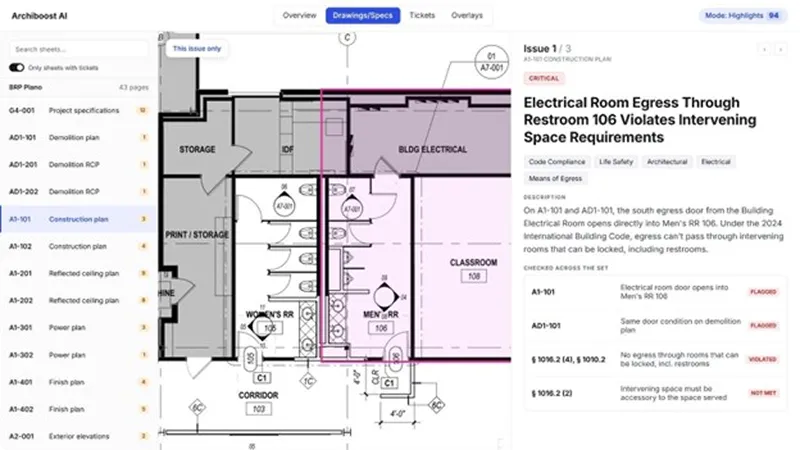
Archiboost flags an electrical room exit that passes through a restroom and lists the code sections it checked. - Project Copilot → Surfaces construction code regulations, jurisdictional requirements, and compliance pathways, while also accounting for project-specific requirements and standards.
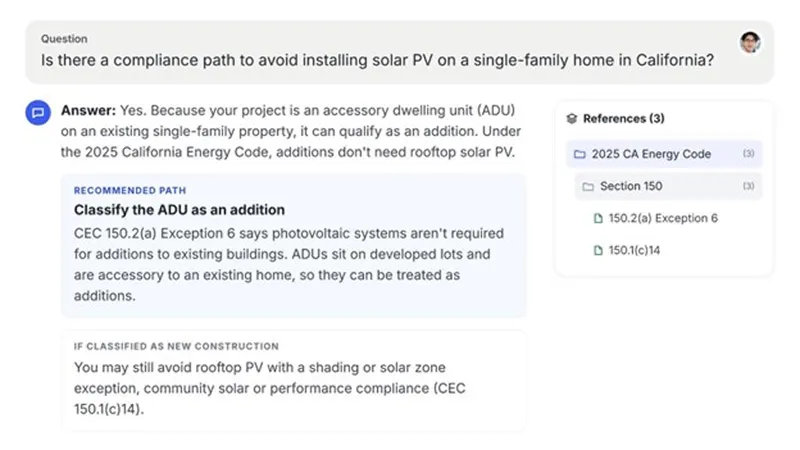
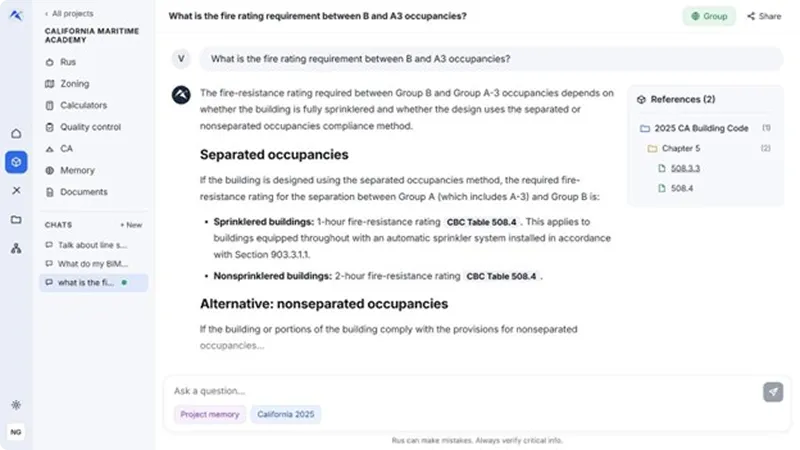
Project Copilot answers a solar PV question for an ADU and cites the 2025 California Energy Code. - Detail Library → Builds an intelligent library of Revit details from older projects, creating a rich resource of real, validated construction details.
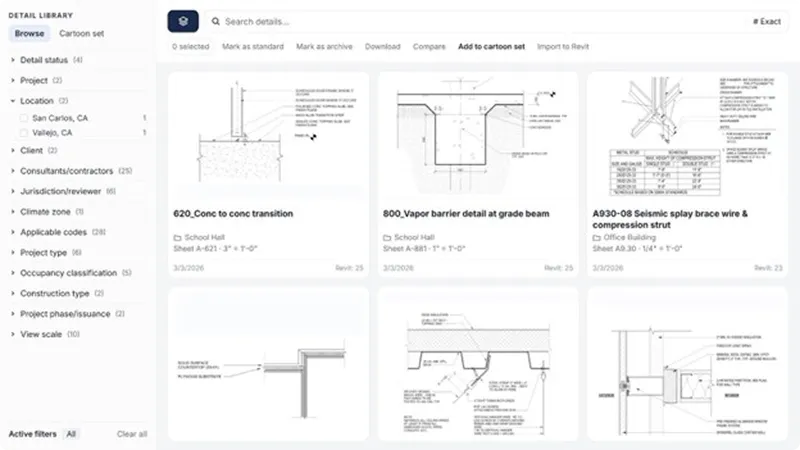
Detail Library lets teams browse past project details and filter them by project, location, code and more. - Firm Data → Leverages institutional knowledge and data to build a business intelligence resource to inform the design and construction process.
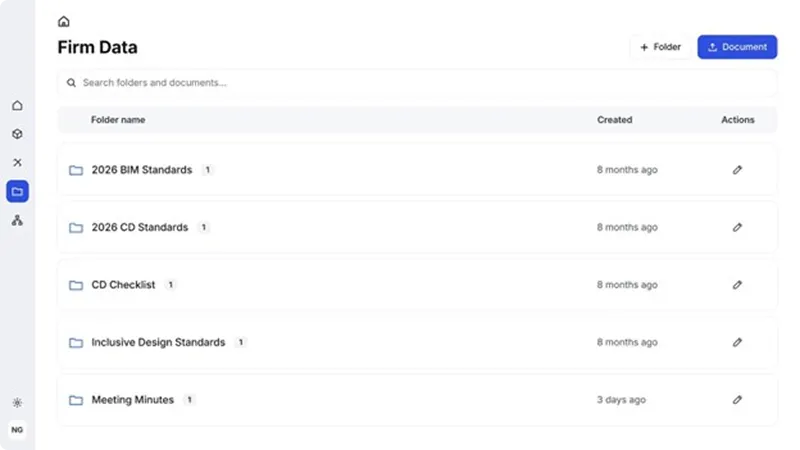
Firm Data keeps a firm’s standards, checklists and meeting minutes in one searchable place. - CA Assistant → Creates a universal inbox for incoming RFIs, submittals, and other project-related documents, checks them against design documents, assigns them to responsible individuals, and generates draft responses.
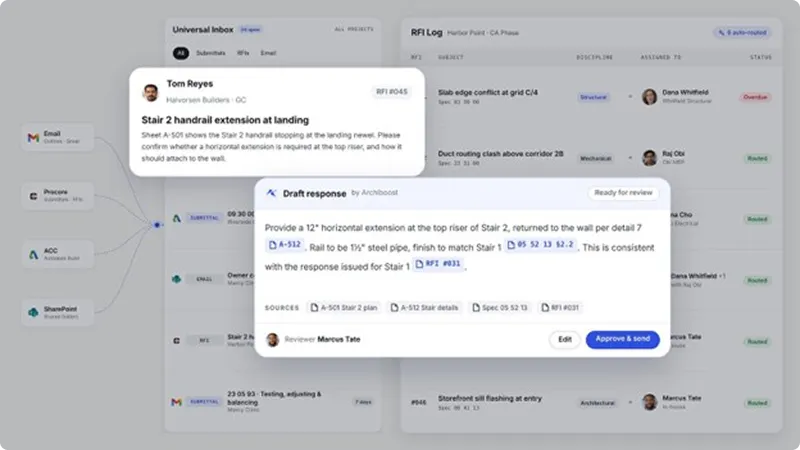
CA Assistant turns an incoming RFI into a draft response with sources, ready for a reviewer to approve.
Our goal is to support a project across design and construction, while keeping each capability useful on its own. As these tools share project context, they can help teams move from finding an issue to understanding its requirements and deciding what to do next.
Code, Knowledge, and QA/QC in Practice
Q3: The code compliance feature sounds like more than a search tool - can you walk us through how it handles jurisdictional hierarchy and project-specific conditions? What does a response actually look like for a user?
Our code compliance agent, “Rus,” was one of the first products we built. We named it after one of the technical architects, code experts, and partners I worked with at WRNS, whom teams relied on for difficult code questions and compliance strategies.
The first version was mainly a retrieval tool: users could search code sections and ask questions. When we showed it to Rus, he told us that finding a section was only part of the work. The harder question was understanding which compliance paths were available for a specific project. That feedback changed our direction.
A code answer depends on more than a general rule. The system needs to account for the governing code and local amendments, along with project conditions such as occupancy, construction type, egress strategy, and project requirements. It also needs to make clear which sources support its answer, so teams can distinguish code requirements from project-specific criteria.
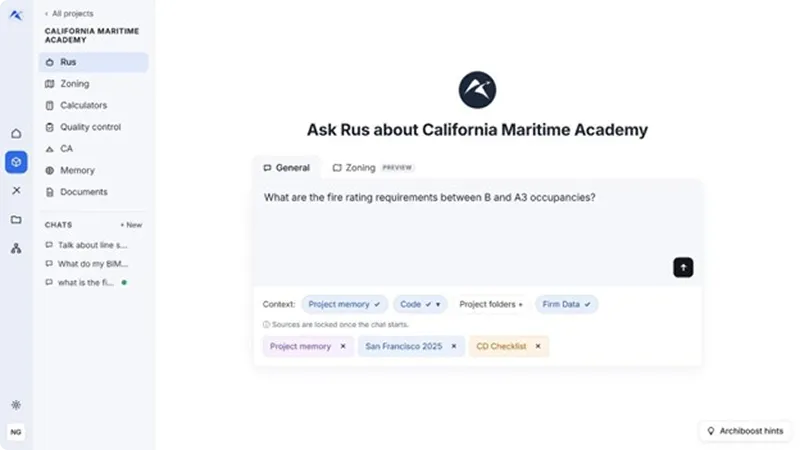
On a WRNS project at the Microsoft Silicon Valley Campus, we tested a later version against a real condition. Instead of returning only a code citation, the platform proposed three possible compliance scenarios. A response should explain the basis for each path, its tradeoffs, and the relevant sources so the project team can evaluate the options.
That’s the distinction we’re working toward: helping technical teams reason through project-specific compliance, not just retrieve code text.
Q4: The Firm Data product is built around the idea of capturing and reusing institutional knowledge. How does a firm actually set that up, and what does it look like once it's working? What kinds of knowledge are hardest to transfer - and has the platform surprised you in how it handles that?
Firms have decades of knowledge spread across past projects, details, markups, specifications, BIM models, standards, and staff experience. Setting up Firm Data starts with bringing relevant project information into one place, such as drawing sets, specifications, detail libraries, standards, client requirements, and QA/QC comments.
The goal is to connect that information so people can search in the language of a design problem. Instead of asking, “Where is that detail from four years ago?” someone might ask, “How have we detailed fiber cement rainscreen slab edges on multifamily projects in California?” The system can return relevant details and their associated sheets, specifications, and project context.
The hardest knowledge to transfer is often judgment: why a senior architect chose one compliance path, why a detail changed during construction administration, or which coordination issues repeatedly lead to RFIs. Much of that knowledge lives in redlines, project records, and people’s experience rather than in a formal standards manual.
What has surprised us is how much useful information can be recovered from those records. When drawing sets, specifications, BIM data, and QA/QC comments are considered together, recurring detailing approaches and coordination risks can become easier to see. We want Firm Data to help firms reuse that knowledge while keeping the source material and context visible.
Q5: The QA/QC review capability analyzes full drawing sets for coordination gaps and compliance risks. What does that process look like from a workflow perspective?
A team starts by uploading a drawing set, specifications, schedules, or other project information and choosing a review milestone, such as design development, construction documents, permit submission, or a pre-issue check. The review is usually initiated by a project architect, technical lead, or QA/QC leader who wants an additional look before a submission or coordination meeting.
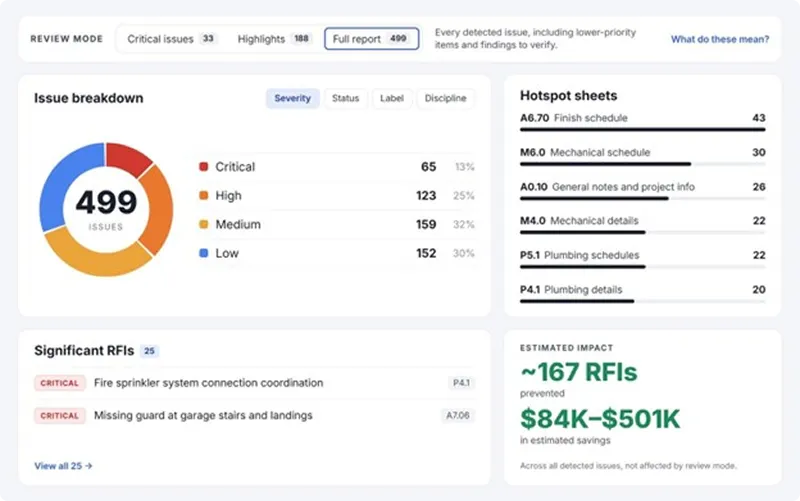
The platform reviews the project across disciplines rather than treating each sheet in isolation. It looks for issues such as code risks, constructability problems, conflicts between architectural, structural, and MEP documents, discrepancies between drawings and specifications, and missing information that could lead to RFIs or permit comments.
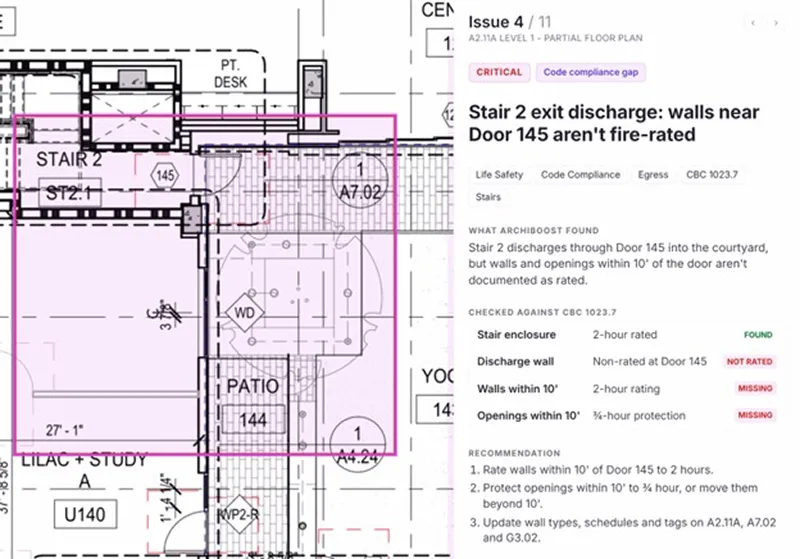
Findings are returned as structured QA/QC tickets tied to the source sheets and views. Each ticket explains the issue, identifies the affected documents, provides supporting references, and suggests a resolution path. For example, a ticket might flag that a wall type on one sheet conflicts with the partition schedule and could fail to maintain the required rating at an exit enclosure.
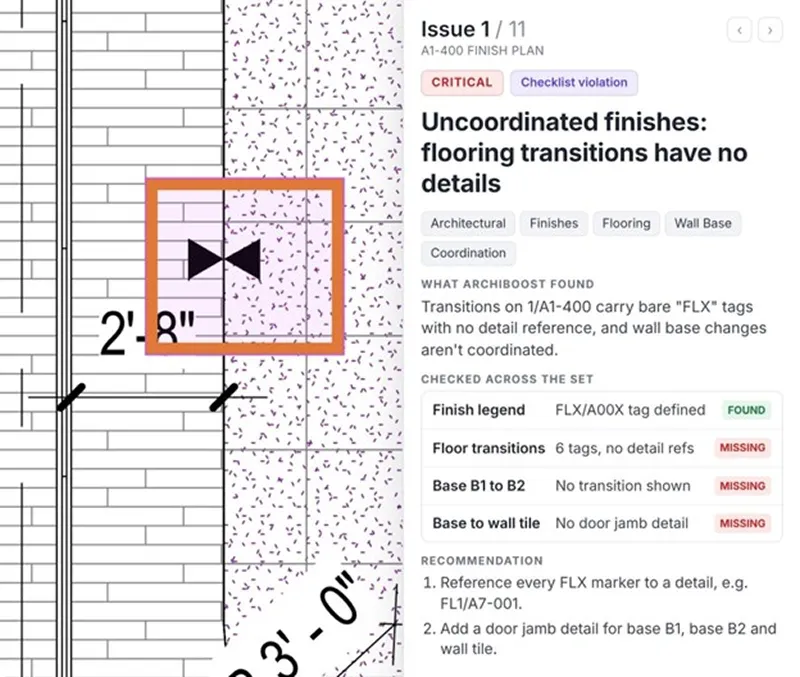
Teams review the findings in the workflow that suits them. Some work through issues in Archiboost; others use the results in Bluebeam, Revit updates, coordination meetings, or internal QA/QC logs. The platform acts as an additional technical reviewer, not a substitute for professional judgment. Its value is in helping teams find and evaluate potential problems earlier, with enough context to verify each finding and decide what action to take.
Q6: Archiboost is positioned as something built by AEC professionals, for AEC professionals and Owners. What does that actually mean for how the product is developed - how does practice experience show up in the product decisions that a generic AI company wouldn't have made?
Our practice experience shaped the product around the way technical teams actually review and coordinate projects. A generic document chatbot can answer questions about a sheet, but project delivery often depends on connecting information across sheets, disciplines, specifications, and requirements.
That changes what the product needs to do. A finding should point back to the documents that support it, explain why it matters, and give the team enough context to verify it. It should also make it easier to prioritize the issues that need attention. Those choices reflect how architects and engineers work: they need traceable information they can discuss with colleagues and use to make a decision.
The difficult cases are often the ones that only emerge across documents: a wall type that conflicts with an adjacent condition, a dimension that creates a coordination problem, or a local interpretation that changes the compliance path. We focus on cross-referencing and verification because a plausible answer is not enough in a high-stakes workflow.
That is what we mean by being built by AEC professionals. We start from the decisions project teams have to make, then build tools that help them review evidence, understand the issue, and apply their own judgment. The technology matters, but trust comes from making the reasoning and source material visible to practitioners.
"We focus on cross-referencing and verification because a plausible answer is not enough in a high-stakes workflow."
Q7: Where is Archiboost headed? What does the platform need to become to fulfill its long-term vision, and what are the biggest remaining gaps between where it is today and where you want it to be?
Today, Archiboost helps teams detect coordination issues, documentation gaps, code risks, and constructability problems. Over time, we want to help teams anticipate the effects of decisions before they become expensive problems.
Imagine moving a wall in a BIM model and seeing how that change could affect egress, MEP coordination, permitting, cost, or schedule. An architect could compare compliance paths; an owner could understand likely cost and schedule impacts before approving a scope change; and a contractor could see coordination risks earlier.
To support that, the platform needs to understand the relationships between design decisions, drawings, BIM models, codes, specifications, project requirements, and outcomes. Much of that information is still fragmented across files and systems, and some of the reasoning behind decisions is never formally recorded. Connecting those sources in a reliable, traceable way is a major gap we are working to close.
The long-term goal is to help project teams make better-informed decisions throughout design and construction, with a clearer view of how a change in one place affects the rest of the project.
The Raise: Why Now
Q8: What made now the right time to raise, and what did investors see in Archiboost?
We raised after customer use showed that the need was real, not just something firms discussed in interviews. Since launch, Archiboost has reviewed more than 550,000 drawing sheets across projects valued at over $3.5 billion. That experience showed us that teams will use AI in a high-stakes workflow when findings are grounded in project documents and can be checked by professionals.

Investors saw early customer traction, a team with experience in both AEC and AI, and an opportunity beyond document review. Connecting drawings, specifications, codes, owner requirements, and project decisions could help teams understand how changes affect the rest of the project. The funding gives us room to strengthen the workflows customers use today and build toward that broader opportunity.
"Since launch, Archiboost has reviewed more than 550,000 drawing sheets across projects valued at over $3.5 billion."
Q9: How will the new funding shape your roadmap and team over the next 12 to 18 months?
Over the next 12 to 18 months, we’ll continue improving drawing QA/QC and code research while developing our Construction Administration Agent. We’re also connecting information across drawings, BIM models, specifications, requirements, RFIs, and submittals so teams can understand project context across those workflows.
A major area of work is spatial reasoning and change-impact analysis: helping teams see how a design change affects related requirements and decisions across the project. We’ll continue expanding the team across architecture, engineering, construction, and real estate, and stay close to practitioners as we build. Our focus is to make the findings traceable and useful enough for professionals to verify and act on.
The aec+tech Takeaway
Archiboost treats drawings, specifications, codes, and firm knowledge as connected sources, so a finding can lead from the affected documents to the relevant requirement and to how the firm handled similar conditions. Its findings point back to the supporting documents and are meant as input for professional judgment, so teams can verify each one before acting. With new funding, the team plans to keep improving drawing QA/QC and code research while building a construction administration agent and change-impact analysis.
Learn more about Archiboost AI on its aec+tech page and at archiboost.ai, and explore more emerging AEC technology on aec+tech.

Recent Articles
Learn about the latest architecture software, engineering automation tools, & construction technologies