
How DGA Used Ichi’s Agentic AI to Rethink Code Compliance

We sat down with Chinmayi Suri, Architectural Designer at DGA, and Brandon Levey, Founder and CEO of Ichi, to learn how the two are working at the intersection of architecture and AI to tackle some of the profession's most time-consuming pain points: building code compliance, QA/QC, and the institutional knowledge that disappears when senior staff retire.
On a recent corporate laboratory project, the team at DGA, a Bay Area architecture firm specializing in life sciences and advanced manufacturing facilities, hit a familiar wall. Their mechanical scope carried a $250,000 line item for fire dampers, and the client wanted that cost justified before signing off. The architects suspected the dampers were not actually required by code for this specific occupancy and assembly configuration, but confirming it the usual way meant setting up a meeting, a senior architect pulling code books, cross-referencing amendments, and chasing answers across the firm. On a project already under deadline pressure, the budget question was at risk of being closed out without ever being properly answered.
Instead, they ran the question through Ichi, an AI platform built specifically for navigating building code complexity. Within seconds they had a cited answer from the code confirming the dampers were not required. The line item came out. The client saved $250,000.
While this is a relatively small sum for highly complex projects, this is just a single example and without that quick verification, the money would not have stayed in the project. It would have come out of finishes, or contingency, or somewhere else the team would rather not have touched. That is the part worth paying attention to. Code research used to be a slow, senior-architect-only task that often gets skipped or rushed under deadline pressure. When it stops being slow, it starts shaping budgets in real time.
How Manual Code Work Is Costing You
Code compliance is one of those parts of architectural practice that almost no one celebrates. It is also one of the most expensive parts of the job, in hours if not always in dollars.
Chinmayi Suri, an architectural designer at DGA, works on cGMP pharmaceutical, life science, and manufacturing facilities that often run past 100,000 square feet and carry layered regulatory requirements. She describes the existing process bluntly. Navigating ADA, fire codes, and industry-specific regulations falls on the most senior architects, the ones who have memorized chunks of code over years of repetition. It is institutional knowledge stored in human heads, queried one Slack message or in-person conversation at a time.
That creates two problems. The first is throughput. Senior staff become the bottleneck on every code question, which pulls them away from the design work they were hired to do. The second is timing. Code checking traditionally happens after the design is mostly finished, so compliance issues surface late, when changes are expensive and the schedule is already tight.
"This stemmed from frustration really. I was sitting on my computer saying this should not take so long, and that's kind of actually where this all started." — Chinmayi Suri, DGA
Her original interest in AI tools came out of that frustration, not out of any particular enthusiasm for AI as a concept.
Why Generic AI Tools Fall Short
The obvious question for any architect frustrated with code research is: Can’t ChatGPT do the job? The answer, so far, has been no, and the reasons are useful to understand.
Brandon Levey, founder and CEO of Ichi, comes from a 20-year tech background that includes work at a Department of Energy national lab and running R&D teams at Square. He grew up in his father's HVAC and sheet metal business, which is partly why he ended up building software for AEC. He breaks the gap down into three things.
Accuracy on compliance codes has to be very high. Architects stamp their drawings, and a model that produces plausible-sounding language without citing the exact code section is worse than no answer at all. The documents themselves are also unusually large. A spec package can run 6,000 pages. A jurisdiction comment letter can run 60 pages with 300 individual items. General-purpose tools are not built to parse and cross-reference at that scale with any reliability. And, the answers always depend on the context that lives inside the firm: what counts as a standard detail, which assemblies the client has used before, what the senior architect on this project type would flag.
Chinmayi put it more directly. Generic AI tools require the user to already have deep domain knowledge to know what to ask and to verify what comes back. That defeats the purpose. The point of an AI assistant for code work is to lower the barrier, not require an expert to operate it.
What Agentic Actually Means Here
Ichi's product is built around what Brandon calls an agentic approach. The term gets used loosely, so it is worth being specific.
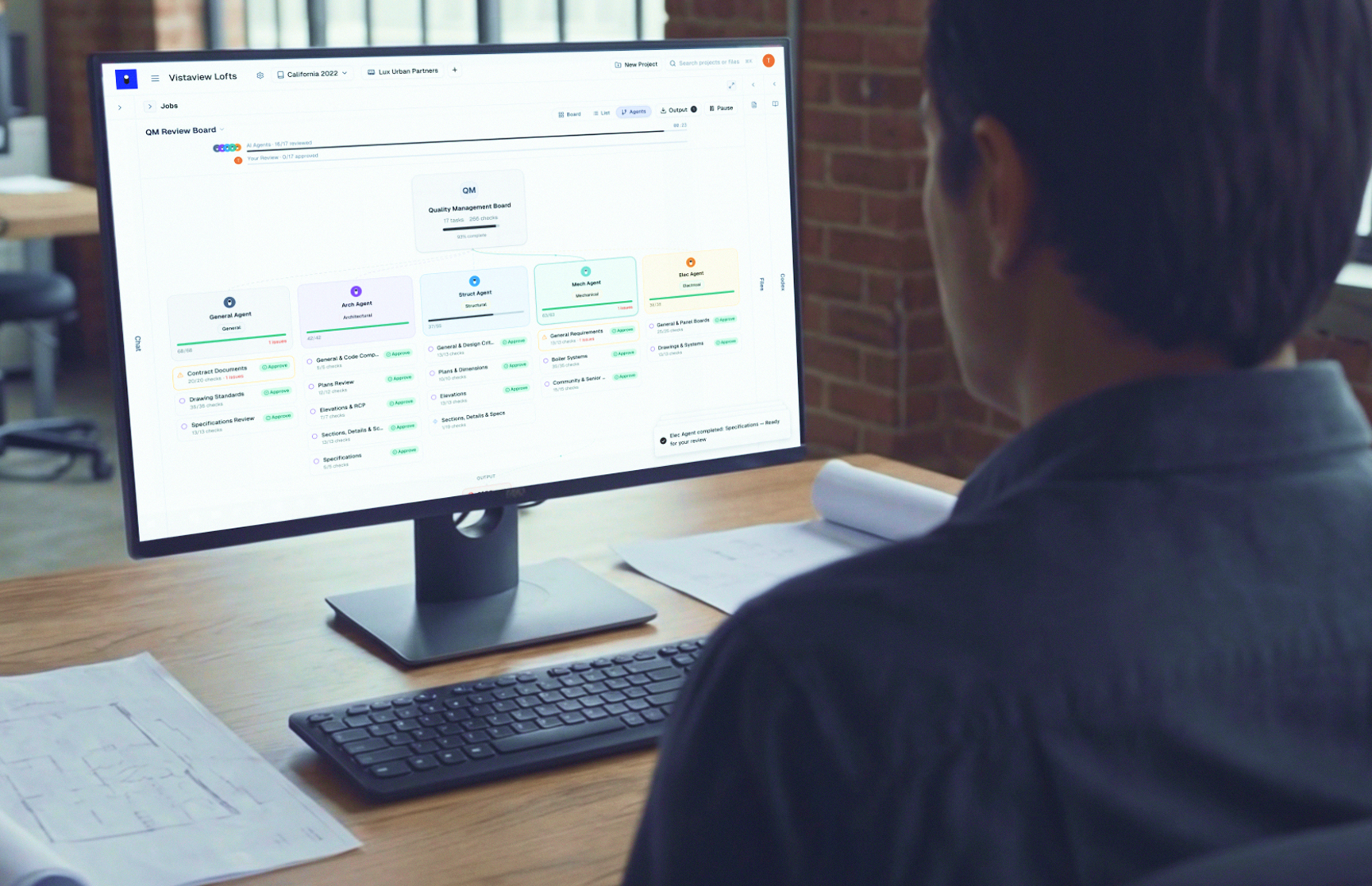
In Ichi's case it means that when users ask Ichi a question they aren’t interacting with a single LLM, but rather many different agents that are specialized in specific tasks. This approach helps the platform guide users when they do not know exactly what to ask,check its own work, and complete longer, more complex tasks.
A simple example. An architect asks a question about an auditorium in California. A generic chatbot returns a generic answer. Ichi instead asks clarifying questions about occupancy load and square footage, because those variables fundamentally change which code sections apply. That guided flow matters in code work, where a wrong assumption upstream invalidates everything downstream.
The error-checking piece is more technical but arguably more important.
"Any type of long-running or long horizon task in AI is going to have errors in it. The way that we evolve through that, a lot of the agentic approaches are by using multiple AI agents to check its work." — Brandon Levey, founder and CEO, Ichi
In practice that means when Ichi pulls code references from a 60-page comment letter or runs a feasibility study, separate agents are reviewing the output for inconsistencies and gaps before the architect sees it. That internal cross-check is what makes the difference between a curiosity and something architects will actually put their name on.
Want to hear the full discussion? Watch the complete panel conversation with Chinmayi Suri and Brandon Levey on YouTube.
Reducing the Work Architects Enjoy Least
The most concrete value Ichi delivers shows up in the workflows least enjoyed by architects.
Comment letters are the clearest case. When a jurisdiction returns a plan check, the architect's first job is translation: turning a long PDF into a structured spreadsheet that maps each comment to the relevant code reference, assigns it to the right consultant, and drafts an initial response. Brandon described one user who spent five to eight hours turning a 60-page letter with 300 comments into a workable spreadsheet. With Ichi, that drops to around 20 minutes.
Feasibility and zoning studies follow a similar pattern. A study that previously took two to four hours of senior staff time becomes a 20-minute guided workflow, producing an exportable document with code references already in place.
On the documentation side, the savings come less from automation than from triage. Chinmayi pointed to 700-page document sets where the real value is having AI do the first pass, locating where specific notes or drawing discrepancies live. The architect still verifies and decides. They just no longer have to read every line to find the three that matter.
The work that consumes the most time in an architecture firm is rarely the work that draws people into the profession. Cutting hours out of that work is where most firms will see the first real return.
Capturing the Knowledge Before It Walks Out the Door
One of the more interesting features in Ichi is what the platform calls Memory. It captures the institutional knowledge of senior staff, the kind of judgment and pattern recognition that takes decades to build and tends to leave the firm when those people retire.
Chinmayi described how the idea took shape at DGA.
"I wish we could put Mark Davis into a notebook LLM." — Chinmayi Suri, on DGA principal Mark Davis
The line is partly a joke about a specific colleague, but it captures something the AEC industry has struggled with for a long time. Knowledge transfer from senior to junior staff is mostly accidental, dependent on proximity, mentorship, and time.
Memory works by ingesting organizational standards, past project notes, and client specifications so the AI's answers reflect the firm's actual way of working, not a generic best practice. DGA has started using it as a training tool, exposing younger architects not just to answers but to the prompts and reasoning senior staff use to get there. The platform already syncs directly with OneDrive and soon will with Google Drive, removing another friction point for firms with messy document storage.
This is also where the security question gets practical. Ichi does not train its models on customer data. For firms handling sensitive client information, particularly in life sciences or government work, that distinction is the difference between adoption and a hard no from legal.
The Barriers Are Real, but Shrinking
Adoption is rarely about whether a tool works. It is about whether a firm can afford the time to find out.
Chinmayi named three barriers: time, trust, and security. Time, because evaluating new software is itself a senior-staff task that competes with billable work. Trust, because architects are personally liable for what they sign. Security, because client data cannot be pasted into a public chatbot.
The trust question tends to dissolve through small wins. Firms that successfully adopt AI usually start with a single project, often a smaller one, and prove the tool against a known answer. Once the output matches what a senior architect would have produced, the conversation shifts from whether the tool is reliable to which workflow it should touch next.
The fear of replacement also fades quickly once people actually use the tools. The intelligent part of the work, as Chinmayi pointed out, still comes from the humans using it. AI takes the repetitive parts. It does not make decisions, and it does not stamp drawings.
The New Baseline
The shift Brandon describes has happened fast. In 2024, the conversation in architecture was still about whether AI was real. By late 2025 it had moved to how to implement it. Firms are now being asked in client interviews and RFP responses what their AI strategy is. Within the next year, not having a clear answer will start to count against firms competing for work.
Chinmayi frames it in the only terms that really matter to working architects.
"You have to start using it. We have to start thinking about using it in our workflow. It is going to become as prevalent to us at some point as Revit is." — Chinmayi Suri, DGA
The shift from hand drafting to CAD took roughly a decade. CAD to BIM took another. Each one looked optional at the start and obvious by the end. The shift now underway, from manual code research to agentic compliance tools, is following the same curve.
Firms picking up the tools now are buying themselves time to figure out how to use them well before that becomes a job requirement rather than a competitive edge.

Editor's Note
This article is based on an aec+tech Expert Talk, Navigating Code Complexity with AI, featuring Chinmayi Suri of DGA Architects and Brandon Levey of Ichi. The conversation explored why building code review remains one of the most manual and time consuming parts of architectural practice, and how AI can help project teams navigate code requirements, reduce repetitive review work, and make more informed design decisions.
Learn more on Ichi’s product page: https://www.aecplustech.com/tools/ichi
Watch the full conversation here: https://www.youtube.com/watch?v=rsm_sSv2urI&t=168s
Recent Articles
Learn about the latest architecture software, engineering automation tools, & construction technologies