The VIKTOR App Builder: Putting Automation into Every Engineer's Hands

- The VIKTOR platform is built by engineers, for engineers.
- Direct integrations with the tools you actually use (Revit, PLAXIS, Rhino, SCIA, etc.).
- Versioning, testing, and audit trails built in.
- Security and compliance from day one.
Short answer: anything from quick calculators to governed, shareable workflows—without waiting on scarce developer time.
Typical use cases
-
Structural: build load/sizing calculators; rapid code checks.
-
Geotechnical: automate design checks and reporting (e.g., PLAXIS post-processing).
-
Mechanical: create product/configuration tools and parametric selectors.
-
Environmental: run scenario analyses and generate standardized reports.
Concrete example—turn analysis into a web app
Turn a recurring data-analysis task into a browser app: upload measurement or simulation data (e.g., an Excel file), run calculations, and instantly produce plots and a PDF report for teammates. For instance, to read acceleration data from Excel, you’d specify the expected column names once; the App Builder handles parsing, validation, and output each time.
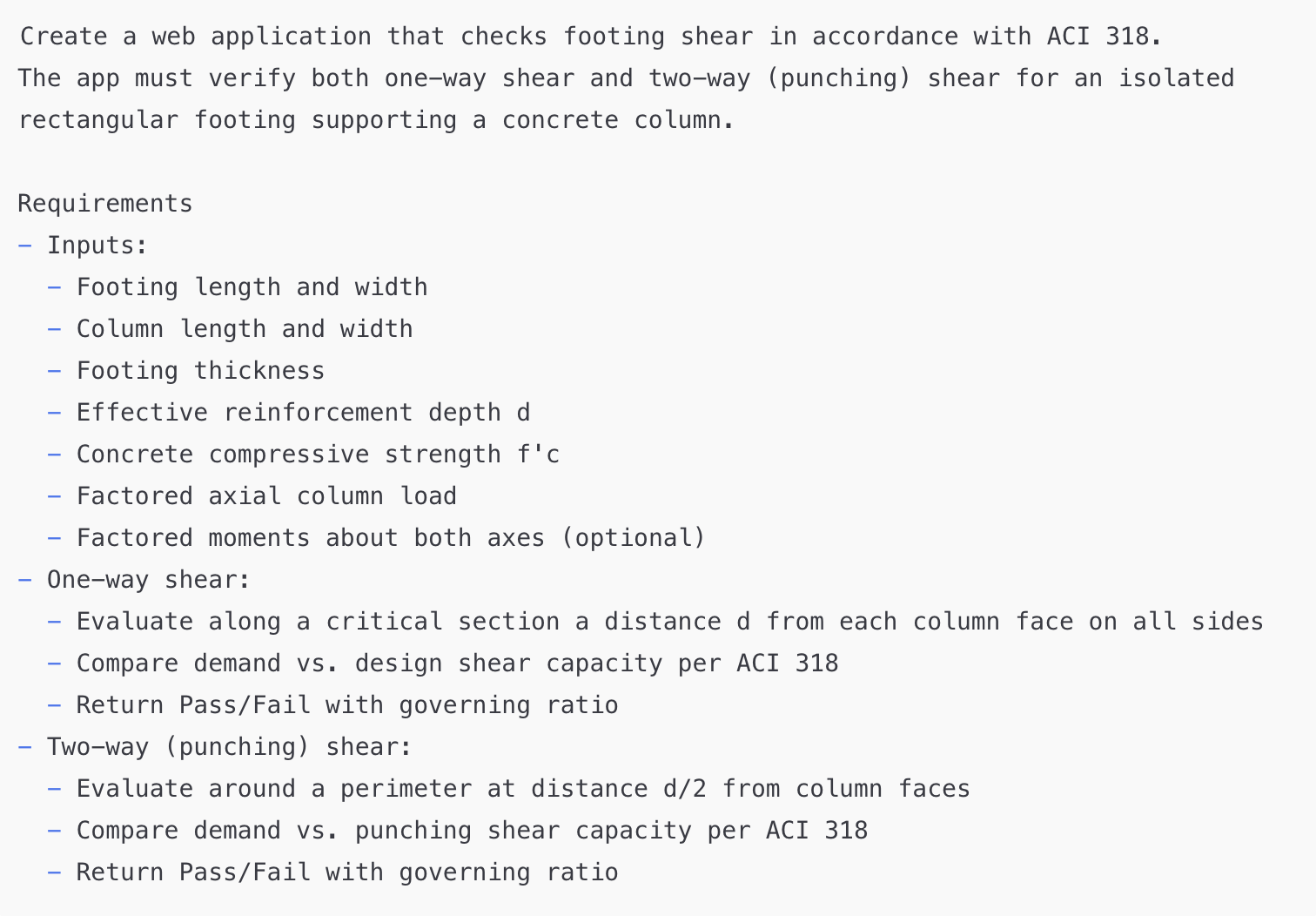
Prompt example (engineering check)
Previously these tasks required weeks of IT support. Now they can be done in hours or days.
Want to see more real-world examples and join a live Q&A? Sign up for our launch event on October 28th
8) Can you share a real-world use case of the App Builder?
For example, at KBR, engineers have created everything from simple unit converters to advanced apps automating complex processes. These apps eliminate repetitive, error-prone tasks and make sophisticated workflows accessible to entire teams. KBR even runs workshops to spread the App Builder across their organization.
9) How does this fit into VIKTOR’s vision of AI in engineering?
Our vision is simple: app-building should be part of every engineer’s work. AI should help them move faster in a transparent, secure, and compliant way. The App Builder is the foundation of this vision: a place where engineers use their domain knowledge to create solutions, supported by AI and governed by enterprise standards.
10) What’s next?
We’re making app-building even faster with deeper AI assistance. Not just generating code but also testing and validating apps. More integrations are coming, and AI will increasingly become a transparent, reliable partner in everyday engineering practice.
11) How can engineers get started?
The easiest way is to experiment directly on the VIKTOR platform and just try to build a small app first. At the end of October, we’re also hosting a live webinar where engineers can see the App Builder in action, explore real-world applications, and even try building themselves.
App-building is no longer limited to IT or coders. Every engineer can now create, share, and improve their own workflows with the freedom to innovate, and the enterprise-level control to ensure security and quality!
Ready to give it a try yourself? Start building with the App Builder right now!
Recent Articles
Learn about the latest architecture software, engineering automation tools, & construction technologies