From Code Books to Computable Compliance: How Kestrel Labs Is Rewiring Building Design
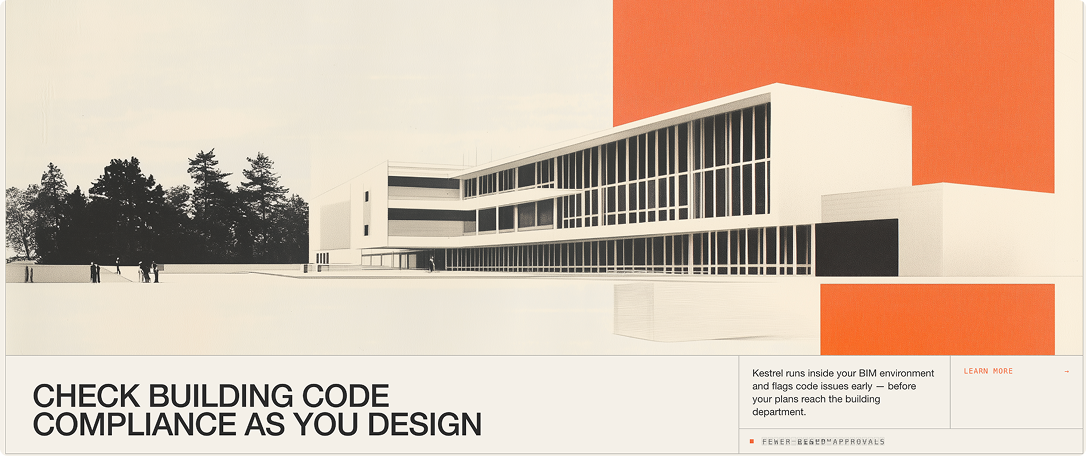
Building code compliance is a tough and time-consuming part of being an architect. Architects spend a lot of hours trying to understand rules checking and rechecking requirements and manually looking for potential problems in designs. As projects get tougher and it’s hard to find code experts it's clear that we need a better way to do things.
Kestrel Labs talks about making building codes something that computers can understand. They want to turn regulatory language into something that machines can read and evaluate within Building Information Modeling (BIM) workflows. The conversation is about how artificial intelligence can help understand code requirements find compliance issues and give architects clear explanations that are tied to specific code sections.
Kestrel thinks that compliance shouldn't be something you only think about before submitting a permit. Instead, it should be part of the design process from the start. By giving architects feedback in time within the tools they already use the platform wants to reduce rework make projects turn out better and let designers have more time, for the creative and human parts of architecture.
1. What made you think that building code compliance was a problem that needed to be solved with Artificial Intelligence?
We didn't start with AI. We started with a problem that every architect knows and feels.
Manual code compliance checks are the part of the job that nobody wants to do and everybody has to. Architects hate it. It's slow, it's fragmented, and it pulls you away from the work you actually became an architect to do. And the time to do it properly is disappearing.
Senior architects built up code knowledge over decades. They know the IBC the way a good lawyer knows case law — not from reading it cover to cover, but from years of applying it on real projects. That knowledge is valuable. And it's walking out the door. Firms are watching their most experienced people approach retirement, and there's no clean way to transfer what's in their heads. You can't put it in a manual. You can't train a junior architect in two weeks.
The other side of that problem is the junior architects themselves. They're immediately billable after their internship. There's no runway for code mentorship. They're expected to perform from day one with none of the experience that made code compliance manageable for the generation ahead of them.
That's not a technology problem. That's a profession-in-crisis problem. And once we saw it clearly, the question became: is there a way to make that code knowledge portable, always current, and always available inside the model where architects are already working? AI turned out to be the right answer to that question — not the starting point.
2. Kestrel is talking about making building code computable. What does that mean and why is it important for the future of Architecture, Engineering and Construction?
Building codes are written in legal language for human readers. They say things like "means of egress shall be provided from every occupied portion of the building" or "accessible routes shall have a minimum clear width of 36 inches." Those sentences mean something very specific in context, but a computer can't evaluate them against a 3D model. There's no shared language between the code book and the building model.
Making code computable means building that translation layer. Taking legal text and turning it into executable logic that can read a model and return a precise, auditable answer: does this door swing comply with IBC 1010.1.2.1, yes or no, and here is exactly why.
Why that matters for AEC is really about timing. For many firms, compliance is still a gate at the end of design. You finish the drawings, you submit, and you find out weeks later what you got wrong. Sometimes it's minor. Sometimes it means reworking a floor plate or rethinking an egress sequence you thought was settled, at a point in the project when changes don't just cost time — they cost fees the firm has already spent.
When code is computable and lives inside the model, compliance becomes a condition of design rather than a verdict on it. The architect finds out while changes are still cheap, not after submission. And that changes what first-pass permit submission looks like for building departments trying to manage real backlogs.
That's a structural shift in how buildings get designed and reviewed. Not a feature. A different way of working. Trimble Connect integration is live today, and SketchUp support is coming soon — so this isn't just a Revit story. It's a BIM-wide story.
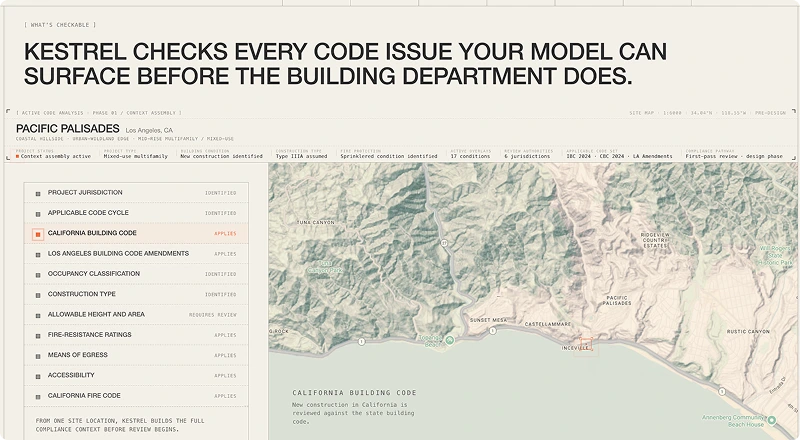
Kestrel assembles project context and applicable codes before running compliance checks.
3. The building codes are really complex. They have a lot of legal language in them. How does Kestrel take these building codes and turn them into something that a machine can understand and use inside Building Information Models?
This is the part that's genuinely hard, and we want to be honest about that rather than make it sound like a solved problem.
Building codes aren't a single document. They're a system. You have the International Building Code, the International Energy Conservation Code, NFPA 101, and then every jurisdiction that adopts those codes and amends them locally. Denver doesn't have the same requirements as Chicago, or Los Angeles, or a rural county in West Virginia. A hospital has different occupancy requirements than a multifamily building. Code is always contextual, and that context changes constantly.
Our data agreement with the International Code Council was important for exactly this reason. ICC gave us direct access to official code content, local amendments, and the interpretive history behind provisions that aren't always self-explanatory on the page. When ICC makes an update, Kestrel gets an update.
The technical approach combines AI-generated logic with deterministic evaluation. The AI does the work of understanding what a code provision requires — accounting for building type, occupancy, jurisdiction, and all the contextual factors that determine which version of a rule applies. The check it runs against the model is precise. We're not asking the system to estimate whether your corridor is compliant. We're asking it to measure the corridor and compare that measurement to a specific, traceable requirement. Those are two different things, and keeping them separate is what makes the output auditable and defensible.
It's painfully important work. We want to take the pain out of it.
4. Artificial Intelligence is a big part of your platform. How does it compare to other systems that are based on rules?
Compliance tools that work outside the model — checking static PDFs after the design is done — run into the same wall every time. They can match a document against a fixed set of conditions, but building codes aren't a fixed set of conditions.
Building codes change every three years at the model code level, and local amendments layer on top of that continuously. Writing and maintaining a rule for every provision, in every jurisdiction, for every project type, is a manual effort that can't keep pace with that reality. We've seen what happens when that approach runs up against the complexity of real projects. The checklist breaks down at the edge cases. And in building code, edge cases are the norm, not the exception.
The way we think about the difference: a rules-based system tells you whether something matches a condition it was pre-programmed to look for. Kestrel reasons through what the code actually requires, accounts for your project type, occupancy, and jurisdiction, and evaluates the design against that. The answer that comes back is precise and repeatable, cited to the specific code section.
Not a guess. Not a suggestion. A traceable result you can stand behind.
5. When it comes to code compliance the stakes are really high. So how do you make sure Artificial Intelligence does not make mistakes or misinterpret things?
This is the right question, and we take it seriously.
Code compliance is actually a domain where AI can be more reliable than people generally assume, because so much of it isn't judgment. It's fact. An egress path is either wide enough or it isn't. A bathroom clearance either works or it doesn't. Those aren't design opinions. They're geometric and dimensional facts that can be measured precisely against a specific standard.
Where AI becomes genuinely risky is when its making judgment calls in ambiguous situations and presenting them as definitive answers. Kestrel is not doing that. When Kestrel flags an issue, it cites the specific code section, identifies the exact element in the model, and shows the specific measurement or condition that triggered the flag. An architect can audit every result the system returns. That transparency is built into the architecture of how it works.
We also have to be honest about scope. Every compliance report Kestrel produces includes a statement of what was checked. What Kestrel covers in 2026 is not the same as what it will cover in 2028. Firms need to know the boundaries and maintain review for areas that aren't covered yet. That's not a limitation we're hiding. It's part of how we think about professional responsibility.
Kestrel doesn't replace the licensed architect's judgment. It makes sure that judgment gets applied where it actually matters — not on the parts of the job where a precise, traceable calculation will do the job better.
6. The Architecture, Engineering and Construction industry has been using Building Information Models for a while now. They still have a hard time with manual workflows for compliance. Why do you think that is?
BIM tools were built to model buildings, not to know the rules that govern them. That's not a criticism of Autodesk or Revit or any of those platforms. Revit is extraordinary at capturing geometry, coordinating information across disciplines, and managing a project through its full lifecycle. That's what it was designed to do.
What Revit has never known is what the International Building Code says about the building you're drawing. Those have always been two separate worlds: the model and the code book. Architects figured out workarounds. Senior staff who've been doing this long enough to carry code provisions in their heads. Code consultants. Pre-application meetings with the building department. Internal checklists that get updated when someone catches something the old checklist missed.
None of those solutions live inside the model. They all require stepping outside the design environment, doing the check somewhere else, and hoping the translation back into the model is accurate. That's where things fall apart. That's where rework starts. And that's where margins get burned on billable hours, issues get missed, and the firm absorbs costs it can't bill back.
Today, Kestrel is the only platform that works inside BIM. Not adjacent to it. Not checking a PDF export. Inside the live BIM environment, where the design decisions are being made. The reason manual compliance has persisted isn't that the industry hasn't tried to solve it. It's that no one has built the bridge between the code as written and the model as designed in a way that's reliable enough to trust on actual projects.
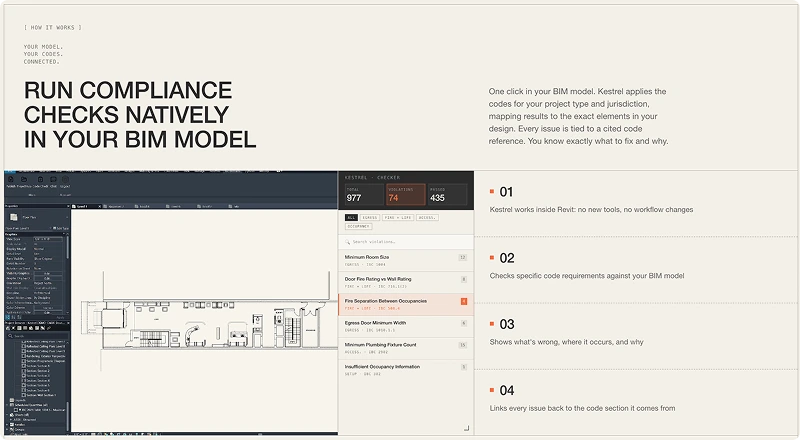
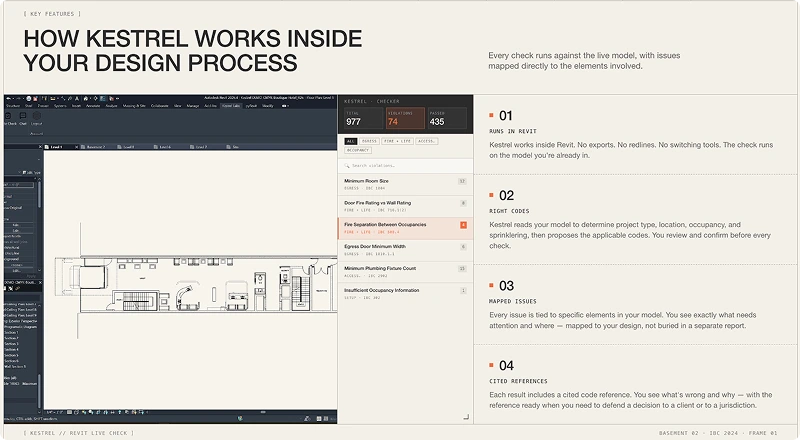
Compliance checks run directly inside Revit, allowing architects to identify issues without leaving their BIM environment.
7. Kestrel works with Revit. So how does it fit into the workflow and what changes for architects who use it when they are designing something?
The most important thing we can say about workflow is that it doesn't change much. That's intentional.
Architects don't adopt new tools because the tools are interesting. They adopt them because the tools fit inside what they're already doing. Kestrel runs inside Revit. No exports. No switching contexts. No importing results back.
When you want to check compliance, it's one click. About 30 seconds. Kestrel applies the codes for your project type and jurisdiction and maps every result to the specific element in your model that triggered it. You see what's flagged, which code section applies, and what you'd need to change. Then you fix it, or you make an informed decision not to and document why. Either way, you go right back to designing.
What changes is when architects find out about compliance problems. Right now, most firms find out at submission, or in a correction cycle that costs weeks and fees the firm can't recover. With Kestrel, you find out while the design is still moving, when a change costs an hour instead of a week of rework.
One thing that's come up consistently with the firms we work with: junior architects. Early-career practitioners don't have years of project experience to fall back on when code decisions come up. Kestrel doesn't replace what a senior architect carries in their head. But it does let a junior team member work with more confidence, surface issues before they compound, and learn what the standards actually require in the context of a project they're actively working on. That's different from reading a code book in the abstract.
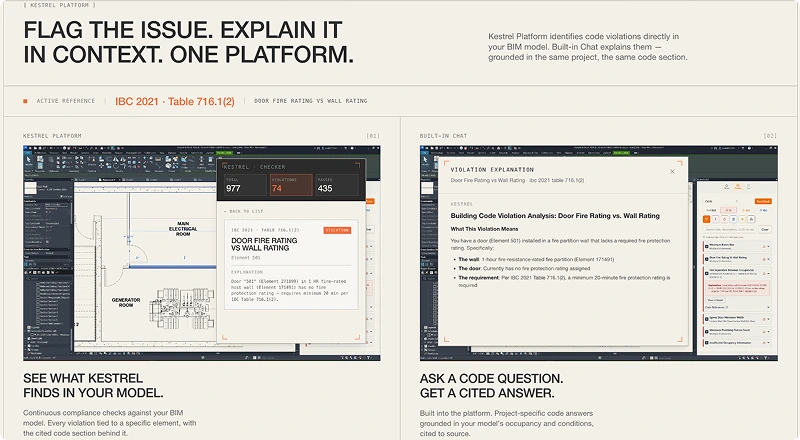
Kestrel provides code-cited explanations for every violation.
8. Do you think that one day building permitting and plan review will be partially automated using Artificial Intelligence?
Yes, and it's already starting in some places.
U.S. jurisdictions are beginning to pilot digital submission processes. The direction is clear, even if the pace varies significantly by municipality. And that second part is critical to understand: the variance. Great technology can get built and still die on the vine if municipal procurement cycles and implementation timelines aren't factored into how you bring it to market. That's a real consideration, and we think about it.
What's less discussed is how the architect side and the building department side connect. If an architect submits work that has been checked against a computable version of the code — with every flag documented and every decision traceable — the plan reviewer's job starts to look very different. Instead of reading through drawings looking for violations, they're reviewing structured compliance data. That's a faster and more accurate process for everyone involved.
The piece we are focusing on today is ensuring architects are part of shaping how this unfolds, not just on the receiving end of it. The profession has a real opportunity to define what machine-readable compliance looks like and what standards it should meet. That's a much better position than waiting for a building department to hand down a digital submission requirement and scrambling to comply on a short timeline.
Firms building compliance into their design workflow now will be best positioned when permitting automation arrives in their jurisdictions. For some of our clients, that conversation with building departments is already happening.
9. There are some parts of architecture that should never be automated even if Artificial Intelligence gets really good. What are those parts?
We'd push back gently on the word "never."
The more interesting question isn't whether AI could eventually replicate certain things — it's whether you'd want it to. And whether the things that make architecture meaningful are the parts that happen to be hard to automate, or whether they're hard to automate because they're meaningful.
The way an entrance sequence makes a child feel welcomed or excluded before they've taken ten steps inside. The relationship between a building and the street it sits on, and what that says about who the building is for. The decision to prioritize natural light in a space where people will spend most of their working hours, even when budget is pushing toward a different answer. Those come from empathy, experience, and the capacity to hold a client's needs and a community's context at the same time.
Will AI eventually understand those things better? Maybe. The better question might be: should it? Isn't that the part of design that is actually fun? The human part? If intent can be better interpreted, better expressed, better served by the tools — does that threaten the work, or does it just change where the architect's energy goes?
Austin thinks about this often. His view is that code compliance is a good problem for AI to take on precisely because it's not that kind of work. It's measurable, it's rule-bound, and getting it right is a baseline condition — not the thing that makes a building good. The spark of human creativity, the design decisions that people got into this field to make — those are not ours to automate, and we have no interest in doing so. The more time architects don't spend on compliance checking, the more of themselves they can bring to the parts that are genuinely theirs.
10. If Kestrel is successful, how do you think it will change the way architects work and the way permits are handled over the next five years?
Five years from now, we think compliance becomes a condition of design rather than a verdict on it. That's the shift.
For architects, the correction cycle stops being the default. First-pass permit submission actually passes. Firms that currently lose 3 to 4 percent of project fees to compliance-related redesign get that margin back. Junior architects develop code fluency faster because they're learning in context — on real projects, with real feedback — rather than absorbing it from a code book in isolation over years.
For building departments, a meaningful part of plan review shifts from finding violations in drawings to reviewing structured compliance records. That helps with the backlogs that have been a genuine problem for municipalities trying to keep pace with construction demand.
The part that drives us is what happens further downstream. Permit delays carry real costs — for developers, for communities, for the people waiting on housing or a school or a hospital. These are some of the most consequential things we build, and the compliance process is one of the places where the gap between how long it takes and how long it should take is genuinely large.
We don't think Kestrel solves all of that. But a profession building with computable compliance standards, sharing structured data with the permitting process, gets projects through faster, with fewer errors, and with more of the architect's time spent on what they actually came here to do.
Kestrel transforms compliance from a final review task into a continuous design workflow integrated with BIM.
Conclusion
The AEC industry is changing with technology. One important area that is being improved is making sure buildings follow the rules. Kestrel Labs thinks that if we can make these rules work with computers and add them to the way we design buildings architects can find problems sooner. This means they will not have to redo things much and they can focus on making buildings look good. We do not know if everyone will start doing it this way. It could change the way we think about following the rules. Of checking the rules at the end we will think about them the whole time we are designing the building. The AEC industry and building code compliance will be connected from the start. Building code compliance will be part of the design process and the AEC industry will be better because of it.

This interview was conducted with Brian Farber, Strategic Advisor at Kestrel Labs, a company focused on making building code compliance computable within BIM environments. He advises the company on strategy, communications, media relations, and policy positioning.
Recent Articles
Learn about the latest architecture software, engineering automation tools, & construction technologies
How DGA Used Ichi’s Agentic AI to Rethink Code Compliance
In this article, we explore how DGA Architects is using Ichi’s agentic AI platform to rethink building code compliance, QA/QC, and time consuming review workflows. Through a recent project example, the article shows how faster, cited code research helped the team remove a $250K fire damper line item and make better decisions earlier. The piece also looks at how AI can capture institutional knowledge, support junior teams, and become a new baseline for architecture firms as client expectations evolve.
Last Call: Accelerate Your AEC Startup with the 2026 Trimble 0–60 Challenge
The 2026 Trimble 0–60 Challenge, an equity-free 12-week accelerator for early-stage AEC startups in automation, AI, and spatial intelligence, closes applications on May 22, 2026. Selected founders gain direct integration with Trimble platforms, expert mentorship, non-dilutive cash prizes, and a Demo Day slot at Trimble Dimensions in Las Vegas.
BIM Has the Intelligence. Why Is Revit Documentation Still Manual?
Graebert’s ARES Trinity 2027 helps AEC teams automate BIM-to-DWG documentation from Revit, IFC, and Autodesk Forma workflows. It reduces manual drawing updates, supports cloud automation, preserves CAD details, improves feedback loops, and introduces ARES Neo for Revit-based drawing validation.
Reer: Bringing AI Directly Into the Heart of CAD Workflows
Reer is redefining how AI is used in AEC by embedding it directly into CAD workflows where the real work happens. Instead of just generating ideas, its AI handles detailed, time consuming tasks with precision inside tools like Rhino. This allows designers and engineers to focus on creativity and decision making, with AI working alongside them as a true collaborator.