
Reer: Bringing AI Directly Into the Heart of CAD Workflows
If you’ve spent any time working in Computer-Aided Design (CAD) or Building Information Modeling (BIM), you know the reality: much of the job isn’t about making decisions. It’s about repetitive tasks—renaming layers in CAD, fixing geometry in BIM, and running the same checks again and again.
Despite all the talk about Artificial Intelligence transforming design, most tools still don’t help with these everyday tasks. They offer ideas—things you could often do yourself—but don’t reduce the tedious workload. That’s the problem Reer is trying to solve by bringing AI directly into the CAD environment, working inside the software you already use.
The idea is simple: don’t just assist with design—be part of the process. Reer focuses on time-consuming tasks so professionals can concentrate on what matters: creativity and big decisions. In this conversation, we explore how Reer is changing AI in Architecture, Engineering, and Construction, making it a constant partner that handles CAD and BIM work so you can focus on designing and creating.
We sat down with Connie Hui, co-founder of Reer, to talk about how the company is building AI powered solutions focused on improving real world workflows and helping people interact with emerging technologies in more practical ways.
1) Can you describe the core mission of Reer and how it differentiates itself from other AI tools in the AEC space?
At Reer, we're turning CAD into AAD (AI-Aided Design). Our mission is to put AI where the work actually happens, inside the tools that matter most.
In AEC, the CAD/BIM files are the most mission-critical across every phase from early design through to construction. And yet, a surprising amount of the time professionals spend inside that file goes toward tasks that are repetitive, error-prone, and a quiet drain on the expertise they actually bring to a project.
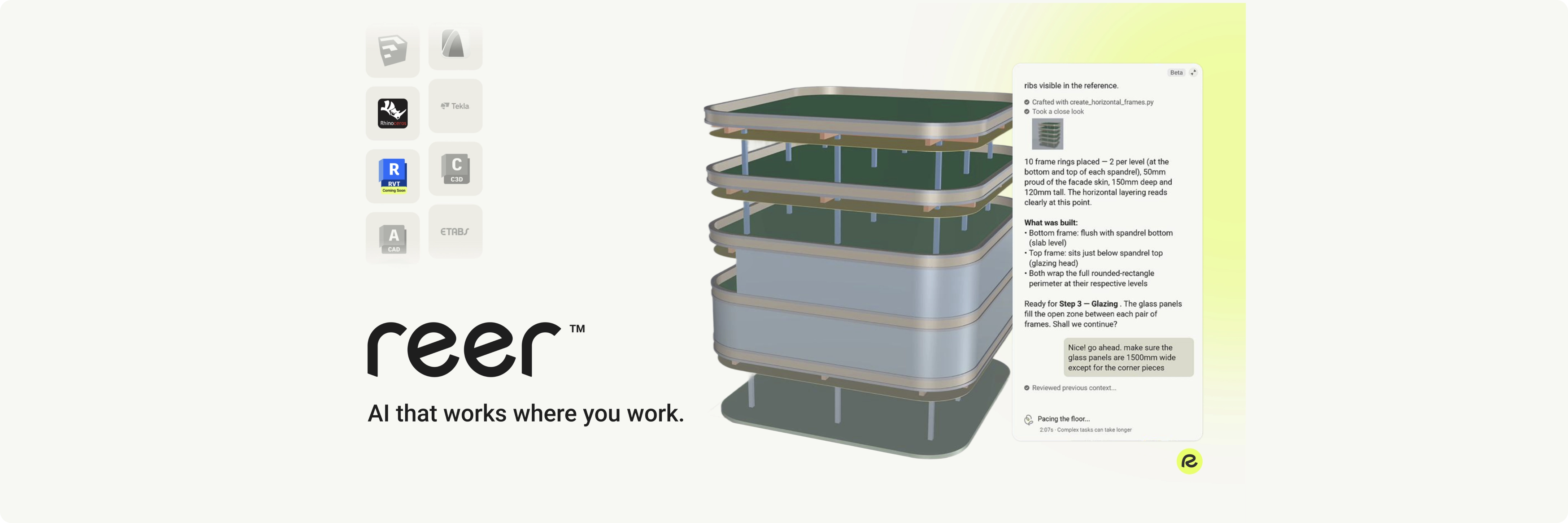
Reer's agent lives natively inside Rhino today, with Revit coming next. It's built not to chat but to act, handling data-driven batch edits, complex calculations, layer organization, and construction sheet production, directly with the tools we all rely on and across the boundary of siloed platforms. It also adapts to your standards over time and turns interactions into a shared foundation of skills that the whole practice builds on.
“Built not to chat, but to act. Put AI where the work actually happens, inside the tools that matter most.”
2) How does Reer’s AI integrate into designers’ existing workflows without disrupting their established tools and processes? What challenges have you encountered integrating into multiple CAD environments, and how have you addressed them?
The core design principle behind Reer is that the best tool is one you don't have to think about adopting. The agent runs natively inside the CAD/BIM file when you need it, out of the way when you don't.
Getting to that level of reliability required solving problems that many AEC enterprises have run into themselves. Teams that have tried building their own AI integrations for CAD often find the same thing — getting a prototype working is one thing, but making it reliable and scalable enough for everyday use across project phases is a different challenge entirely.
What that experience points to is that CAD environments need an architecture purpose-built for them. Workflows require continuous, real-time interaction rather than simple one-off requests. And any result the agent produces needs to be exact and repeatable, because it's touching the file the entire project depends on. Reer is built around those realities from the ground up, which is what makes it something teams can actually trust and use every day, not just demo.
“The best tool is one you don’t have to think about adopting.”
3) From your perspective, what are the biggest limitations of traditional AI design tools when applied to complex CAD workflows — and how does Reer overcome them?
Most AI tools built for design are optimized for a single, well-defined moment, such as generating an image, suggesting a layout, and running a compliance check. That's genuinely useful, but it doesn't reflect how complex CAD workflows actually operate. A real project involves hundreds of interdependent decisions, file handoffs, calculation checks, and iterative edits, all happening inside a living model.
The biggest limitation we see is that most tools treat the CAD environment as an output destination rather than a workspace. They sit outside the process, ask you to bring something to them, and hand something back. That creates friction, breaks context, and puts the burden of integration on the user.
The second limitation is precision. Generating a concept image or suggesting a floor plan arrangement has a lot of tolerance for variation. Modifying actual geometry based on specific requirements or coordinating data between Rhino and Revit does not. The bar for reliability is fundamentally different, and tools not built for that environment tend to fall short when it matters most.
Reer is built around both of those realities. The agent lives inside the workflow rather than alongside it, and it's engineered to be precise and repeatable on the kinds of tasks where errors have real consequences. The goal isn't to replace the designer's judgment. It's to handle the work that doesn't require it, reliably enough that professionals can actually trust it with their documents.
“The goal isn’t to replace the designer’s judgment. It’s to handle the work that doesn’t require it.”
4) Reer aims to handle repetitive and time-consuming tasks in AEC workflows. Can you share specific examples where the tool has significantly reduced manual effort—beyond general automation?
While Reer is built to handle all kinds of error-prone grunt work that fills professionals' day, what we've found most distinctive is the range of where it adds value — from the smallest incremental behaviors to complex multi-step parametric workflows.
On one end, something as fundamental as selecting objects in Rhino happens constantly. Every command, every edit, every check requires it. Because it's so habitual, most users don't register it as lost time. But when you observe how experts actually work across a full day, those moments accumulate significantly.
On the other end, a professional sustainability consultant recently used Reer to complete a data-driven building orientation analysis — detecting and closing line gaps while maintaining wall type categorization, extracting interior versus exterior facade orientation data, and compiling everything into a table. A task that would normally take her a week to build as a Grasshopper script was done in 30 minutes using natural language.
The longer-term direction is to make Reer increasingly predictive. The agent learns the patterns behind how you work and starts anticipating your next move, removing friction before you even feel it, in the most unobtrusive way possible.
“What the agent removes isn't just time. It's the translation layer between what you want to do and what the tool needs you to do – we don’t have to think like a machine to use one.”
5) Data privacy and control are critical in AEC. How does Reer ensure that local CAD files and intellectual property remain secure when AI operates within a project? What strategies or technologies are used to avoid external file uploads or breaches?
Data privacy is a serious concern for AEC firms, and rightfully so. The files Reer works with contain proprietary design work and project IP that teams have a professional and contractual obligation to protect.
Our approach is architectural. Reer operates through secure file linkage, meaning the agent works directly with files in their local environment. There's no file upload, no external server, no point in the workflow where your CAD files are in transit or sitting somewhere outside your control. Everything stays on your machine or your firm's own infrastructure, and Reer works within that boundary.
But security goes beyond where files live. AI agents represent a fundamentally new paradigm — especially in contrast to traditional deterministic software. And we are well aware of that and taking that seriously. We carefully designed the harness of the agent so that it would ask for permission before making any file changes and to be fully transparent about what it's doing and why at every step. Every action the agent takes is undo-able with a single control-Z, so you're never locked into something it did without your approval. Users who've worked with Reer consistently describe it as feeling meticulous and precise, like a reliable colleague who shows their work rather than just handing you a result.
“These are not just features. It's a design principle we've held from the start”
6) Who are your early users and customers — are they primarily small practices, large firms, or specific disciplines within AEC? Can you share examples of how different teams (e.g., architects vs. engineers) are leveraging Reer in their workflows?
We're still in the early stages of building out our user base, but the signal we're getting is already pointing in some clear directions. Our current users span a range of firm sizes and disciplines, from boutique design practices to larger firms with dedicated computational design teams. And what they have in common is that they're already technically fluent. They know their tools well, which means they immediately recognize the value of an agent that can take over the parts of the workflow that don't require their expertise.
On the architecture side, we see a lot of excitement around design tasks, including parametric modeling, facade studies, and the kind of iterative geometry work that Rhino is built for. On the engineering and technical side, the pull is more toward precision tasks: compliance checks, calculation-driven model edits, and coordination work that spans multiple files.
What's been interesting is that the entry point varies by user but the underlying need is consistent: everyone has a version of the same problem. There's work that requires their judgment and work that doesn't, and the latter is eating more of their day than it should. Reer meets them wherever that friction is highest.
7) How have clients responded to using AI as a creative partner rather than just a generation tool? What feedback or success stories stand out from early adopters?
One of the most consistent things we hear is that the shift in mindset happens faster than people expect. Many users come to think of Reer as a tool they instruct, and fairly quickly start treating it more like a collaborator that understands the context of what they're building. That transition tends to happen not through a single big moment, but through a series of smaller ones: the agent anticipating a follow-up action, catching an inconsistency, or handling a tedious sequence without being asked twice.
What stands out from early adopters is less about dramatic time savings and more about a change in how they relate to the repetitive parts of their work. When those tasks are handled reliably, professionals find themselves staying in a more focused, creative state for longer. And once they experience that, going back feels unbearable. The feedback we find most encouraging is when someone says it feels like working with a colleague who is always one step ahead. Not because they were told to be, but because they understood the problem well enough to act on it. That's the bar we're building toward. As we grow, we look forward to sharing more specific stories from the teams we work with.
“It feels like working with a colleague who is always one step ahead.”
8) Looking ahead, how do you envision the role of AI Agents like Reer evolving in AEC? Are there emerging integrations, formats, or workflows that you are particularly excited about?

Recent Articles
Learn about the latest architecture software, engineering automation tools, & construction technologies