Automating MEP Clash Resolution in AEC: Meet Vavetek AI and BAMROC
Clash detection is a solved problem — most teams working in Autodesk Revit and coordinating models in Autodesk Navisworks know the drill: run the clash test, export the report, book the coordination meeting, assign fixes, and repeat the cycle.
But anyone who has lived through it knows the truth: the real work doesn't start when clashes are found. It starts afterward — in the hours and days of manual repositioning, rerouting, and re-checking that follow.
At a recent product demo webinar hosted by aec+tech, the team behind Vavetek AI - Nitin Gupta (Founder & CEO), Vimal Yadav (Founding Member and Product Lead), and Anuj Gupta (COO & Co-founder) — walked through the thinking, technical architecture, and live demonstration of BAMROC, their automated MEP clash resolution software for Revit. The session brought together AEC professionals, BIM coordinators, and engineering consultancies curious about where AI-assisted coordination was actually headed not in theory, but in practice, inside live Revit models.
Throughout the discussion, one observation stood out: the industry has become very good at detecting clashes. Resolving them, however, remains largely manual, repetitive, and meeting-heavy.
Their solution is BAMROC, an AI-powered, patent-protected system built not just to find conflicts between MEP and structural systems, but to resolve them automatically, inside your existing Revit and Navisworks workflow.
That difference changes everything.
The MEP Coordination Bottleneck in a “Digital” Workflow
For many teams, AEC teams, MEP coordination quietly eats up a huge portion of time during the engineering design phase.
Ducts get nudged around beams. Pipes are rerouted beneath ceilings. Cable trays shift to maintain clearance. And every change risks triggering a fresh set of clashes somewhere else in the model.
It's common for a BIM coordinator to spend an entire day resolving 60 to 75 clashes. On large projects with hundreds — or thousands — of conflicts, the ripple effect can stretch schedules and push up costs. To stay safe, designers often oversize shafts or lower ceilings more than necessary, sacrificing spatial efficiency just to avoid coordination risk.
The scale of the problem is significant. BIM coordinators who are highly skilled professionals are routinely tasked with resolving clashes one by one, manually adjusting routing and elements across models that span multiple disciplines, floors, and subcontractors. There is no automated audit trail. Validation is a separate exercise. And every coordination meeting adds overhead without adding design value.
Unlike tools such as Revizto or Solibri which excel at detecting, tracking, and assigning clashes, BAMROC is designed specifically to resolve them automatically.
Vavetek AI's founder, architect Nitin Gupta, who brings more than 30 years of industry experience, has seen this pattern over and over again. The conclusion his team reached was straightforward: detection is largely solved. Resolution isn't.
Moving from Reports to Real Action
In a live demo, the BAMROC workflow initially looked familiar.
Structural, mechanical, electrical, and plumbing models were linked in Revit. A clash test was run in Navisworks. Sixty-three clashes appeared.
Normally, this is where the coordination meetings begin.
Instead, the Vavetek’s Navisworks plugin generated a formatted clash report and pushed it back into Revit. The user defined a scope, selecting a specific floor and section box and chose resolution strategy such as moving elements (Movement Strategy) or bending MEP systems around obstructions (Bend Strategy).
Then the manual work stopped.
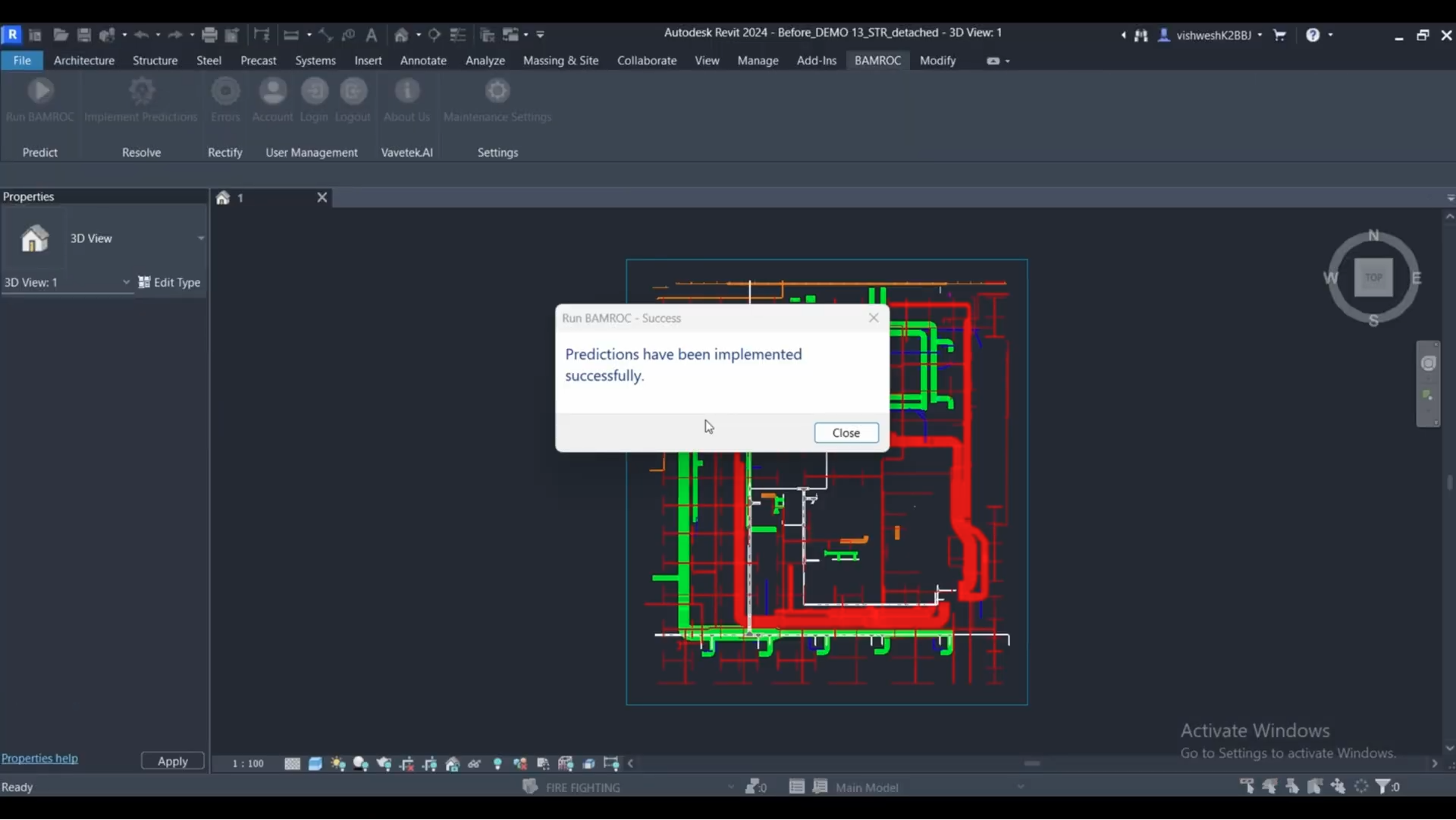
The computation shifted to the cloud. BAMROC's AI engine analysed every clash, explored viable solutions, and produced a prediction file - specifying how each element across every Revit file needed to move. Back in Revit, a single click on "Implement Prediction" applied all those changes to the model. Within the same session, all 63 clashes were resolved. Structural constraints were respected. Gravity pipes maintained slope. Pinned elements stayed in place. In all design intent is preserved.
Once implementation was complete, the built-in CRDR (Clash Resolution Diagnosis Report) tool in the Navisworks plugin validated the results. The system generated detailed HTML reports with before-and-after images of every clash, giving project teams a clear, documentable audit trail. For firms that need to hand over coordination evidence to clients or third-party checkers, those reports replace what would otherwise be hours of manual documentation.
Behind the scenes, the system applies mathematical, rule-based logic. It’s deterministic, meaning the same inputs will always produce the same outputs. Unlike generative AI systems that can behave unpredictably, Bamroc doesn’t “hallucinate.” It doesn’t improvise. It follows defined geometric rules at scale.
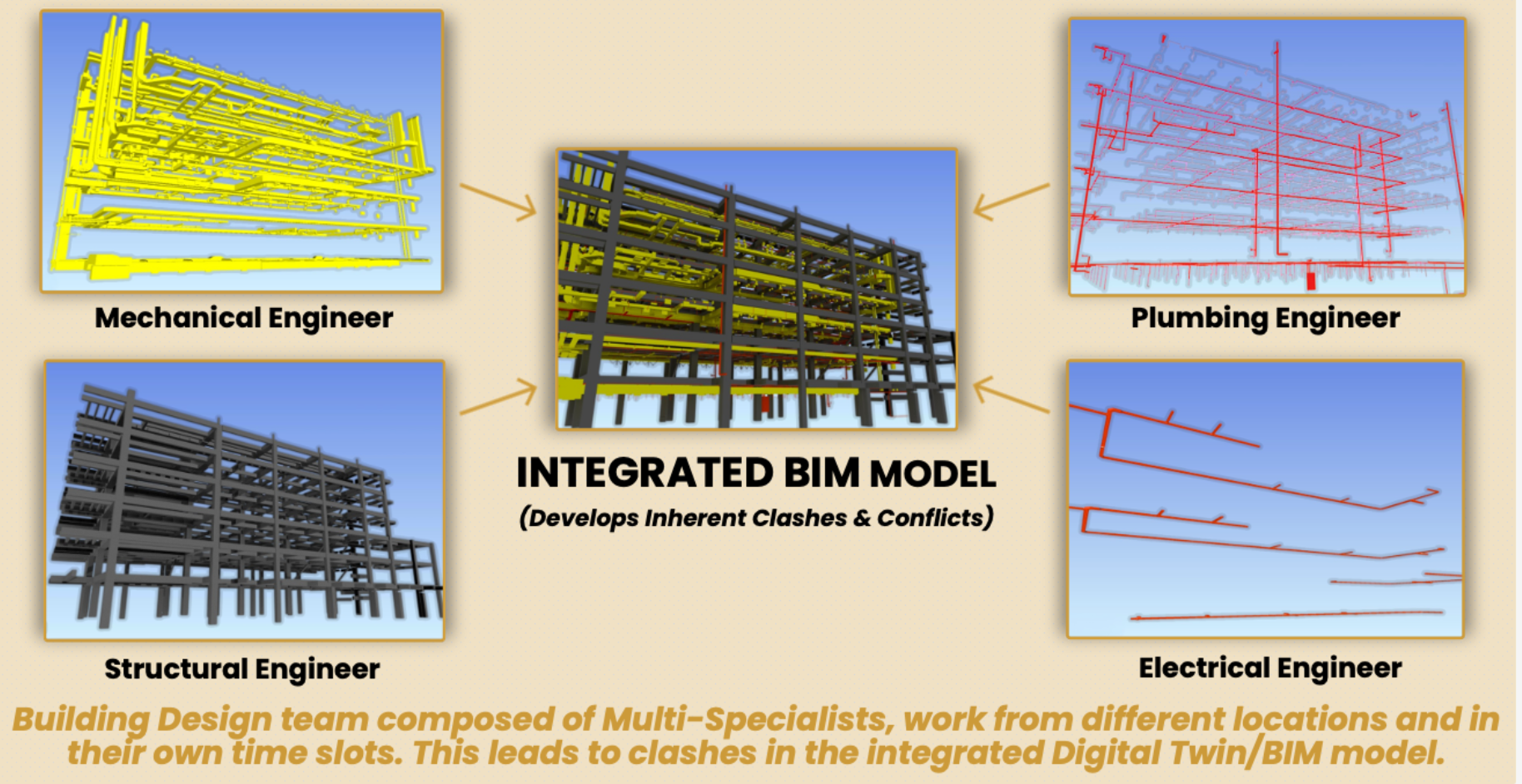
Fig. 2) Separate discipline models converge into a single BIM environment—where inherent clashes emerge before automated resolutions with Bamroc
Automation, Without Losing Control
One of the biggest concerns engineers have about AI in BIM workflows is losing visibility and control. What changed? Why did it move? Can I trust it?
As Nitin Gupta, Founder and CEO of Vavete AI, explained during the session:
“The interesting part to share with you is that the AI technology used in BAMROC is logic-based and rule-based. For that reason, we are not looking at any percentage of hallucination at all.”
BAMROC addresses these concerns directly. After processing, users can review detailed before-and-after visualisations for each clash. Errors logged during implementation are colour-coded: green indicates issues that BAMROC corrected automatically; red flags the small subset that requires human review. Engineers can navigate through those errors one by one, manually fix them, or use the AutoConnect feature to reconnect elements quickly. Changes can be validated, approved, or examined further before final sign-off.
Customization is another key piece. Firms can define clearance requirements—such as maintaining a 300 mm gap between services. Regional codes and company standards can be embedded without rewriting the system.
In short, the AI adjusts to the firm’s workflow—not the other way around.
Speed, Scale, and Early Momentum
The time savings are hard to ignore. Tasks that might take a full day manually—resolving dozens of clashes—can be completed in under an hour, including processing and review. Larger datasets with thousands of clashes naturally take longer, but the efficiency gap remains significant.
Beta testing began last year, with early traction in the Middle East — particularly in the United Arab Emirates and Saudi Arabia — where fast-paced, large-scale construction projects make MEP coordination efficiency critical. The region's project scale, compressed timelines, and high concentration of complex mixed-use and infrastructure developments create exactly the conditions where BAMROC's speed advantage compounds most.
Engineering consultancies and turnkey contractors are piloting the system.
For now, BAMROC supports Revit's RVT format and fits directly into existing Navisworks and ACC-based workflows, meaning teams don't need to replace their current tooling. IFC compatibility and expansion into other modelling ecosystems are on the roadmap, which would open the system to firms not working inside Autodesk's environment.
A Shift in the Coordination Mindset
For years, coordination meetings have been a rite of passage in BIM workflows. Clash reports circulate. Teams negotiate for space. Adjustments trigger more adjustments.
BAMROC points to a different possibility. Coordination still matters — human expertise, project-specific knowledge, and design intent cannot be automated away. But much of the mechanical repositioning could happen quietly, automatically, and predictably in the background, long before a coordination meeting is ever scheduled.
That reframes the conversation. Instead of asking, "Who's going to fix these clashes?" — teams may start asking, "Which of these actually require human judgment?"
If that shift takes hold, automated resolution could become as standard as detection once was.
And in a world of tighter margins, compressed timelines, and increasingly complex models, that evolution may reshape what efficient engineering design truly looks like.
Looking Beyond Clash Resolution
Automated MEP clash resolution is just the beginning. Vavetek AI's broader mission is to build a suite of AI copilots that enable value engineering at scale — giving building developers and turnkey contractors the ability to audit and optimise engineering designs at speed, reduce construction costs through smarter design decisions, and deliver projects on schedule.
The 3D geometric reasoning and spatial optimisation engine that powers BAMROC is not a single-purpose tool. It forms the foundation of Vavetek AI's wider technology platform, and the same capability that resolves MEP clashes can be applied across other design domains where spatial reasoning matters.
The first application beyond MEP coordination is structural design: OptiFound, Vavetek AI's AI copilot for the audit and optimisation of structural foundation designs, is currently in a proof-of-concept stage. Future development will extend the platform to air-conditioning system design and façade engineering — areas where iterative, AI-driven optimisation can drive significant savings in material costs and construction time.
The underlying idea is simple: small inefficiencies compound across projects, and manual checking and habitual overdesign create hidden waste at every stage. If AI copilots can handle 80–85% of repetitive engineering review work, human expertise can focus on the decisions that genuinely require judgment and experience.
To learn more, visit Vavetek's official page on aec+tech or explore the latest features and request access on the Vavetek website
Recent Articles
Learn about the latest architecture software, engineering automation tools, & construction technologies
Why BIM Validation Is No Longer Optional in AEC Project Delivery
An unvalidated BIM model isn't just a quality risk anymore—it's a budget risk, a legal liability, and a schedule threat. This article examines how Solibri's rule-based model checking is becoming essential across data center construction, transportation infrastructure, and design-build delivery, where the cost of getting the model wrong keeps rising.
Fixing the Real Bottleneck in BIM with Solibri CheckPoint
Solibri CheckPoint is about fixing what slows BIM teams down after clashes are found. Instead of the heavy desktop setup, it runs model checks in a web browser while cloud computers handle the 3D work. More people can review models, assign issues, and track changes. This helps teams move from “problem found” to “problem fixed” faster, with less waiting and rework. In this article, we explain everything you need to know about Solibri CheckPoint.
Blueprints AI: Generating Construction Documentation with Artificial Intelligence
In this interview, we sat down with Al Dram, CEO and co-founder of Blueprints AI, to explore how artificial intelligence is transforming construction documentation for architects. Al shares how design teams can turn prompts, sketches, and existing files into permit-ready drawing sets—and rapidly respond to city review comments using AI-driven revisions. The conversation highlights what this shift means for architecture and AEC firms struggling with time-consuming drafting workflows and growing documentation demands.
Pioneering Technical Report Management (TRM™) for AEC Firms: A Quire Deep Dive
Learn how Quire founder Kelly Stratton is reinventing technical reporting in our latest aec+tech interview, where its purpose-built TRM™ platform, WordBank-powered standardization, AI-driven Smart Search, quality control, and the Lazarus knowledge engine come together to help AEC, environmental, and CRE teams cut reporting time and errors while unlocking their institutional expertise.