IT That Works the Way Architects Think: A Conversation with Flying Buttress Founder Michael Donahue
Fig .1) Flying Buttress - Technology Services for Architecture, Engineering, and Design
Most managed service providers treat AEC firms like any other client: set up the email, monitor the firewall, renew the licenses.
The problem is that an architecture practice is not a law firm or a retail chain. Its people work differently, its software stack is large and demanding, and its culture runs on consensus rather than mandate. Multi-gigabyte Revit models moving across offices and continents are a routine operational challenge, not an edge case. A generic MSP is rarely equipped to meet those realities.
Flying Buttress was built specifically for this gap. Founded in 2010 by Michael Donahue, who spent nearly a decade managing IT inside architecture firm WATG, the company describes itself as the world's largest IT firm dedicated entirely to Architecture, Engineering, and Design practices.
In this aecplustech article, we asked Donahue key questions to give you a clear understanding of how Flying Buttress thinks about AED technology, what a cloud-first migration actually looks like in practice, and why he does not believe in five-year plans.
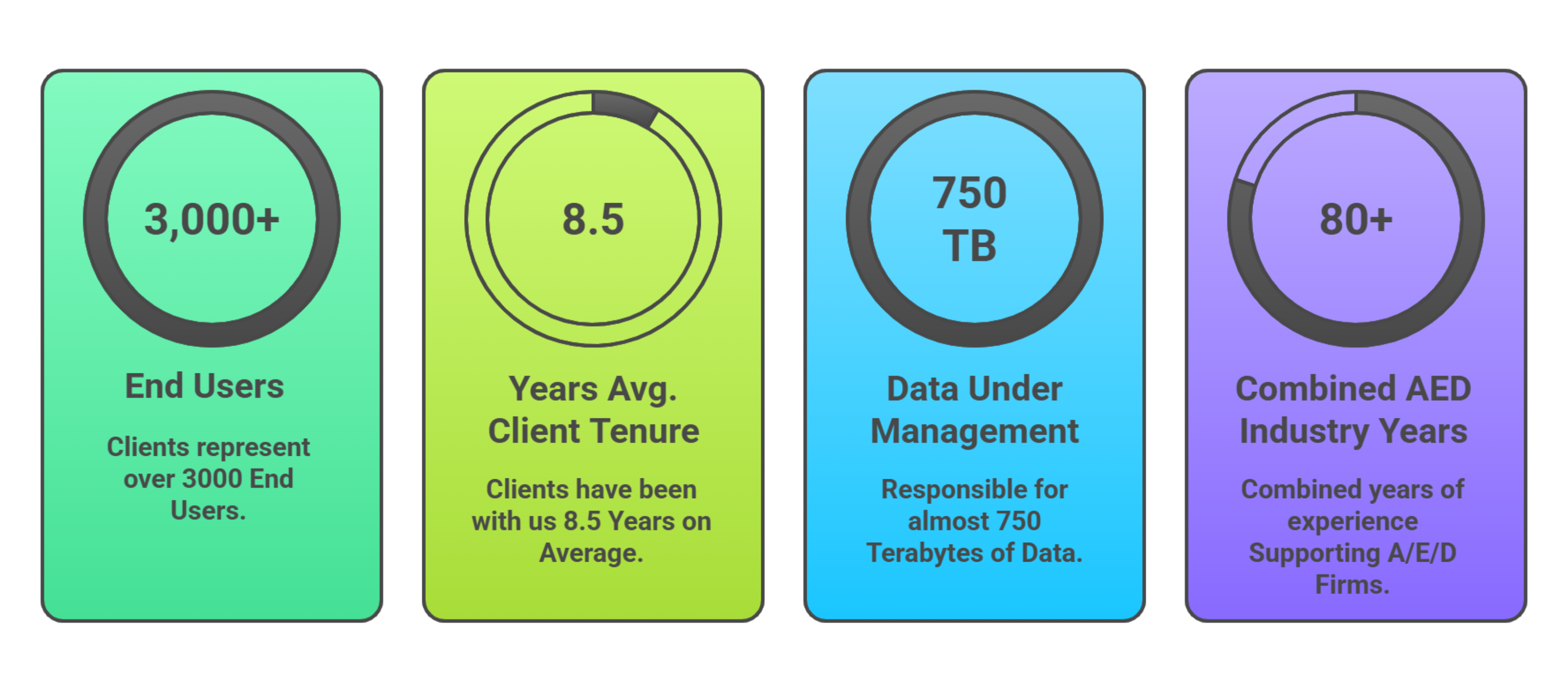
Fig 2.) Flying Buttress at a glance: the scale and experience behind the world's largest MSP dedicated to AED firms
1) Can you tell us the story behind Flying Buttress — how and why the company was founded specifically to serve Architecture, Engineering & Design (AED) firms?
Although I have been in IT my entire career, I was not exposed to the specific needs of AED firms until I was hired at WATG in 2000. When I left in 2008, I was running the IT department, which included our KM and development staff. In this role, I had oversight of our budget and managed our vendor and consultant relationships.
When I started Flying Buttress in 2010, I wanted to create an MSP that worked the way I wished it would when I was internal IT. An MSP that was honest, ethical, and cared more about existing clients than chasing new ones. I am proud of what Flying Buttress has become some 16 years later.
2) Flying Buttress specializes in managed IT services for AED firms. How does your approach differ from a generalist managed services provider?
The difference is significant in three ways: technical, financial, and cultural.
For technology, it is about understanding how to support an Autodesk environment, including patching and licensing, and the same for all the ancillary applications: Bluebeam, Deltek VantagePoint/Ajera, Lumion, SketchUp, and more.
Financially, having lived through a couple of significant economic downturns means we understand the importance of cash flow, WIP, and so on when budgeting and making the most of overhead dollars. We also understand the concept of deliverables and how to get the user able to work on them in a minimal amount of time.
Finally, the culture of AED is unique. In most other verticals there is a strong top-down culture: we are doing X because the CEO says we have to. With AED, the concept of a mandate is rare. This is a consensus culture. It makes it very difficult for IT, but that is part of the challenge. How do you implement change when there is no "just do it" button?
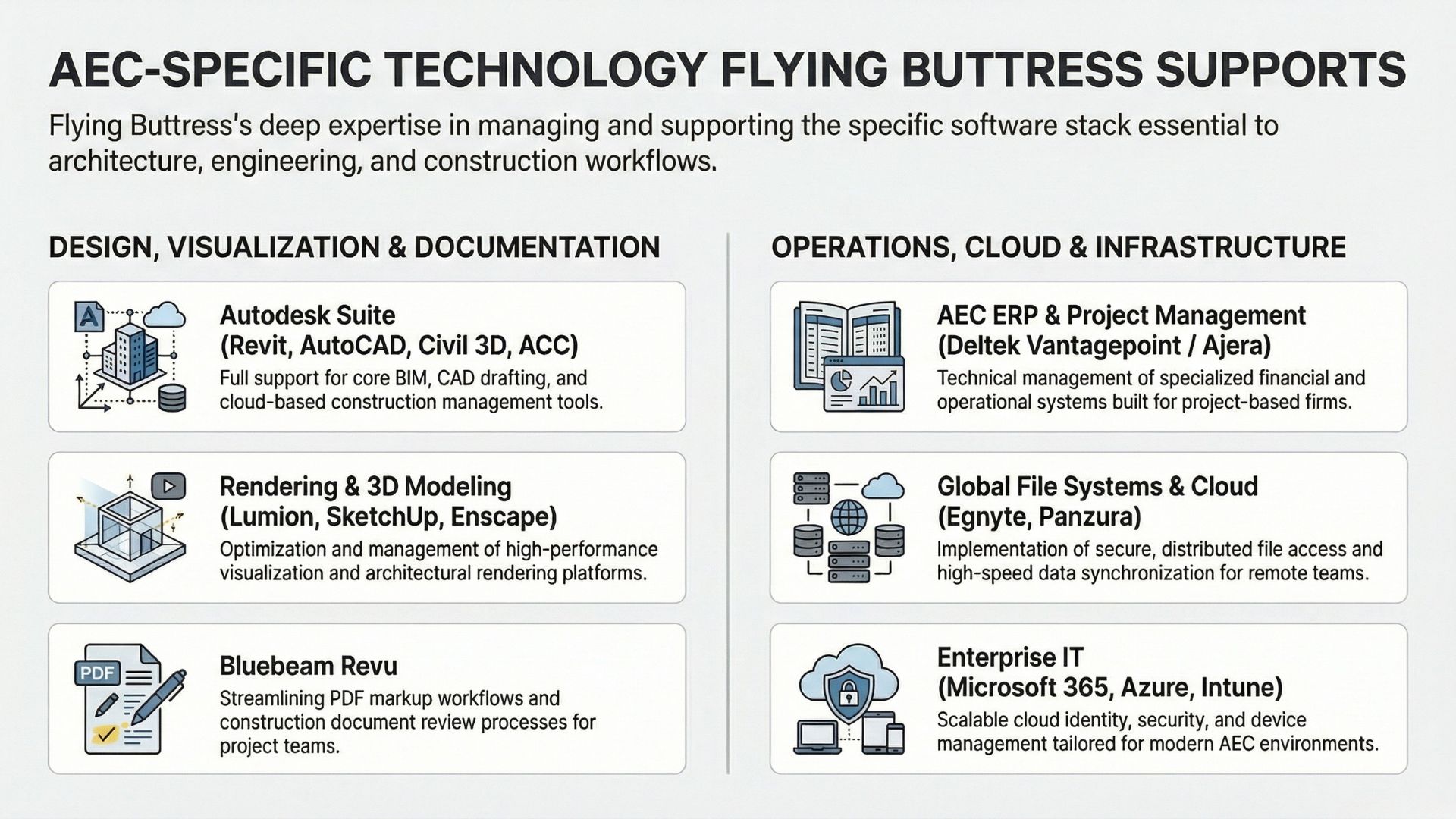
Fig 3.) Flying Buttress supports the full AED software stack, from Autodesk and Bluebeam to Egnyte, Deltek, and Microsoft Azure
3) Many AEC firms struggle with collaboration across offices and with large design file workflows. How does Flying Buttress address these challenges technically and strategically for your clients?
It sounds simplistic, but the answer is the cloud. A combination of Autodesk Construction Cloud and Egnyte eliminates the traditional data silos that firms face. If we can do that without expensive hardware and on-premise equipment, so much the better.
For what it is worth, I have still not found any application that truly replicates the in-office collaboration experience, let alone the typical studio layout. That gap is real and worth acknowledging honestly.
"A combination of ACC and Egnyte eliminates the traditional data silos that firms face. If we can do that without expensive hardware and on-premise equipment, so much the better." - Michael Donahue, Founder & CEO, Flying Buttress
4) Can you describe a customer success story or case study that illustrates how your services have transformed a firm’s IT environment or business outcomes?
To be fair, we get a fair amount of our clients from firms that are already in trouble or want to make sure an upcoming transformation investment is spent wisely.
We recently took a 120-staff firm across three offices that was running VDI and offsite files and moved them to a full, cloud-first profile. One laptop per user. Work from anywhere. Significant security upgrades. And less expensive than the previous setup.
"One laptop per user. Work from anywhere. Significant security upgrades. And less expensive." - Michael Donahue, on a recent 120-person, three-office cloud migration
5) Security and data protection are major concerns in AEC practices. How do you approach cybersecurity and risk mitigation for firms that rely heavily on critical design data?
This is not easy in the AED world, in part due to the culture. There is a lack of mandate, as mentioned earlier, but also, designers and engineers generally want to share knowledge. It is an open, collaborative environment. There is a clear tradeoff between security and ease of access that needs to be managed carefully.
The cloud also plays a large role here: major platform providers offer more comprehensive security and backup capabilities than most individual firms could replicate on their own, regardless of budget.
Our approach is built on layered security and automated resolution, but the human factor is what we cannot fully control. We can only train for it.
6) Looking ahead, what emerging technologies or trends do you think will most impact technology strategies within AEC firms — and how is Flying Buttress preparing to support those shifts?
AI, right now, is still in the nascent stage for most firms, much like 3D printing and virtual reality were years ago. Exciting, certainly front-of-mind, but there are not many concrete examples out there demonstrating impact on deliverable quality or the bottom line.
One advantage Flying Buttress has is that because we work with an extensive list of clients, we are better positioned than most to see what actually works and what does not across firms. What I can tell you is that we do not believe in strict five-year plans. Our outlooks cap at three years. Things are changing too quickly.
"We don't believe in strict five-year plans. Our outlooks cap at three years. Things are changing too quickly." - Michael Donahue, Founder & CEO, Flying Buttress
7) What advice would you give AEC firm leaders who are evaluating whether to outsource their IT support versus building internal technology capabilities?
I would always recommend some percentage of outsourcing, but that percentage can vary significantly based on firm size. We quite often work with internal IT in a hybrid mode, so it is not necessarily one or the other.
What is most important is having some tie-in to firm leadership who can ensure alignment with business goals, whether that happens at a consultant level or as internal staff. MSPs are especially helpful when considering new technologies, or for firm-to-firm comparisons: is our IT percentage of budget in alignment with other firms our size? That kind of benchmarking is difficult to do from the inside.
Conclusion
Flying Buttress offers managed IT across every layer of a firm's technology environment, from individual workstations to global network infrastructure and strategic oversight.
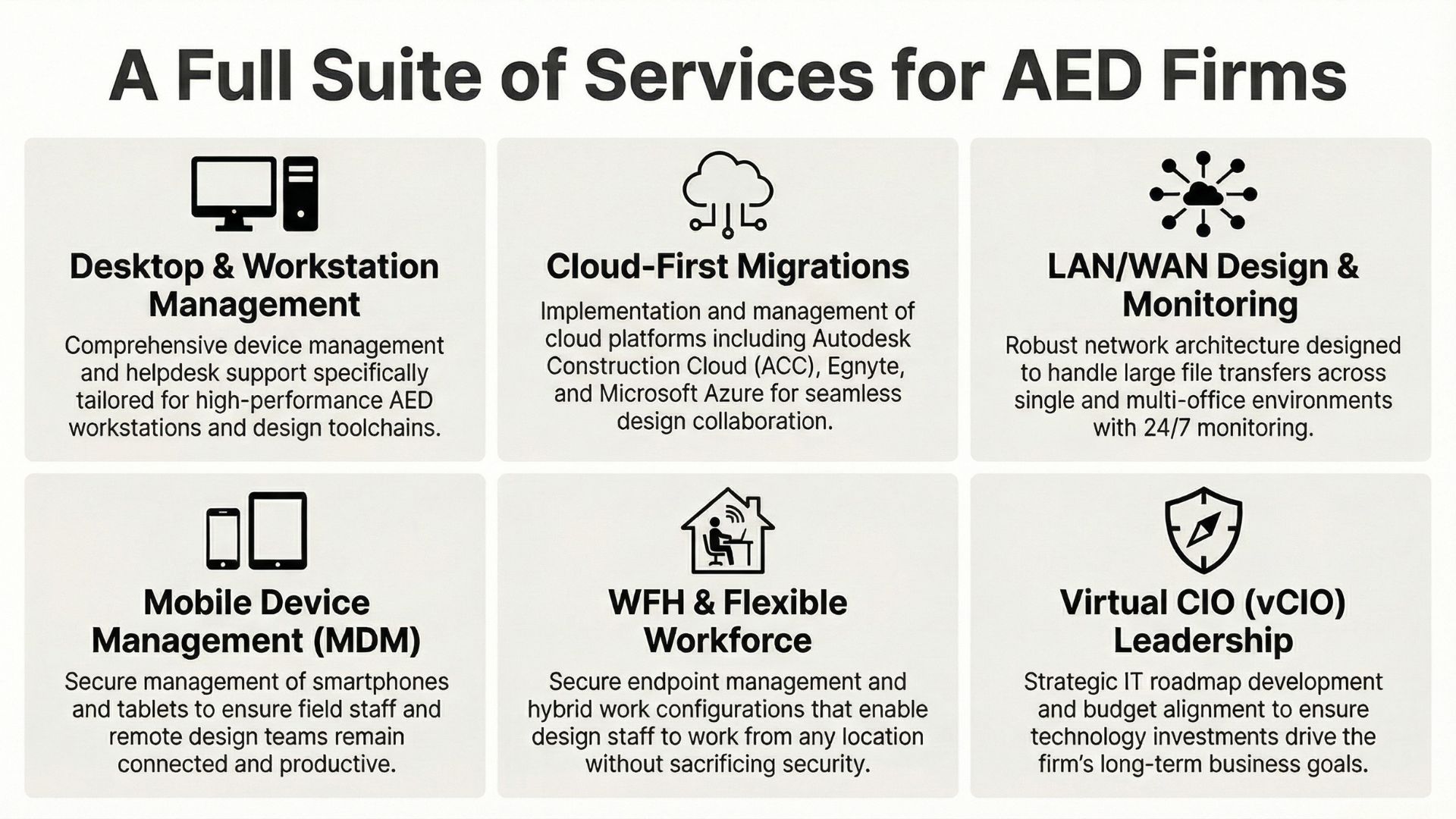
Fig 4.) From workstation support to Virtual CIO oversight, Flying Buttress covers every layer of an AED firm's technology environment
To learn more, visit Flying Buttress official page on aec+tech or explore the latest features and request access on the Flying Buttress website
Recent Articles
Learn about the latest architecture software, engineering automation tools, & construction technologies
Why BIM Validation Is No Longer Optional in AEC Project Delivery
An unvalidated BIM model isn't just a quality risk anymore—it's a budget risk, a legal liability, and a schedule threat. This article examines how Solibri's rule-based model checking is becoming essential across data center construction, transportation infrastructure, and design-build delivery, where the cost of getting the model wrong keeps rising.
Automating MEP Clash Resolution in AEC: Meet Vavetek AI and BAMROC
Vavetek AI's BAMROC tackles one of AEC's most persistent bottlenecks: not finding clashes but resolving them. While tools like Revizto and Solibri handle detection well, the fix still falls on BIM coordinators working manually through conflicts one by one. BAMROC plugs into existing Revit and Navisworks workflows and uses rule-based AI to automatically resolve MEP and structural clashes at scale—cutting work that might take a full day down to under an hour.
Fixing the Real Bottleneck in BIM with Solibri CheckPoint
Solibri CheckPoint is about fixing what slows BIM teams down after clashes are found. Instead of the heavy desktop setup, it runs model checks in a web browser while cloud computers handle the 3D work. More people can review models, assign issues, and track changes. This helps teams move from “problem found” to “problem fixed” faster, with less waiting and rework. In this article, we explain everything you need to know about Solibri CheckPoint.
Blueprints AI: Generating Construction Documentation with Artificial Intelligence
In this interview, we sat down with Al Dram, CEO and co-founder of Blueprints AI, to explore how artificial intelligence is transforming construction documentation for architects. Al shares how design teams can turn prompts, sketches, and existing files into permit-ready drawing sets—and rapidly respond to city review comments using AI-driven revisions. The conversation highlights what this shift means for architecture and AEC firms struggling with time-consuming drafting workflows and growing documentation demands.