Egnyte AEC Summit: Cloud, AI, and Data Strategy
The 2025 Egnyte AEC Summit put a spotlight on some of the most stubborn operational challenges facing AEC firms today. Firms like Corgan and PCL Construction took the stage to talk through joint venture collaboration, AI data readiness, and what it takes to make digital transformation stick beyond the pilot phase. The conversations were grounded, practitioner-led, and pointed at the problems that don't resolve themselves.
The 2026 edition tackles what Egnyte calls the "Day 2" challenges: the harder questions that emerge once a firm has made the initial transition and is now trying to scale, secure, and actually leverage the data it has been accumulating for years.
We spoke with Kevin Soohoo ahead of the event to get a preview of what's on the agenda, why it's structured the way it is, and what AEC firms at every stage of digital maturity can expect to take away.
Register here to secure your spot before reading on.
1) How did Egnyte choose the summit’s three pillars: desktop workflows, cloud collaboration, and AI grounded in firm data?
Those three pillars were chosen because they reflect the current reality and the near future of the AEC industry.
Design still relies on desktop applications. Beyond the main BIM platforms, companies use a long tail of hundreds of specialized apps that won't be cloud-native anytime soon. Egnyte "cloudifies" these workflows, providing global access without sacrificing local speed.
On collaboration: projects are never completed solo. They require a Common Document Environment that connects all the firms involved. While the actual data inside is crucial, it's still contained in documents, drawings, specifications, and contracts that need secure management across the multi-firm project lifecycle.
And on AI: fear of missing out is significant right now, but most firms are sitting on massive amounts of dark data. A small pilot might look good, but trying to scale AI across untagged, unstructured historical data is risky. The summit is designed to help firms move past the hype by grounding AI in their own verified, searchable data.
"Fear of missing out (FOMO) on AI is huge, but most firms are sitting on massive amounts of 'dark data.' A small pilot might look good, but trying to scale AI across untagged, unstructured historical data is risky." - Kevin Soohoo, Head of Global AEC Practice, Egnyte
2) What’s still blocking AEC firms from moving beyond hybrid desktop-cloud workflows, and how does the summit address it?
The shift is challenging because of the physics involved and the sheer diversity of tools in AEC. We're talking about massive files, point clouds and high-res renderings, that absolutely need local speed. Plus, the hundreds of specialized desktop applications firms depend on just don't run well, or at all, in a browser. For a long time, the idea of being truly serverless was a pipe dream. But with Egnyte's approach to file handling and caching, that's actually becoming a reality.
The summit addresses this by validating "the Hybrid Reality". Thinking about it as "Cloud versus Desktop" is the wrong frame. By using hybrid caching and smart file-locking, firms can enable designers to use their complete, specialized software toolkit at the speeds they need, while the cloud seamlessly handles synchronization and security behind the scenes.
The goal isn't just uploading files it's fundamentally optimizing the way the work gets done.
3) What does the summit address for AEC firms still unsure about cloud adoption, especially around file size, security, version control, and real project demands?
The summit directly addresses complex project realities by demonstrating how a Common Document Environment (not to be confused with a Common Data Environment) effectively manages the heavy lifting. That means handling vast datasets, terabytes of data, and guaranteeing strict version control even with extensive involvement from dozens of subcontractors and outside consultants.
The summit also tackles the security trust gap. Attendees will see how to automate data and security policies that are far more robust than what a local server setup can achieve. And they'll gain insight into how their peers have successfully eliminated the pervasive file-scatter problem ensuring that whether teams are in the field or the office, they move beyond simply using the cloud and gain full control.
4) "AI grounded in your firm's actual data" is a central theme of the 2026 summit. What does that look like in practice across the sessions, and what should attendees expect to walk away with?
In practice, it means shifting the focus from generic generative AI to specialized business intelligence. Most public AI models are trained on the open internet, which is useless and even dangerous when trying to solve a specific structural RFI or summarize a private project history. The summit shows exactly what happens when you point AI strictly at your own Common Document Environment.
"At the summit, we'll show you exactly what happens when you point AI strictly at your own Common Document Environment." - Kevin Soohoo, Head of Global AEC Practice, Egnyte
Attendees will leave with a clear roadmap for data readiness and, more importantly, data sovereignty. The sessions will demonstrate how an AI agent can instantly query 20 years of a firm's specific specs and contracts to find answers, all while keeping the data inside a defined security perimeter. It never leaves the firm's environment to train public models. The ultimate goal is to show attendees how to turn their archives from a digital graveyard into a secure, searchable knowledge base that remains entirely under their control.
5) What practitioner stories are shaping the 2026 agenda, and what should attendees be able to do differently after the summit?
The 2026 agenda tackles the Day 2 challenges of digital transformation from different points of view.
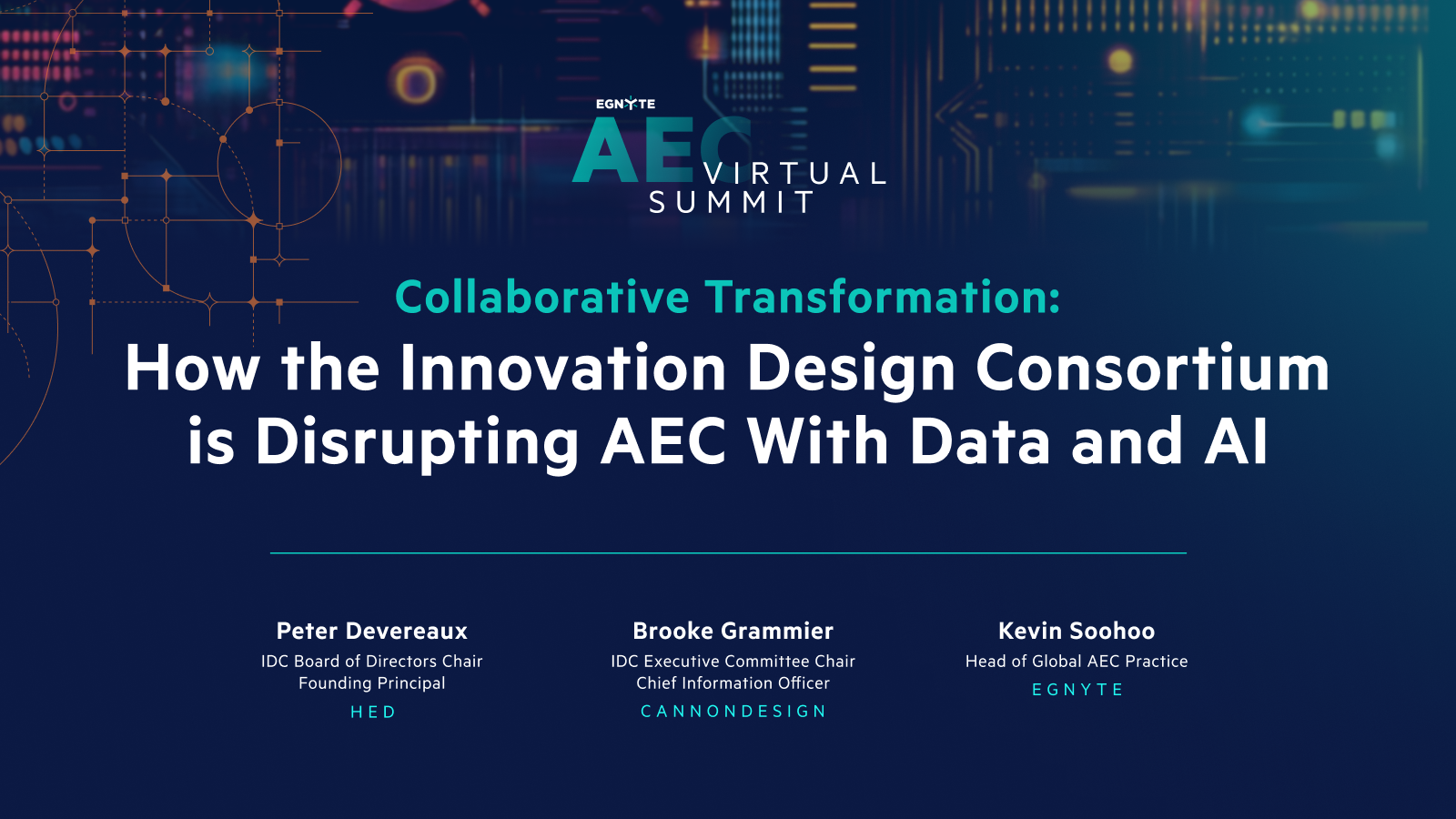
The CIO of Moffat & Nichol will show attendees how they built a firm-wide culture of data governance, making the case that success requires the right balance of people, process, and construction tech software, not just the right software. ACEC and CFMA are also part of the program, with their respective leaders sharing how engineering firms and construction finance professionals are navigating disruption, AI readiness, and data privacy.
Joint venture delivery gets dedicated focus again, demonstrating how a Common Document Environment, as a shift from the traditional CDE model, manages the friction inherent in multi-firm infrastructure projects.
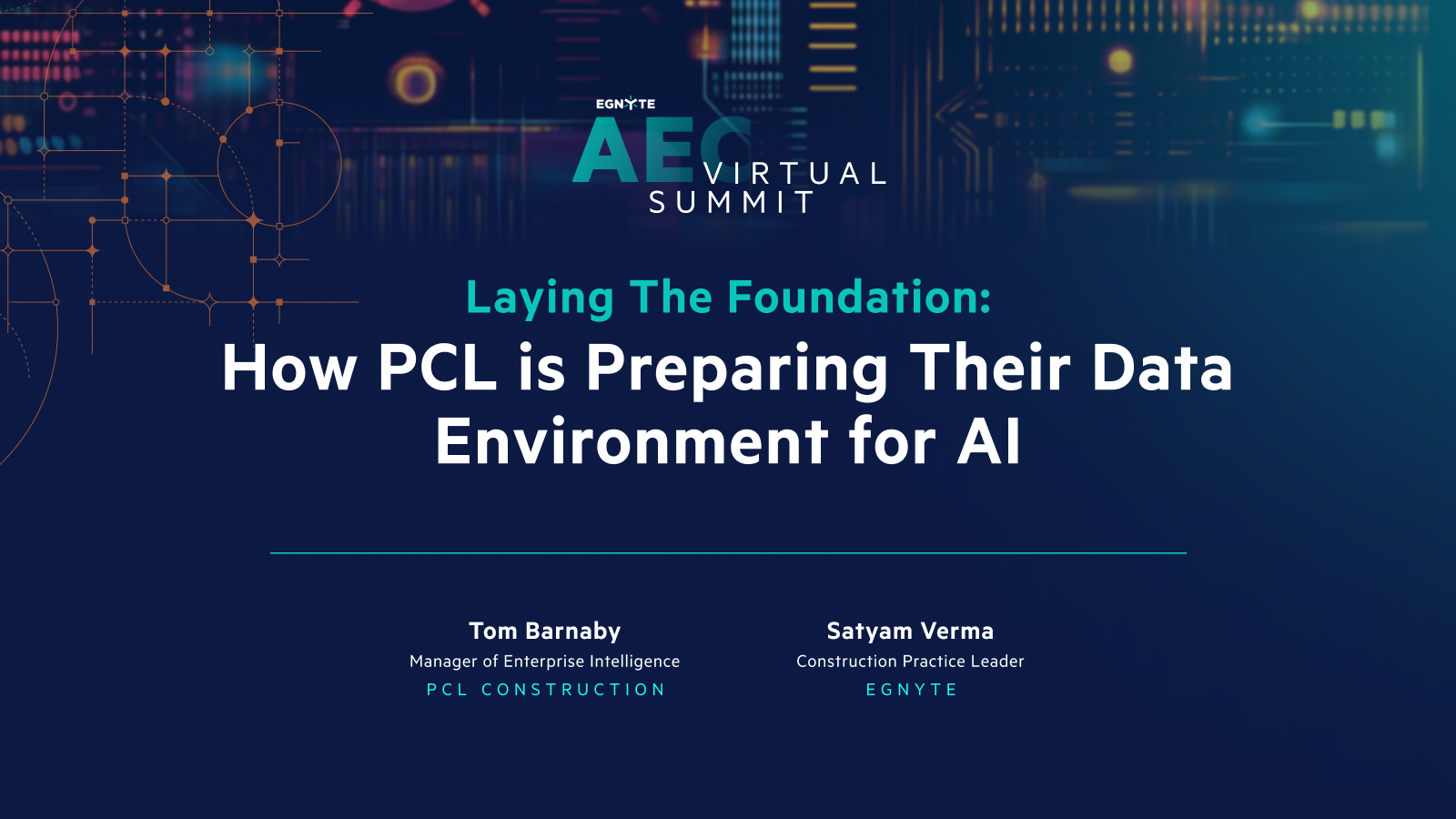
The broader goal is to get attendees to stop viewing file storage as a commodity. For too long, firms have relegated their files to generic platforms like Box or SharePoint. Your document strategy is your data strategy. If you overlook where your files live, you're ignoring the foundation of your AI capabilities and your firm's long-term competitive edge.
Secure your spot at the 2026 Egnyte AEC Summit.
6) Is the summit useful for firms at any cloud or AI maturity level, or is there a baseline needed to get real value?
The value is truly universal, because the problems being solved, data scattered across systems, security concerns, and the challenge of managing a long tail of specialized software, are major headaches for every firm of any size, regardless of how advanced their technology stack is today.
For firms still relying on on-premise servers and slowed down by VPNs, there's a clear path to move workflows to the cloud without losing the fast local performance designers need. You don't have to already be in the cloud to benefit, you just need to be ready to upgrade your document strategy.
For firms that are already cloud-native, the benefit shifts to how you manage and optimize your data with AI: handling data access at scale, guaranteeing top-tier security during joint ventures, and deploying private AI agents that genuinely understand your company's proprietary data.
Your starting point isn't your technology, it's the realization that your project files aren't just static records anymore. They are the core intellectual property that will drive your firm's future. Whether you're at the beginning of this journey or fine-tuning an AI strategy, the summit is designed to leave you with a plan built for exactly where you are today.
7) As AI starts using firm content to generate outputs, is the industry keeping up with data governance and security risks, and how does the summit address them?
Honestly, many firms are adopting AI faster than their governance policies can keep up. The pattern is becoming familiar: AI tools get deployed before the necessary guardrails are in place, creating real risk of exposing sensitive project data or proprietary financial information to the wrong people, or worse, to public AI models.
The industry is playing catch-up, and the summit addresses this through what we call Secure Intelligence. The sessions aren't about abstract cybersecurity, they're demonstrating the practical steps to implement automated sensitive content detection and granular permissions within your Common Document Environment. The goal is to show IT and design tech leaders how to establish a safe-to-query data perimeter. You shouldn't have to choose between AI innovation and data security. By laying the right governance foundation first, when your AI pulls from firm content, it only accesses information that the specific user is already authorized to see.
8) What should an IT lead or design technology director be thinking about differently by the end of the summit?

Recent Articles
Learn about the latest architecture software, engineering automation tools, & construction technologies